
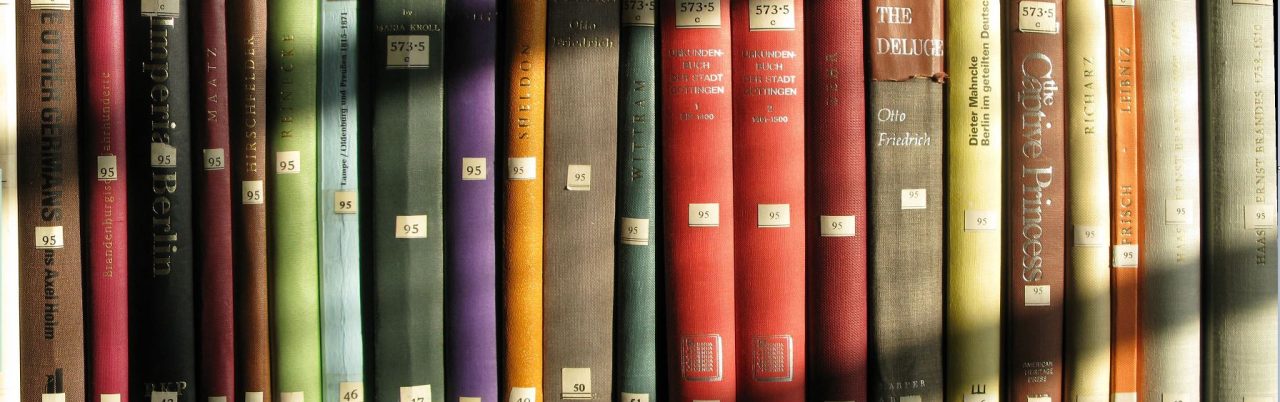
Recently, our colleagues in the Maps Department of the University Library took delivery of Atlas uchyteli︠a︡ istoriï = Teacher’s atlas of history, a 2024 publication from Kyiv. The Head of Maps and I had agreed that it would be a useful and interesting purchase as an example of a teaching resource for Ukrainians particularly in terms of its coverage of the ongoing Russian war against Ukraine with the continued Russian occupation of Ukrainian territory.
The atlas is in Ukrainian but has its introduction also in English. It contains maps in 5 sections: the Ancient World, the Middle Ages, the end of the 15th century to the 18th century, the end of 18th century to the beginning of the 20th century, 1914-1945, and 1945 onwards. Independent Ukraine features in maps spread over pages 210 to 213; two are dedicated to the era of the war.
Here is a map entitled “Revolution of Dignity. The beginning of the Russo-Ukrainian War. (2013-2021)”
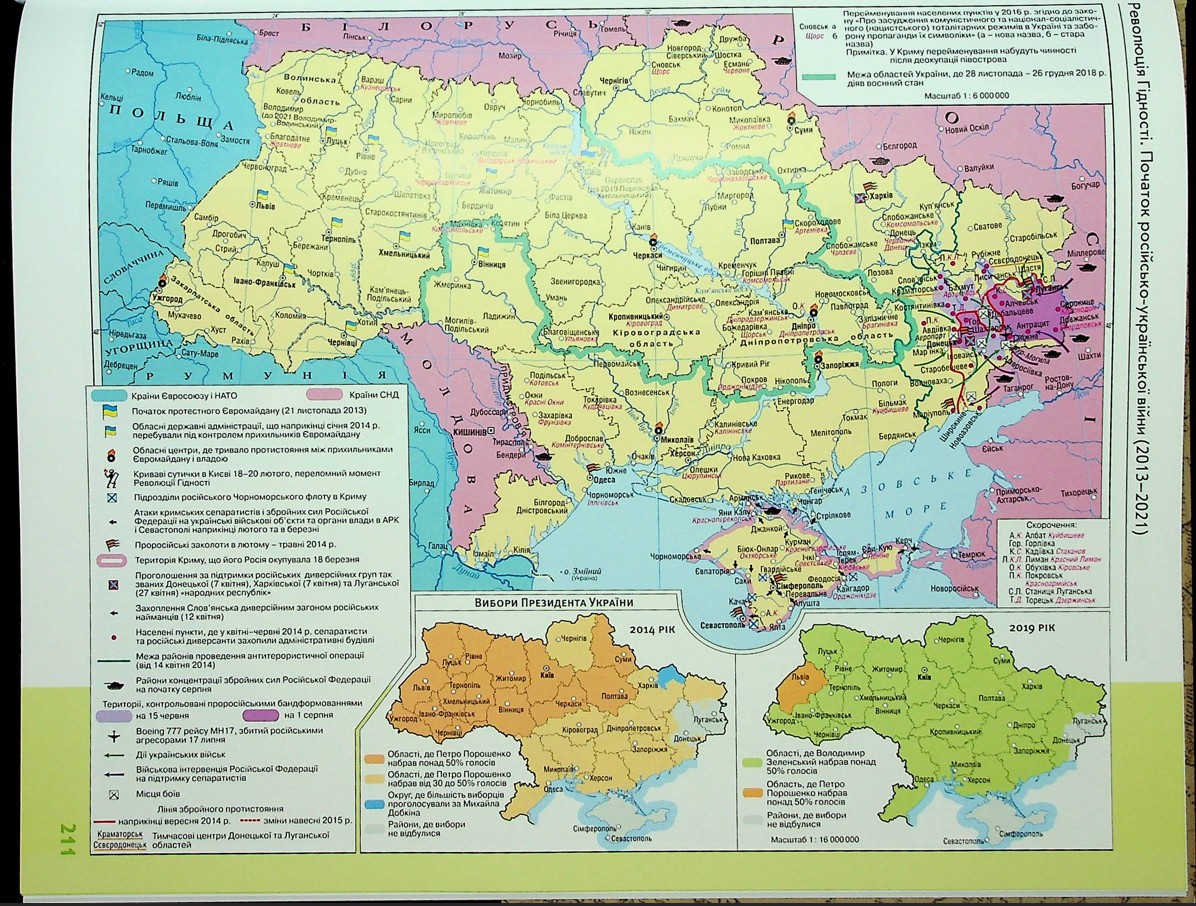
The smaller maps at the bottom of the page show regional results for the 2014 presidential election (darker orange shows where Petro Poroshenko gained over 50% of the popular vote, lighter orange where he got between 30 and 50%) and the 2019 election (as before, darker orange shows Poroshenko with over 50%; green shows where Volodymyr Zelenskyi won over 50%). Each of the two shows areas in grey – in parts of the Donetsk and Luhansk, as well as Crimea – where neither presidential election was able to take place.
The following map is entitled “The Russo-Ukrainian War 2022-2023”. Apologies for the angle and glare affecting the photo.
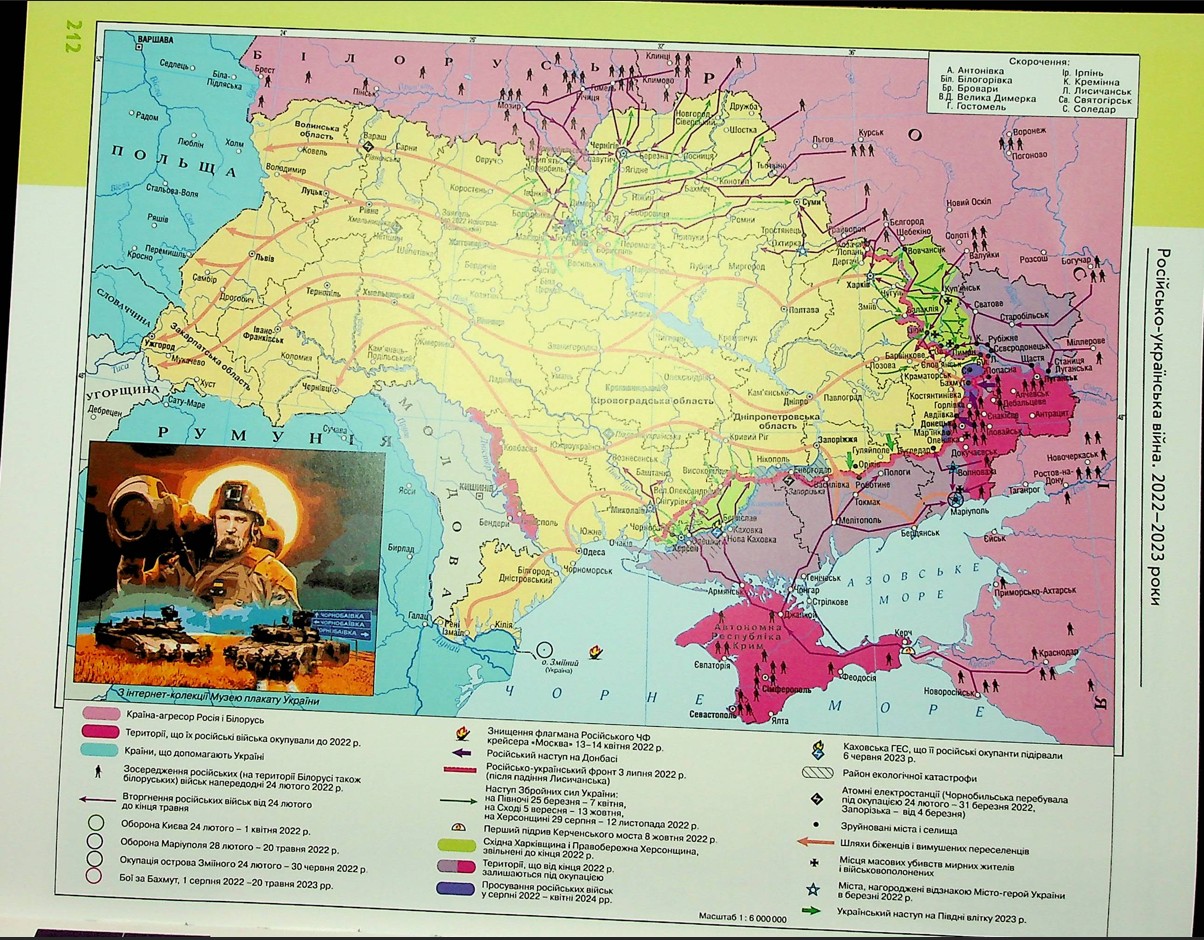 The image in the bottom left-hand corner of the map is from the “internet collection ‘Museum of the Ukrainian poster'” and shows the 19th-century poet Taras Shevchenko as a modern Ukrainian soldier and traffic signs pointing in three different directions to Chornobaïvka, the small town near Kherson that was occupied in 2022 by the Russian army but where the Ukrainians made multiple successful attacks routing the Russians before liberating the town later that year.
As reflected by the atlas’s contents overall, maps for teaching normally reflect history. Teaching one’s own country’s modern history during a war with an occupying force and with an ever-shifting front line is a completely different prospect. Even if for the two maps shown here alone, this was a worthwhile purchase and one we hope will be used for research and teaching now and into the future.
The atlas can be called up and consulted in the Map Room.
Mel Bach
 Languages across Borders