
Ravensbrück was published in Neuchâtel by Éditions de la Baconnière in 1946, as part of the blue series of “Les Cahiers du Rhône”, a collection directed by Albert Béguin. As a tribute to the French flag, the collection was subdivided into the blue, white and red series. Works in the blue series dealt with contemporary events. The Cahiers defended a form of Christian humanism and spirituality opposed to Nazi materialism and the compromises of the Vichy regime. Ravensbrück is a compilation of testimonies by 13 survivors of the German concentration camp for women, starting with French résistante Germaine Tillion, author of the longest piece by far. It includes texts by Anne Fernier, Violette Maurice, Nina Zwanska, Anise Girard, Grazunska Chrostowska, Renée Metté, Bluette Morat, Monique Nosley, Geneviève de Gaulle, Thérèse Grospirron, Marie-Elisa Nordmann and Génia Rosoff. They cover subjects ranging from hunger to scientific experiments, and communism to prayer in the camp.


The copy in the Chadwyck-Healey Liberation collection (Liberation.c.1667) is signed by Germaine Tillion and Geneviève de Gaulle (niece of Charles de Gaulle), who dedicated it to Jean de Fez, the then Mayor of the 8th Paris arrondissement. Both women were interred at the Panthéon in 2015, along with two male résistants, Pierre Brossolette (a journalist, officer of the Free French) and Jean Zay (a lawyer and politician), both assassinated 1944.
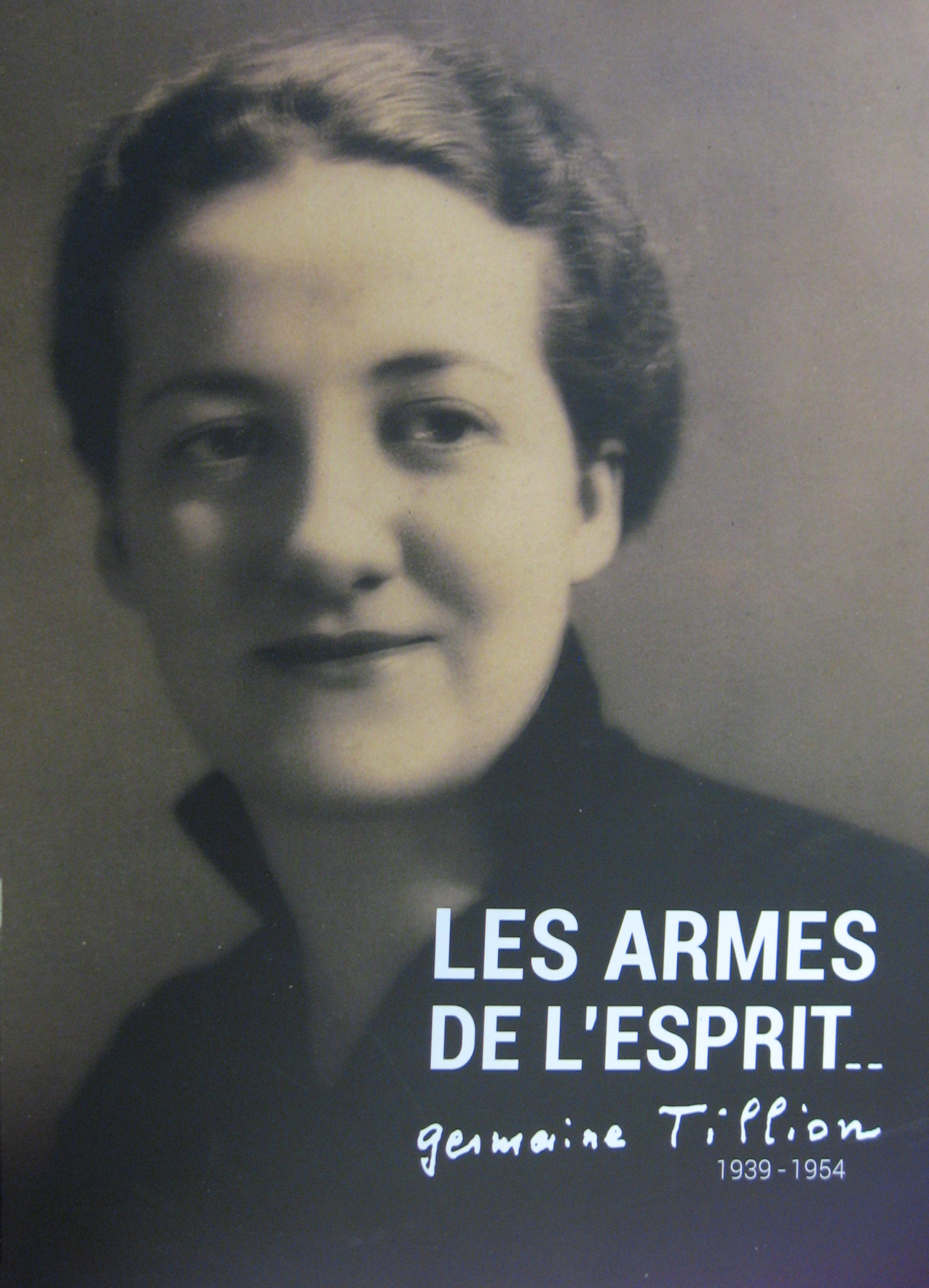
Germaine Tillion’s biography is well known: she was an ethnologist who worked in Algeria before and after the Second World War. She was part of the Union Nationale des Combattants Coloniaux, worked with the Musée de l’Homme resistant network, and the Free French, but was denounced and arrested in August 1942, betrayed by a priest who was an informer for the Gestapo. She was deported to the forced labour camp of Ravensbrück in October 1943. Her own resistant mother, Emilie Tillion, was also deported to Ravensbrück in February 1944 and gassed in Uckermark in March 1945. While in Ravensbrück, Germaine Tillion worked to gather evidence about life and death in the camp, including scientific experiments on co-detainees, and analysed the economic exploitation of the prisoners in the concentration camp system. She wrote and directed the clandestine operetta Le Verfügbar aux Enfers (referring to the prisoners who were not part of a work Kommando but remained available for all the worse chores in the camp), which deals with humour and songs about life in Ravensbrück: a “naturalist” sets out to describe the “creatures” in the camp. Cambridge University Library hold two editions of the operetta, from 2005 and 2007. The first edition includes a full facsimile of the small original manuscript notebook, held at Musée de la Résistance et de la Déportation de Besançon. Tillion’s testimony and analysis about Ravensbrück, which first appeared in 1946 in the text entitled “A la recherche de la verité”, was reworked and expanded twice by the author, in 1973 and 1988. The later editions were based on extensive research and considerable documentation on French women deported to Ravensbrück and nearby camps (more than 7000 women), including Nazi testimonies, and later benefiting from the opening of access to WW2 archives.


Germaine Tillion, Le Verfügbar aux enfers (1944-45), ill. France Audoul.
In this blogpost, we want to shed the light on one of Tillion’s comrades in Ravensbrück, the illustrator of the 1946 volume. Last year, Charles Chadwyck-Healey gave a talk at the Institut Français as part of a study day on French collections in the UK, about the constitution of the Liberation collection. His presentation (which will be published in Paper Trails at the end of this year) included pictures from Ravensbrück, including the illustration facing the title page. We wondered who the artist was, as the information did not feature prominently in the publication, and had never been commented on. A little research revealed that these were drawings by Jeanne Lherminier (also called Jeannette L’Herminier), listed as an “artist”, arrested on 19 September 1943 and deported on 31 January 1944, in the “Auteurs de ce cahier” on page 211 of Ravensbrück. Jeanne is listed after France Audoul, “artiste peintre”, who drew an illustration for the manuscript of Tillion’s Le Verfügbar aux Enfers (see picture above).
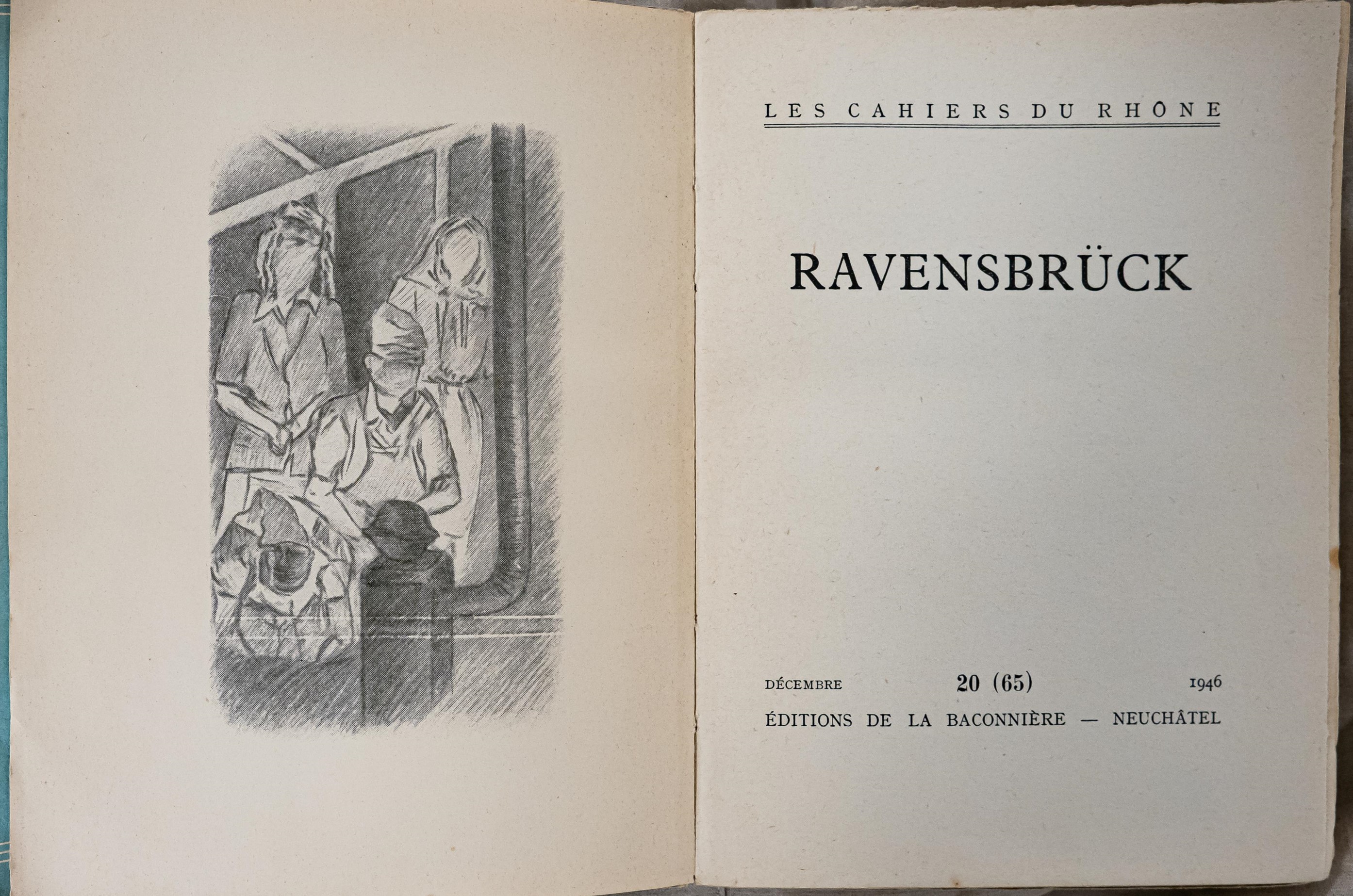 In Ravensbrück, the illustrations feature without any caption or direct credit, but the attribution to Jeannette L’Herminier is clear from the style of the images: pencil drawings which predominantly feature prisoners in the camp, wearing striped pyjamas, and whose distinctive feature is the absence of a drawn face (there is no individual portrait as such; L’Herminier claimed that this was due to her lack of artistic training).
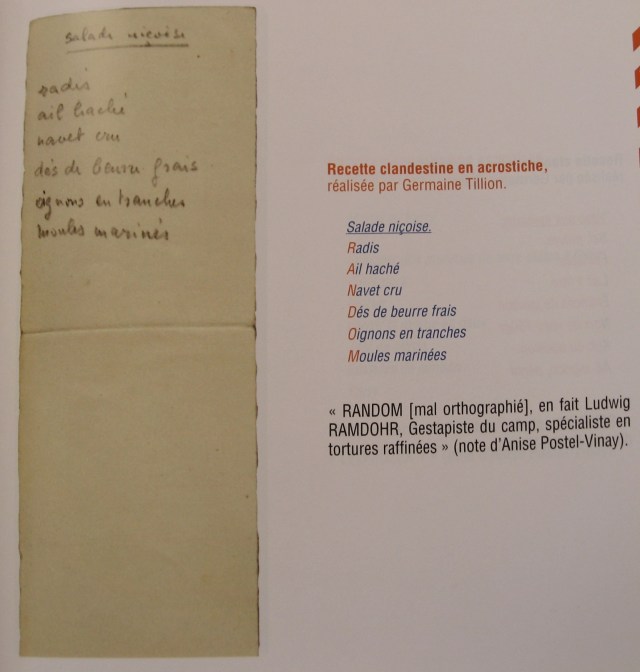
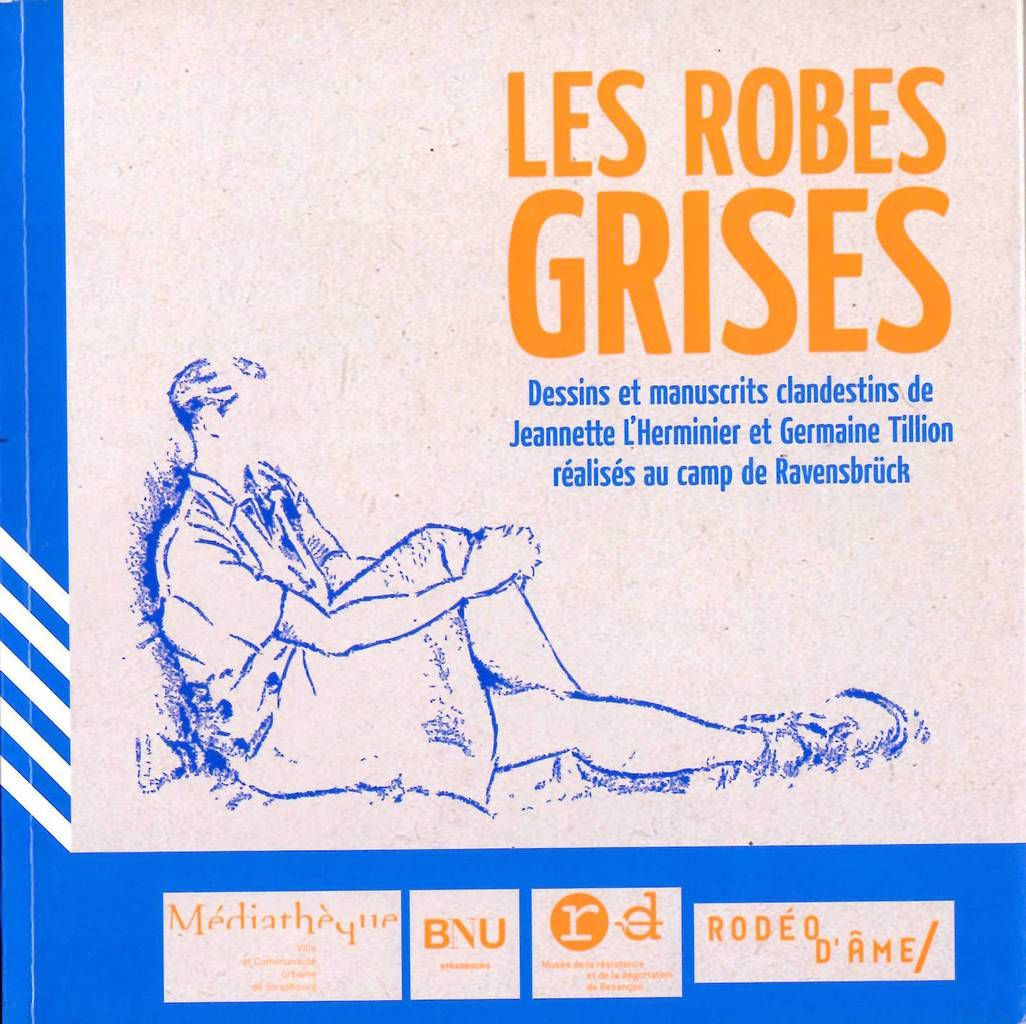 The attribution of the drawings was confirmed by the examination of the catalogue published on the occasion of the exhibition held in Strasbourg at Médiathèque André Malraux in 2011 : Les robes grises : dessins et manuscrits clandestins de Jeannette L’Herminier et Germaine Tillion réalisés au camp de Ravensbrück. The exhibition highlighted both L’Herminier’s pencil drawings and manuscript “food recipes” from Tillion, also produced in Ravensbrück, who hid the names of Nazi camp staff in acrostics poems: commandants, SS, female guards, gestapo torturers, workshop leaders, etc. Germaine Tillion gave testimony as a witness against the female guards of Ravensbrück at the trial of Hamburg in 1946-1947.
 Les robes grises (2011)
Jeannette L’Herminier, who had studied art history, was part of the “Buckmaster” British resistance network. She was arrested, with her aunt Marguerite, by the Gestapo for hosting an American plot in September 1943 and was interned in Ravensbrück in January 1944. By chance, she found a pencil and started drawing, taking for models her comrades from Block 22, then those from the ammunition factory Kommando where she worked in Holleischen (next to the camp of Flossenburg), from April 1944.
Ravensbrück (1946)
The drawings were made by L’Herminier on scraps of papers such as the white spaces of German newspapers (which were given to the prisoners as toilet paper), or the packaging for bullets (recognisable thanks to their cross-shape), while L’Herminier worked in the ammunition factory. The illustrations reproduced in Ravensbrück do not appear in the exhibition catalogue, where some of the pencil drawings are signed by their model who is then identified. The images share common themes and postures : figures resting while leaning on wall or a table, gathering around the stove, or on the bunk beds. These drawings evoke everyday life at the camp, the exhaustion and the loneliness but also the moments of solidarity and friendship. They picture different types of people in the camps : prisoners in their stripe pyjamas, as well as medical staff and female guards, such as the one -wearing boots- who is surprised while she takes a standing nap, resting on a radiator. The drawings work as testimony and memory: for L’Herminier they “kept alive the women who did not come back”.


Ravensbrück (1946) and Les robes grises (2011)
The studied pose of the female prisoner standing in front of a bunkbed in her striped dress with the matricula number and triangle (whose colour identified which type of detainee she belonged to) on the left arm, shows the persistence of elegance and attitude as a sign of ongoing resistance and diffidence even within the camps, despite the harsh conditions of detention. L’Herminier found that asking her co-detainees to hold these poses was also a way to sustain their moral. She said that keeping up appearances was a way to hold on, while giving up would be fatal.
When Jeannette L’Herminier was liberated from Ravensbrück in May 1945, she could not take her drawings with her so gave them to Elizabet Barbier who distributed them to several women of Holleischen for safekeeping. Thanks to them, most of the drawings made their way back to Jeannette who in 1987 gave 148 drawings to the Musée de la Résistance et de la Déportation de Besançon. About 20 are held at Musée de l’Ordre de la Libération (based at the Invalides in Paris) and a few are in private collections. Germaine Tillion gave her archives to BNF, but the documents relating to her deportation are also held at the Besançon museum.


Ravensbrück (1946) and Les robes grises (2011)
References :
Les robes grises : dessins et manuscrits clandestins de Jeannette L’Herminier et Germaine Tillion réalisés au camp de Ravensbrück. Strasbourg : Rodéo d’âme, 2011. [not at the UL]
Ravensbrück / Germaine Tillion [and twelve others]. Neuchâtel : Éditions de la Baconnière, 1946 (Liberation.c.1667).
- A la recherche du vrai et du juste : à propos rompus avec le siècle / Germaine Tillion ; textes réunis et présentés par Tzvetan Todorov. Paris : Seuil, 2001.
- Dialogues : d’après les entretiens filmés par Jacques Kebadian et Isabelle Anthonioz Gaggini / Geneviève de Gaulle-Anthonioz et Germaine Tillion. Paris : Plon, 2015
- Germaine Tillion : une certaine idée de la résistance / Lorraine de Meaux. Paris : Perrin, 2024. On order
- Germaine Tillion, une femme-mémoire : d’une Algérie à l’autre / Nancy Wood ; trad. Marie-Pierre Corrin. Paris : Autrement, 2003.
- La traversée du mal : entretien avec Jean Lacouture / Germaine Tillion. Paris : Arléa, 1997.
- Le témoignage est un combat : une biographie de Germaine Tillion / Jean Lacouture. Paris : Seuil, 2000.
- Le Verfügbar aux enfers : une opérette à Ravensbrück / Germaine Tillion. Paris : La Martinière, 2005.
- Les armes de l’esprit : Germaine Tillion 1939-1954 / Claire Andrieu [and 13 others]. Besançon : Musée de la Résistance et de la déportation, 2015.
- L’esprit de Résistance au Panthéon : Germaine Tillion et Geneviève de Gaulle-Anthonioz, Jean Moulin et Jean Zay, Pierre Brossolette et René Cassin / Bernard Zahra. Paris : Riveneuve, 2015.
- Pierre Brossolette, Geneviève de Gaulle-Anthonioz, Germaine Tillion et Jean Zay au Panthéon / Olivier Loubes, Frédérique Neau-Dufour, Guillaume Piketty, Tzvetan Todorov. Paris : Éditions Textuel, 2015.
- Ravensbrück / Germaine Tillion ; suivi de Les exterminations par gaz à Ravensbrück / par Anise Postel-Vinay. Les exterminations par gaz à Hartheim, Mauthausen et Gusen / par Pierre Serge Choumoff. Paris : Seuil, 1988.
- Survivre : notre ultime sabotage : Ravensbrück, mémoires pour l’avenir. Association Germaine Tillion. Paris : Éditions Tirésias-Michel Reynaud, 2022.
- Une opérette à Ravensbrück : le Verfügbar aux enfers / Germaine Tillion. Paris : Éditions de la Martinière, 2007.
Ps : a study day sponsored by the Association Germaine Tillion is organised at the BnF on 21 November 2024
The talk by Marie Puren, “The new editorial and literary landscape in post-war France (1944-1946)” which tfocuses on the Liberation collection and takes place at Cambridge University Library this Thursday at 5pm is fully booked, but we will share its recording in due course.
Irene Fabry-Tehranchi
 Languages across Borders