
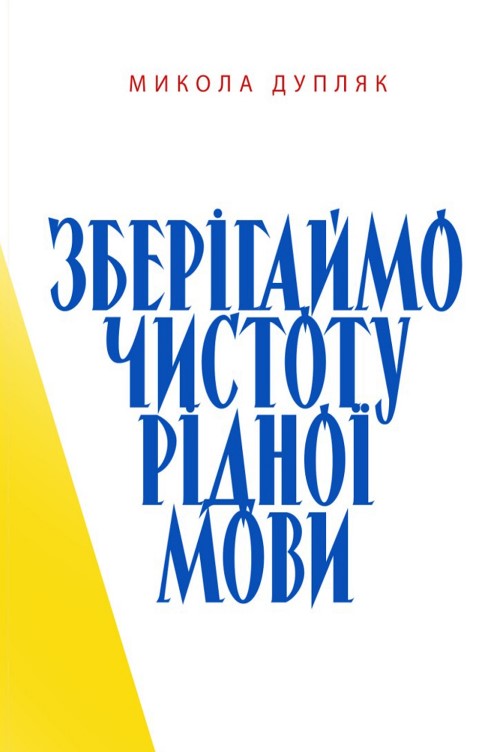
 Nearly a year ago, I wrote about a new book bought at the request of the University’s Ukrainian lector about the Ukrainian language. This new post looks at an ebook I bought earlier this month to complement that acquisition: Zberihaiemo chystotu ridnoi movy [Let’s preserve the purity of our native language] by Mykola Dupliak. Marketed primarily as a book for general interest to Ukrainian speakers but also of interest of course to students and researchers studying Ukrainian, the 343-page book consists of 75 chapters and ends with an index of foreign words and expressions that “pollute” Ukrainian.
The book’s introduction explains that the chapters are in fact the author’s regular articles in the monthly journal Borysten (the introduction is written by Borysten‘s editor). The author himself then provides an introduction, explaining his knowledge and love of his mother tongue Ukrainian in the context of a childhood in WW2-era Poland and eventual emigration to the US.
The particularly great importance placed on keeping Ukrainian unsullied by the post-WW2 diaspora is something I’ve seen examples of frequently in my years working with and building our Ukrainian collections. In a quite mind-blowing but maybe not uncommon case met in real life, I was told by the sons of a Ukrainian émigré (whose not insubstantial Ukrainian book collection they were donating to the UL) that he had decided not to teach them Ukrainian at all for fear that they wouldn’t speak it correctly. This book’s author, on the contrary, has spent his US life promoting Ukrainian and teaching it at schools for diaspora children.
The importance of the Ukrainian language as a unifying force has of course come to the fore during the Russo-Ukrainian War, and particularly so since the start of the 2022 full-scale Russian invasion. While most languages can easily (and, for many, most overwhelmingly) identify English pollution, for Ukrainian, it is of course the influence of Russian that is problem #1. A glance through the index of this book shows that Russian words and phrases are by far its most common subjects.
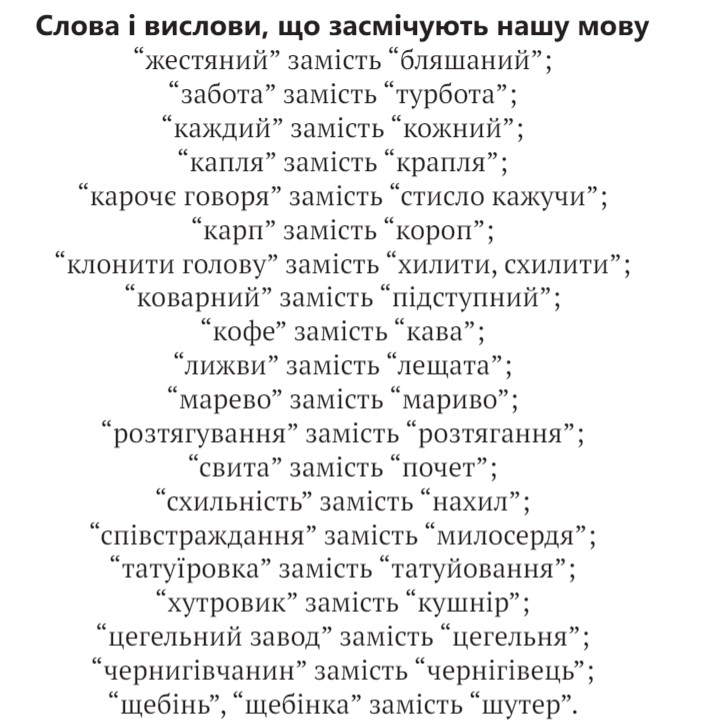 In each chapter, Mr Dupliak discusses various examples of commonly used vocabulary in Ukrainian which he demonstrates has its roots or structure elsewhere. Each chapter then ends with a list of suggested changes – eg instead of [this non-Ukrainian term/formulation] use [this Ukrainian term/formulation]. See an example list in the second illustration here.
I’ll be writing to the Ukrainian lector to point this new purchase out. It should be of interest to his students and colleagues to see so many examples of non-Ukrainian Ukrainian drawn out, providing a useful addition to last year’s purchase of Ievheniia Kuznietsova’s Mova-mech.
Mel Bach
 Languages across Borders