
The University Library recently acquired the first two volumes of the newly published Obras completas de Maria Ondina Braga (Complete Works of Maria Ondina Braga). This collection showcases the writings of an important and unique 20th century Portuguese author previously underrepresented in our holdings. Born in the northern Portuguese city of Braga, which shares her name, Maria Ondina Braga travelled widely and is best known for her writings about the former Portuguese colony of Macau, where she lived and worked in the early 1960s.
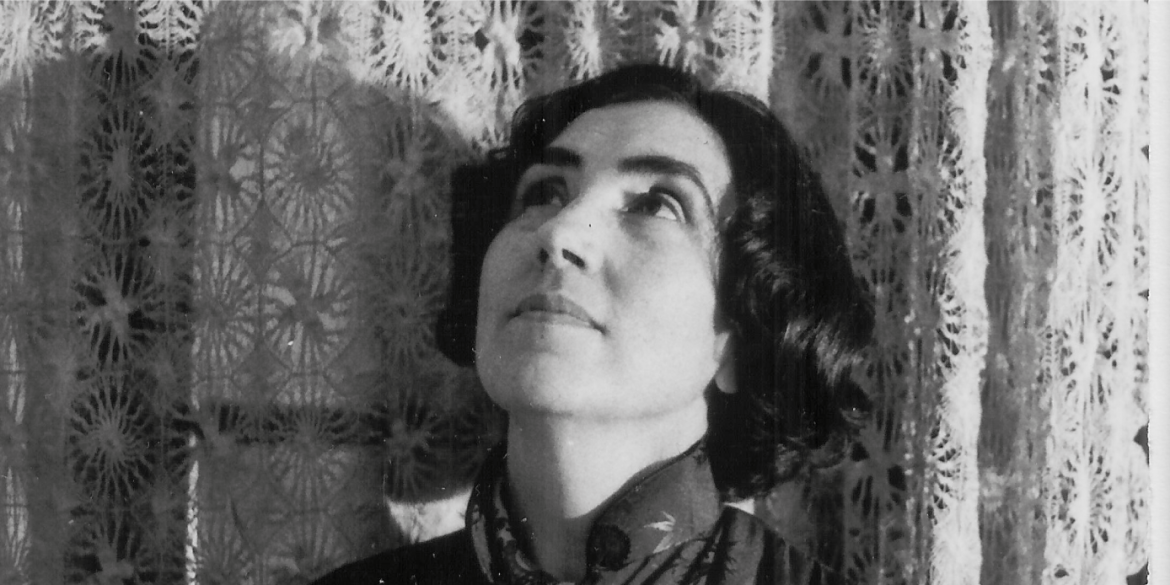
Braga’s centenary was celebrated in 2022, although throughout her writing career, she claimed to have been born in 1932 – a decade later than her actual birth year. Her nephew explained, “It’s the date the author took for herself, like others chose a pseudonym” [1]. From childhood, Braga yearned to explore the world beyond her home city. Her uncle encouraged this curiosity, supporting her education and interest in other countries and cultures.
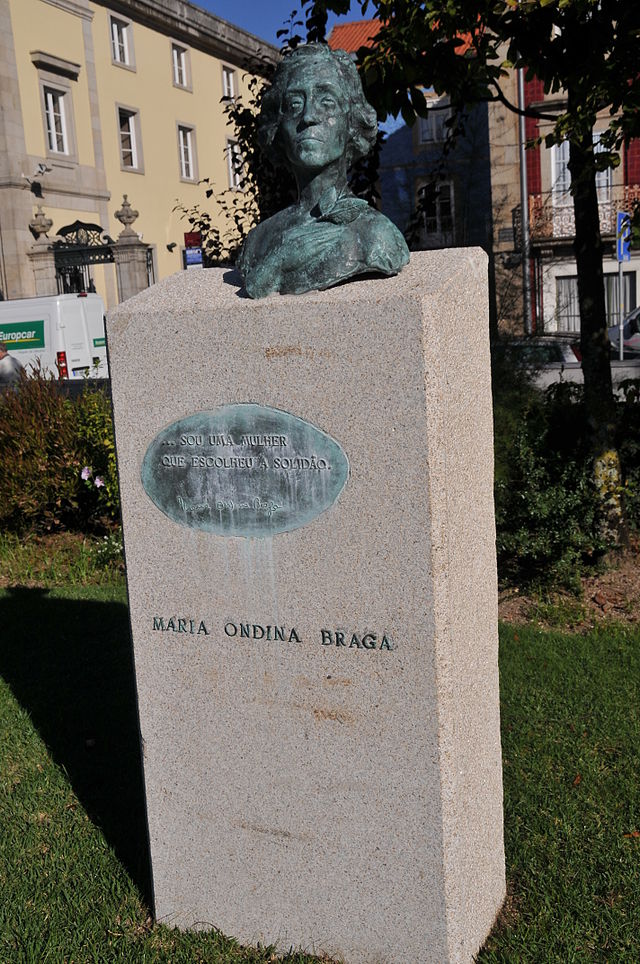
Monument commemorating Maria Ondina Braga in her home city of Braga (image from Wikimedia Commons) 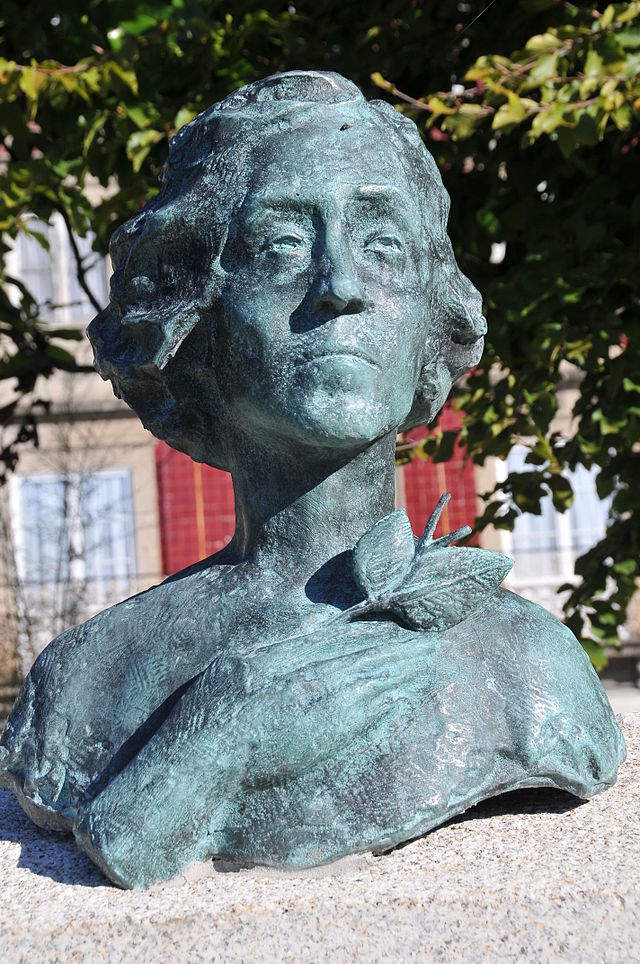
Bust of Maria Ondina Braga (image from Wikimedia Commons) 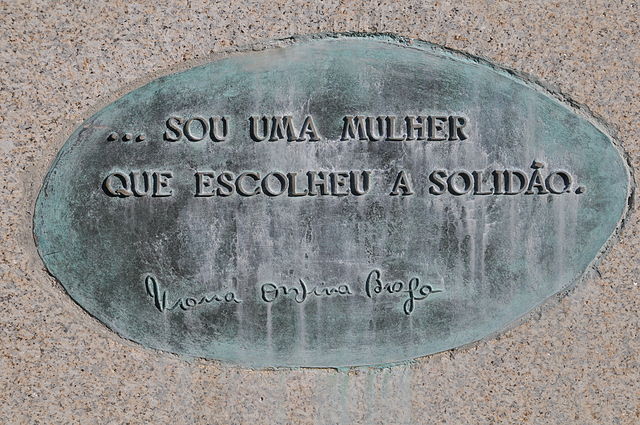
Plaque quoting Maria Ondina Braga, “…I am a woman who chose solitude.” (image from Wikimedia Commons) 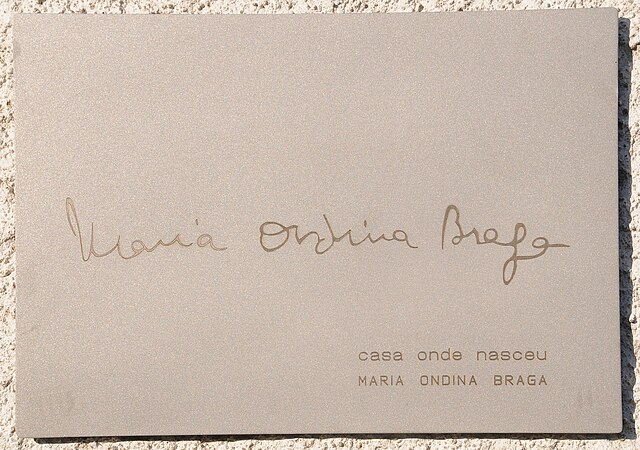
Plaque marking the house where Maria Ondina Braga was born in Braga (image from Wikimedia Commons)
A solitary individual, Braga’s unmarried and orphaned status afforded her greater independence and freedom of movement than many Portuguese women of her era. However, this also meant she had to support herself financially during her travels through means other than writing, while also guarding against the risks of lone female travel. When she left Portugal in 1956 to improve her English and French, she worked first as an au pair in England and then as a children’s tutor in France.
In the 1960s, Braga continued teaching abroad, eventually arriving in Macau – the place that would most profoundly influence her writing – almost by chance. She had brief stays in Angola and Goa but had to leave both when Portuguese colonial rule was overthrown. Although she lived in Macau only until 1964 and did not return until 1991, this small “overseas province” of Portugal became a central focus of Braga’s writing for the rest of her career.
Claire Williams, one of the editors of the new Obras completas, notes:
“it is clear from her memoirs that she had always felt out of place, different from her friends and family, and needed to explore and discover alternative identities. Macao seems to be the place with which she found most affinity: the site of multiple languages and identities, neither totally Chinese nor totally Portuguese, neither completely ancient nor thoroughly modern, but fluctuating somewhere in-between”[2]
Braga also wrote retrospectively about Britain, often depicting the experiences of Portuguese emigrants and exploring themes of dislocation and loneliness that permeate her work [3,4]. However, about half of her published writing relates to Macau and, later, Beijing, where she lived and worked in 1982. Her time in Beijing inspired her to write “Angústia em Peking” [Anguish in Peking] (1984).
Her first book to gain wider acclaim was the collection of short stories set in Macau, “A China fica ao lado” [China is next door] (1968). David Brookshaw, who has translated and written extensively about Braga, observes:
“A China Fica ao Lado, has as its unifying theme the exploration of the Chinese culture of Macau. To this extent, the author adopts the stance of an observer from outside, who is drawn into and is fascinated by the world she observes and seeks to understand. […] Maria Ondina resorts to an intermediary between herself and the host culture. In a number of her stories, she is introduced to facets of local culture by her Chinese friend, Mei Lai, who is herself a person between two worlds, having been born in the United States of Chinese parents. In this way, the outsider, the Portuguese narrator, is complemented by the insider, Mei Lai.”[5]
Braga’s unique writing style reflected her personality and experiences. Claire Williams describes “her portraits of characters who love solitude and self-analysis; her ambiguous, suggestive style, often described as ‘discreet’ […] the relative unimportance she attributed to plot (focusing instead on impressions, psychological states and atmosphere), and her combination of staccato syntax yet baroque vocabulary”[2]. David Brookshaw adds, “Maria Ondina Braga’s stories are also characterized by a particular interest in the juxtaposition and coexistence of fantasy and reality, and in the subsidiary theme of madness. In this sense there is a concern for the absurd and the incongruous, which is more akin to magical realism.”[5]
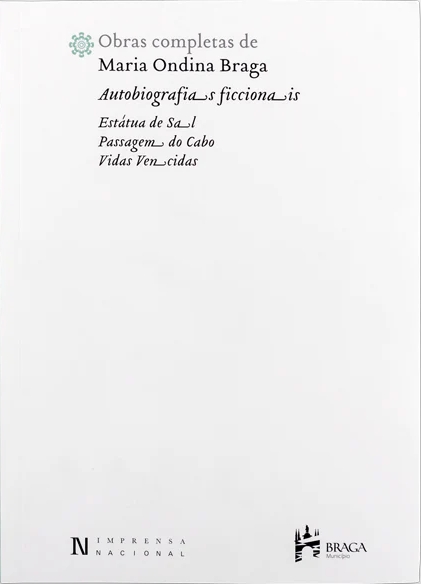
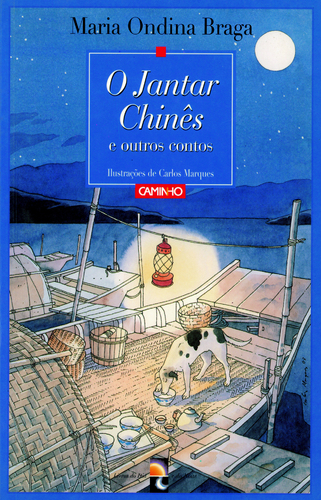
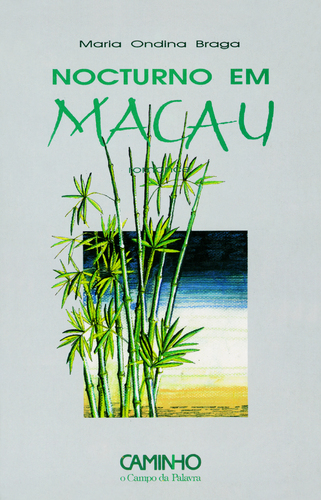
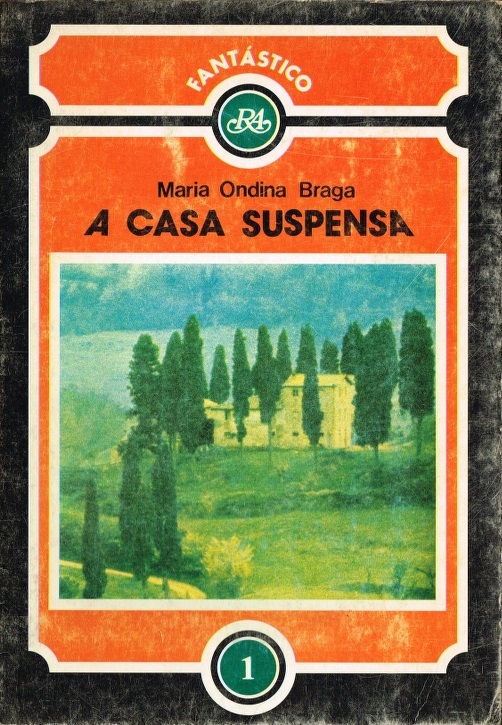
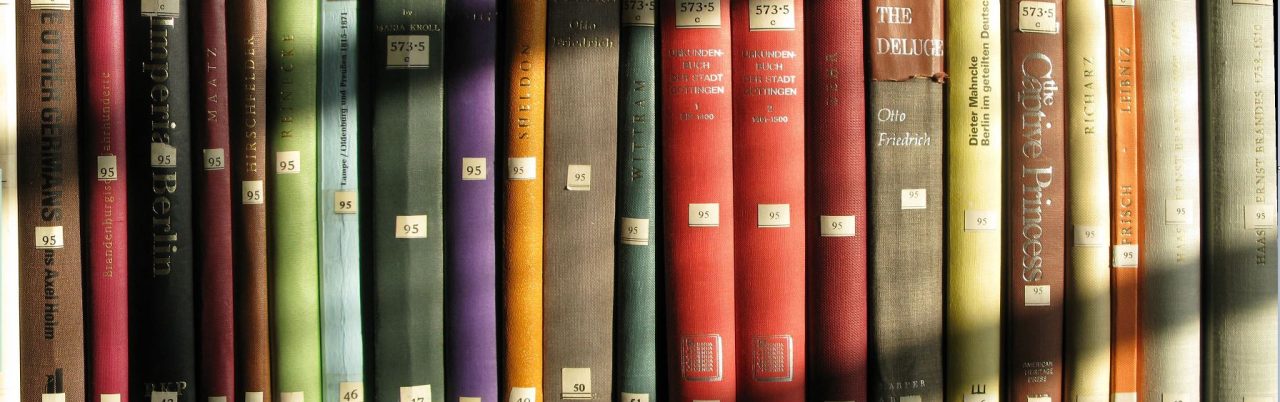
Some books by Maria Ondina Braga held in the University Library
In A China fica ao lado, Braga often portrays and empathises with marginalised characters, such as the opium addict of “O homem de meia vida” (The half-alive man) and the young girl at a leper colony in “Os lázaros” (The lepers). While she evidently felt a degree of alienation herself as an unmarried woman of limited means, her writing also reflects her colonial and racial position in her depiction of Chinese characters. José I. Suárez writes:
“Several female characters in these stories are impoverished Chinese. They, as females of color, symbolize the most exploited of subjugated people: they belong to the lowest and most formalized class of subalterns and, as such, have no history. Most important, as fictional characters, these women are unmistakably patriarchal constructs even though their creators are women. That is, they speak and act as the authors, however well-meaning their intent may be, believe they should.”[6]
Miscegenation is a common theme in Braga’s writing, as in much colonial literature, and her treatment of this sometimes exhibits elements of exoticism, orientalism and fetishisation. However, when she describes mixed-race relationships in the story “O filho do sol” (The child of the sun) and her later novel Nocturno em Macau [Night in Macau] (1991), she deviates from the gender relations typical of much colonial writing. Unlike the stereotype described by David Henry Hwang as “the submissive Oriental woman and the cruel white man” [7], both this story and novel portray relationships between a European woman and a Chinese man – and neither woman is portrayed as the “deranged idiot” that Hwang’s character suggests would be the case were the more stereotypical racial/gender roles reversed.
In addition to fiction, Maria Ondina Braga wrote poetry, memoirs and journalism, and translated writers such as Graham Greene and Bertrand Russell into Portuguese. Her restlessness and curiosity as both a writer and person is perhaps best conveyed by the quote from her first novel Estátua de sal [Statue of salt] (1969), “Partir é esperança. Chegar desencanto” (Leaving is hope. Arriving is disenchantment).
We look forward to receiving the further volumes of her Obras completas, as they are published.
Christopher Greenberg
References:
- Carvalho, T. (2022). Maria Ondina Braga. Quantos anos tem um centenário? Jornal i, 17 January 2022, accessed 18 July 2024.
- Williams, C. (2009). Re-exploring the empire: Maria Ondina Braga’s journeys to Macao and other places. Revista de Cultura, International Edition 29, 120-124.
- Gago, D.N. (2018). British landscapes in the works of Maria Ondina Braga and Jorge de Sena: issues of identity in crossing borders. Moderna Språk, Vol.112 (1), p.141-152. DOI: https://doi.org/10.58221/mosp.v112i1.7705
- Williams, C. (2010). Nas terras de Sua Majestade: Portuguese emigrants to Britain in the works of Maria Ondina Braga. Portuguese Studies, Vol. 26 (1), p.111-122. DOI: https://doi.org/10.1353/port.2010.0006
- Brookshaw, D. 2002. Perceptions of China in modern Portuguese literature : border gates (p. 80). Lewiston, N.Y. : Edwin Mellen Press.
- Suárez, J.I. (2020). Novels and short stories from Macau: two different perspectives. Journal of Lusophone Studies 5.1, 224-237. DOI: https://doi.org/10.21471/jls.v5i1.323
- Hwang, D.H. 1988. M. Butterfly (p. 17). London: Penguin.
 Languages across Borders