
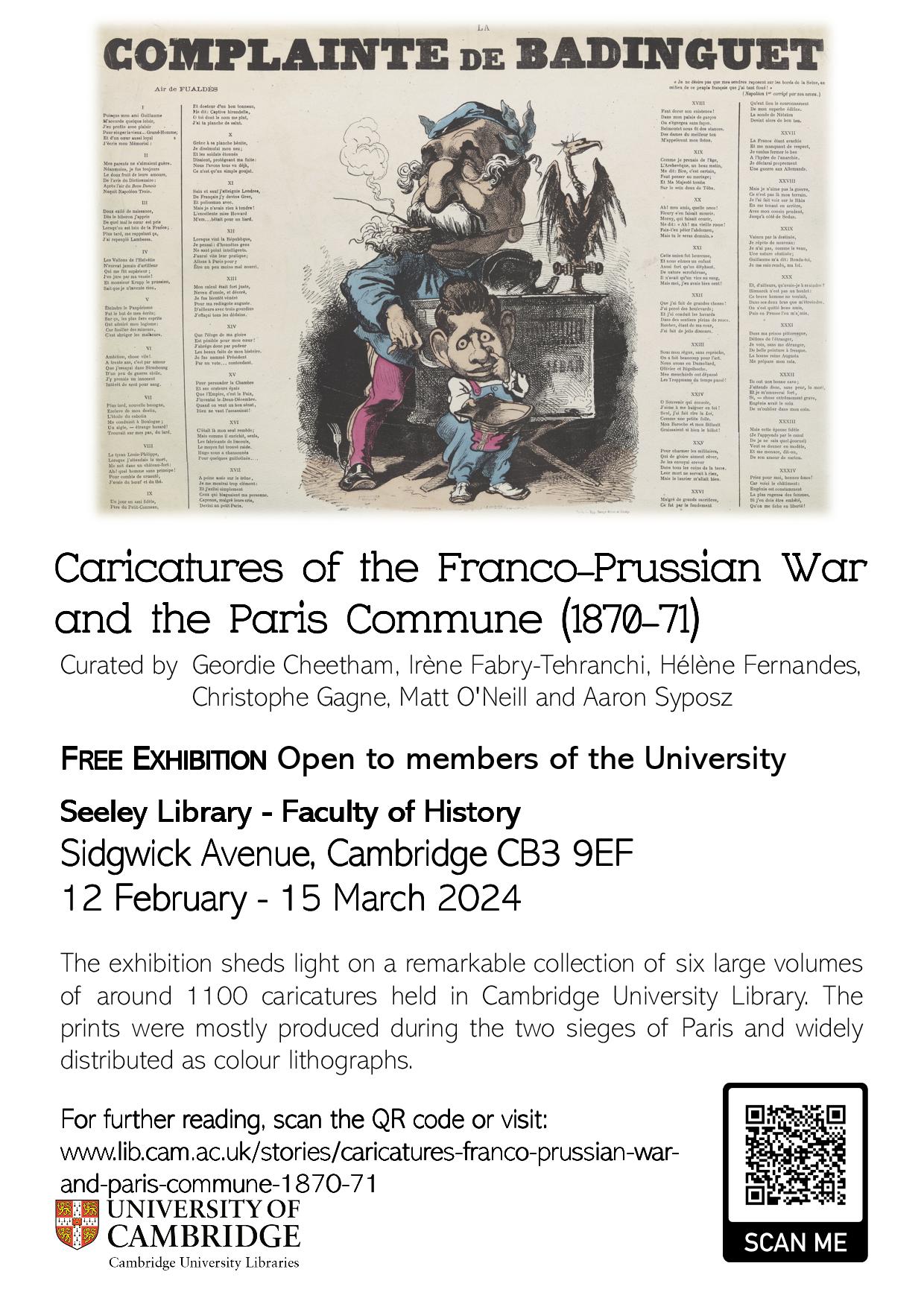
A new exhibition of a selection of facsimiles of Cambridge University Library’s collection of 1870-71 caricatures is opening on 12 February at the Seeley Library (History faculty). This accompanies an ongoing translation project. This year, Geordie Cheetham worked on the translation and commentary of the song “La Complainte de Badinguet” (Badinguet’s Lament, CUL, KF.3.9, p. 162), published in Paris c. 1870 and attributed to the caricaturist, painter and song-writer André Gill (1840-1885).

This satirical piece imagines the (by that point former) French Emperor Napoleon III writing a lament following his defeat and capture in the Franco-Prussian war (1870-71). He was nicknamed ‘Badinguet’ after the name of a worker who helped him escape from prison following an attempted coup in 1846. The image shows the demoted emperor playing a barrel organ inscribed “Sedan” and his son Louis-Napoléon Bonaparte picking his nose and making a collection, accompanied by a skeletal eagle.
As a public form of communication, caricature relies on the viewer being au fait with its plentiful references, which in Badinguet’s lament twist and turn with every line. Thus, the project was not merely a translation of French to English (challenging enough); but implied the recognition – and then translation – of in-jokes which seem at times bizarre and difficult to understand, all while trying to retain the rhythmic patterns of Napoleon III’s self-aggrandising song. Though difficult to translate, this humorous work was although very enjoyable: it relates lurid and unsavoury details of the life of Napoleon III. The stanzas are replete with betrayals, coups, and a fair deal of sexual innuendo.
| II. Mes parents ne s’aimaient guère. Néanmoins, je fus toujours Le doux fruit de leurs amours, De l’avis du Dictionnaire : Après l’air du Beau Dunois Naquit Napoléon Trois |
II. My parents hardly loved each other Nevertheless, I was always The sweet fruit of their love, According to the dictionary: After the Beau Dunois was played, Napoleon the Third was born. |
Although according to the official history, Napoleon III was the son of the king of Holland, Louis Napoleon Bonaparte (brother of Napoleon I), and Hortense de Beauharnais (Napoleon I’s step-daughter), the poem questions his legitimacy (his mother was reputedly unfaithful to her husband) and presents his birth as a miraculous, fairy-tale event. The Beau Dunois refers to a song whose music was attributed to Hortense de Beauharnais and which was associated with the Bonapartists. It served as an informal national hymn under the Second Empire (especially when La Marseillaise was banned).
The issue we faced when translating this piece was consistently maintaining both the rhyming scheme and meaning of the original text. Occasionally the inclusion of somewhat questionable half-rhymes (‘death’/’fortress’) – or even the abandonment of the rhyming scheme altogether – was the unfortunate compromise. Syllables were also lost and gained here and there, meaning the translation loses its rhythm more than the original. The upside of this poetic sacrifice is, of course, that the translation achieves a good level of fidelity to the source text. That is not to say it is perfect: what rendered the piece even more difficult was its density of contemporaneous allusions, which are inexplicable even to the modern native speaker – the precise meaning of some word choices, such as ‘lard’ in the seventh stanza, are therefore explained only speculatively in our commentary.
| VII. Plus tard, nouvelle besogne, Esclave de mon destin, L’étoile du cabotin Me conduisit à Boulogne ; Un aigle -étrange hasard ! Trouvait sur mes pas, du lard. |
VII. After that, another chore! Slave of my own destiny, The star of false celebrity Led me to Boulogne; An eagle – what a coincidence! Tracing my steps, found ham. |
In August 1840 Louis-Napoleon launched a second coup, this time by boat from across the channel. The time seemed ripe for a Bonapartist coup: Napoleon I’s ashes were due to return to France from Saint-Helena four months later, and nostalgia for the Empire was heightening. Before leaving England, the crew purchased a vulture to ape the eagle, symbolic of Napoleonic power. Here the song claims an eagle followed them because he was attracted by ham – among the ample stocks of food prepared for the expedition. It may be a pun on the name of the Château de Ham where Louis-Napoleon was imprisoned, following the failure of this second attempt.
In understanding the historical context, a familiarity with 1870-71 caricature goes a long way; for instance, a throw-away line about ‘fusiller des mineurs’ in stanza V might seem innocuous at first, but the repression of striking miners at La Ricamarie and Aubin in 1869 became a cause célèbre in Paris and appeared in several 1870-1 prints, before Émile Zola liberally drew on the experiences of both when writing Germinal (1885).
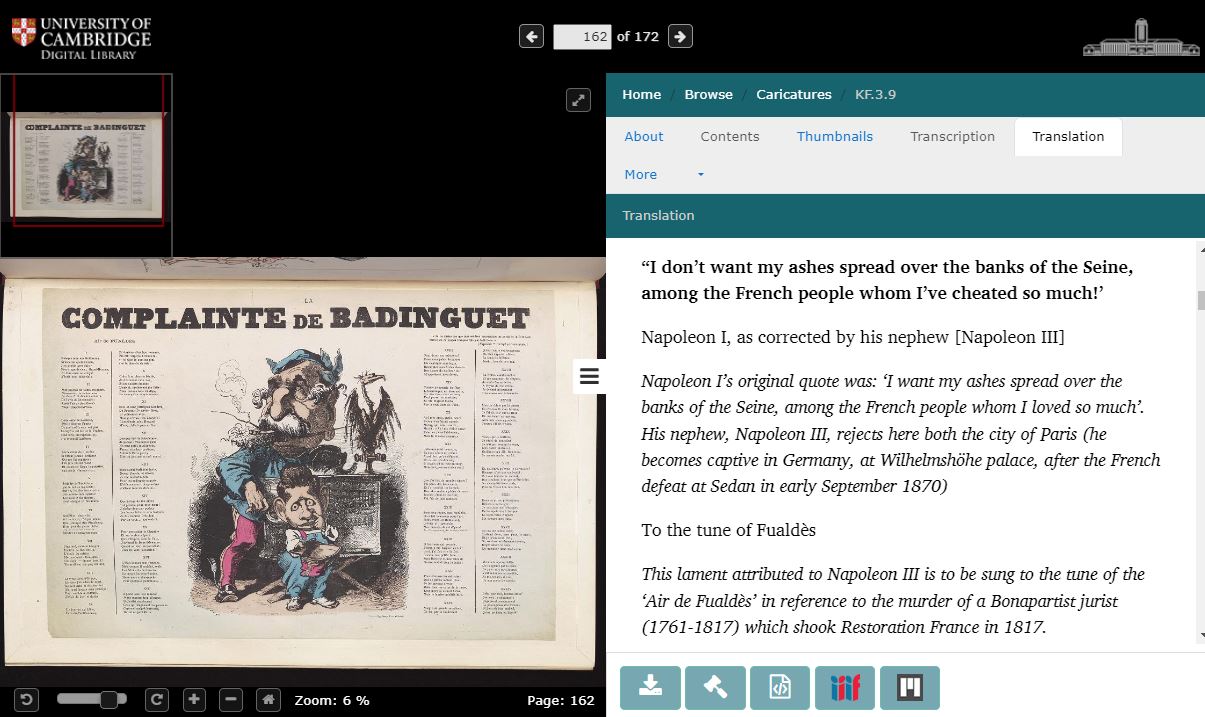
Facing the challenges raised by the translation and commentary, it was good to tackle the project in a collaborative way. There is still more work to do on the translation of the Lament! You can examine the results published in TEI (with the help of Abigail Tomlinson, Isabelle Watts and Huw Jones) on the Cambridge Digital Library (click on the tab ‘Transcription’ in the banner) and have a go at the remaining stanzas. In the meantime, we hope you enjoy the display: it is open to member of the University during the Seeley library opening hours from 12 February to 15 March 2024. The main caricatures collection is available for consultation in the University Library Rare Books reading room (KF.3.9-14) and you can also visit the 2022 virtual exhibition.
Anthony Chapman-Joy
Geordie Cheetham
Irène Fabry-Tehranchi
 Languages across Borders