
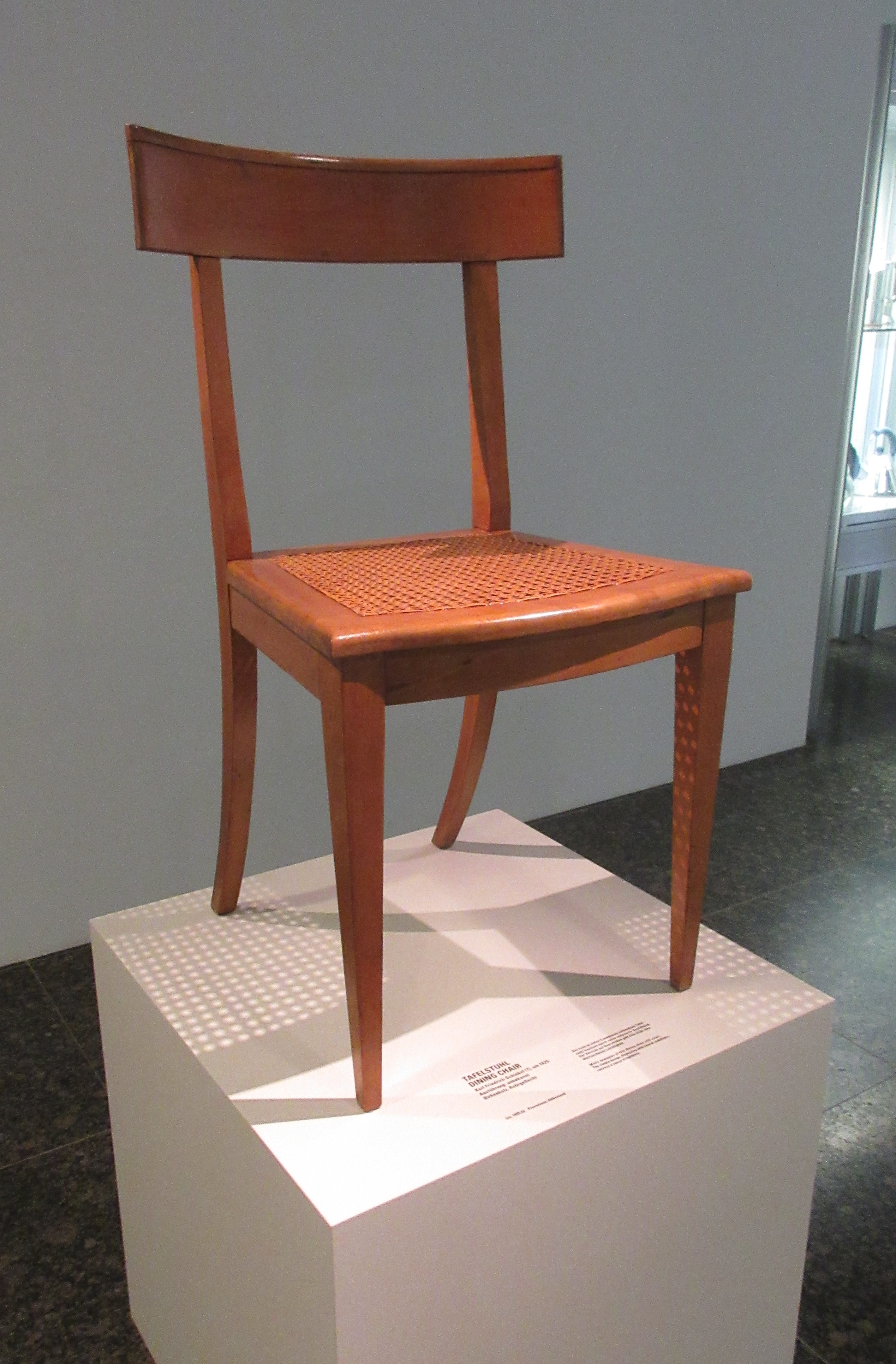
Karl Friedrich Schinkel (1781-1841) was a pre-eminent contributor to the 19th century planning of the city of Berlin, and several of the imposing buildings that he designed can still be admired today in the centre of the city – for instance, the Konzerthaus, the Neue Wache and the Altes Museum. It is now 200 years since he started work on his plans for this museum, the first of several to make up the Museum Island complex. Like many, I knew of him as an architect so I was surprised when I saw a simple chair, perhaps designed by him, during a pre-pandemic visit to Berlin’s splendid Kunstgewerbemuseum. This inspired me to look beyond his architecture and so this blog post will explore non-architectural aspects of his work and feature items from the University Library’s collections.


I said that the chair above was perhaps designed by Schinkel – the museum caption has a question mark after his name. He did, however, definitely design furniture and I was delighted to discover that our Rare Books department has a copy of a huge volume (50 cm tall by 66 cm wide) dating from 1835 which shows some of his furniture designs (Waddleton.aa.1.4). It was a challenge to photograph but this slideshow gives a flavour of its contents:
His furniture has also been the subject of a doctoral thesis, Schinkels Möbelwerk und seine Voraussetzungen by Frijthof Hampel (406:5.c.95.10).
Another large format volume in Rare Books is Sammlung von Theater-Decorationen (Tab.b.414), published in 1849, a few year’s after Schinkel’s death. This contains huge plates showing stage sets that he made for various theatre productions including Egyptian-style backdrops designed for Mozart’s Magic Flute:
A recent doctoral thesis, demonstrating that Schinkel’s work is still relevant and of interest to researchers today, examines his stage scenery in more detail: Die Verwandlung der Bilder: Karl Friedrich Schinkels Bühnendekorationen by Andrea Hensel (C218.c.9953).
As a young man Schinkel, like so many other young men of his generation, travelled south to Italy for artistic inspiration (Reisen nach Italien: Tagebücher, Briefe, Zeichnungen, Aquarelle, 576:16.b.95.2) and began his career working as a painter. It has been suggested that he abandoned painting for architecture when he became disheartened, comparing his own work with what he considered to be the superior work of Caspar David Friedrich. If this is the case, I am sure he would be pleased to know that paintings of his are now in the collections of Berlin’s Nationalgalerie alongside those of Friedrich. Indeed, they were featured together alongside the work of their contemporary Carl Bleichen in a 1985 exhibition: Gemälde der deutschen Romantik in der Nationalgalerie Berlin (S405:3.b.9.228). Personally, I think his paintings stand comparison with Friedrich’s, often using similar colours but generally incorporating more architectural themes:
All images via Wikimedia Commons
The University Library also has books highlighting other specific aspects of Schinkel’s work:
- a 2017 doctoral thesis considering his contributions to sepulchral art, Die Grabmalkunst von Karl Friedrich Schinkel by Lena Rebekka Rehberger (C202.b.1371) and,
- a 2011 exhibition catalogue on his sculptural designs, Karl Friedrich Schinkel: Entwürfe für Bildhauer by Rolf H. Johannsen (Library Storage Facility) – there is no evidence that he ever did sculpt with a chisel.


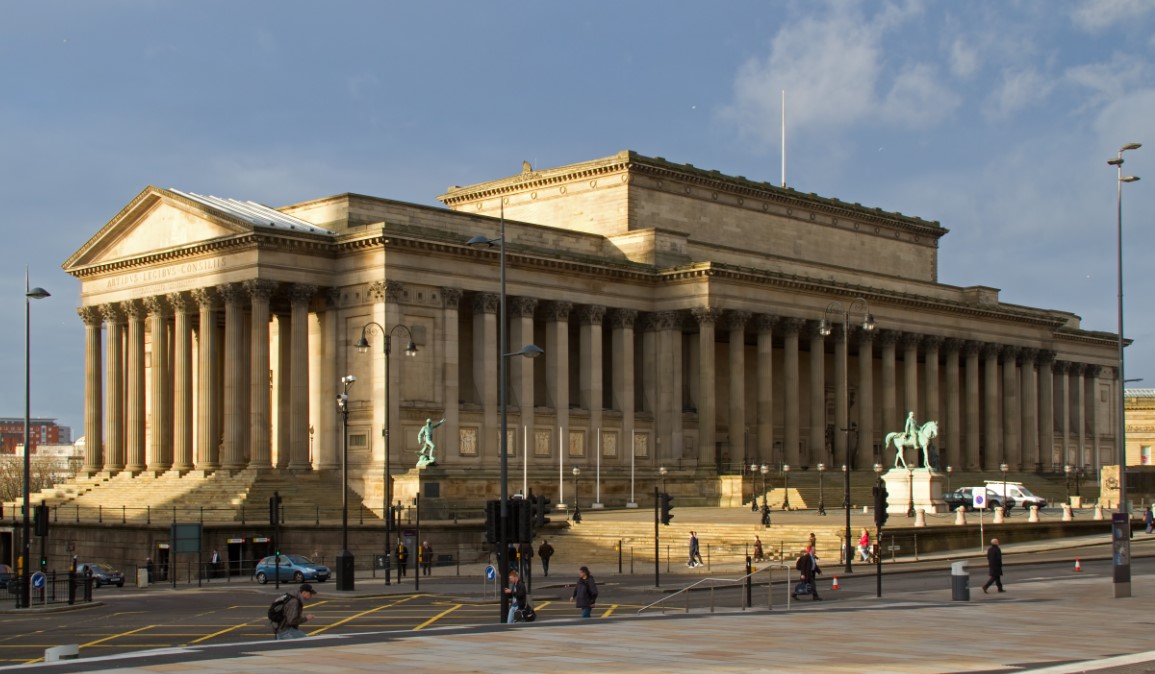
In 1826 Schinkel undertook a trip to Paris, Scotland and England, visiting tourist sites as well as industrial towns. We have his account of the trip in both German (Reise nach England, Schottland und Paris im Jahre 1826, S530.c.98.1) and English (The English journey: journal of a visit to France and Britain in 1826, 530:4.c.95.60). I find it fascinating to think that he visited Liverpool and admired the Town Hall but was almost 30 years too early to marvel at Elmes’ St George’s Hall, a neoclassical structure that would not look out of place alongside his buildings in Berlin.
Katharine Dicks
Further reading
- Karl Friedrich Schinkel: a universal man (S401:7.a.9.187), catalogue of a 1991 exhibition held at the Victoria and Albert Museum, London, bringing together, soon after German reunification, items that had been kept separate in the two German states
- Karl Friedrich Schinkel: Architektur, Malerei, Kunstgewerbe (S401:7.b.9.622), accompanying an earlier exhibition held in West Berlin
- Schinkel: a meander through his life and work by Kurt W. Forster (401:7.c.201.40)
- Karl Friedrich Schinkel: unter dem bestirnten Himmel by Christoph von Wolzogen (C211.c.564-565), an extensive biography in two volumes
 Languages across Borders
His furniture designs are lovely. He had such an eye for beauty, symmetry, lines, curves and stylish decoration. The paintings are absolutely stunning too. It is always nice to discover that an artist has expressed themselves in different mediums, and done so well in each of them. Thank you for highlighting his wonderfully wide-ranging talents.