
In the week leading up to the coronation of King Charles III we look back more than 350 years to the coronation of Charles II, celebrated in John Ogilby’s 1662 The entertainment of his most excellent majestie Charles II, in his passage through the city of London to his coronation. Etchings of the royal cavalcade and of the ceremony in Westminster Abbey were provided by Wenceslaus Hollar. Click on the images below to see larger versions:


 Hollar is an interesting figure to focus on here as he was born in Prague but spent much of his adult life in England, and his work documented the times in which he lived. He first came to England in 1637 in the service of the Earl of Arundel whom he had met in Cologne the previous year and accompanied on a nine month trip down the Rhine. The drawings he made then can be seen in Hollar’s journey on the Rhine (S404:5.a.9.29).
When the Civil War broke out in England Hollar was on the Royalist side and was captured by Cromwell’s men at the siege of Basing House. He managed to escape to Antwerp where he lived for a few years, continuing to produce large amounts of work. These include a fine etching of Antwerp Cathedral and an etched version of a portrait of himself by Johann Meyssens (here shown on the cover of C202.b.2517; see below for more on this book).


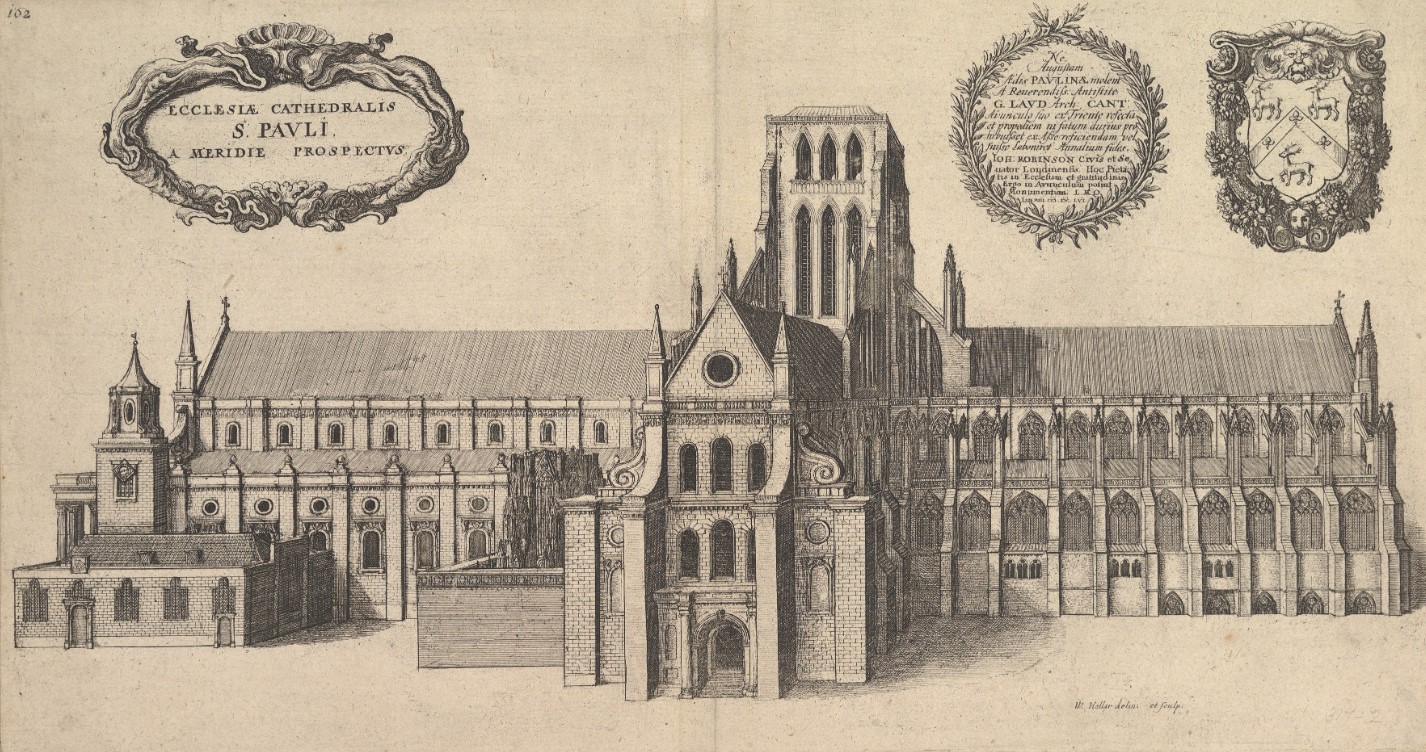
Hollar returned to England in 1652. An important commission was providing the engravings for William Dugdale’s 1658 History of St Paul’s cathedral, significant because it described and illustrated Old St Paul’s cathedral before it was destroyed in the Great Fire of London.
Immediately after the Great Fire of 1666 Hollar created a panorama from the Southwark side of the river showing how the city had been devastated. Being able to document what he saw provides us with a fascinating insight into the disaster and contrasts with an earlier panorama he created from the same spot before the Great Fire. Click on the images below (both via Wikimedia Commons) to see larger versions:


The fire happened in September 1666 and we know that Hollar’s new print was finished by 22 November as Samuel Pepys mentioned it in his diary:
my Lord Bruncker did show me Hollar’s new print of the City, with a pretty representation of that part which is burnt, very fine indeed.
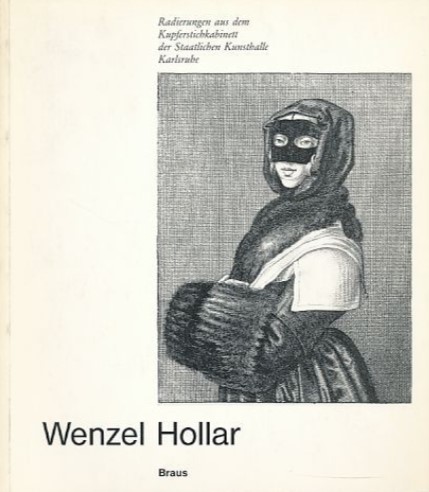 Hollar has by no means been neglected by scholars and the UL has a good number of books reflecting interest in him and showing the variety of his work. One notable publication is Wenzel Hollar, 1607-1677: Radierungen aus dem Kupferstichkabinett der Staatlichen Kunsthalle Karlsruhe (S404:27.c.9.30). The 550 etchings in Karlsruhe represent one of the oldest collections of Hollar’s works as they were acquired by Margrave Friedrich V of Baden-Durlach, a contemporary of Hollar’s. The picture chosen for the book cover shows a woman dressed for winter and is one of several of his works to feature fur muffs, each showcasing the exquisite detail he was able to achieve with tiny strokes for individual hairs.
Perspectives on Wenceslaus Hollar (C202.b.2517) is the most recent book we have on him and stems from a 2010 symposium held in Toronto. The intention was to highlight the diverse range of his work and to perhaps reappraise his prolific output. The book is also noteworthy for containing a lengthy and up-to-date bibliography.
Katharine Dicks
Further reading
- Wenceslaus Hollar: delineator of his time by Katherine S. Van Eerde (404:5.b.95.12)
- The man who drew London: Wenceslaus Hollar in reality and imagination by Gillian Tindall (404:2.c.200.4) , a biography but with fictional imaginings
- Hollar’s England: a mid-seventeenth-century view by Graham Parry (404:5.a.95.17)
- Wenceslaus Hollar: a Bohemian artist in England by Richard T. Godfrey (S404:5.b.9.223), catalogue of an exhibition held at the Yale Center for British Art, in 1995


 Languages across Borders