


This post looks in brief at some of the most recent Ukrainian arrivals in the UL. For obvious and awful reasons, we do not expect more books from Ukraine for some considerable time, but we will keep back money for Ukrainian material so that we can support publishers and vendors through purchases when Ukraine can again turn to peace-time activities.
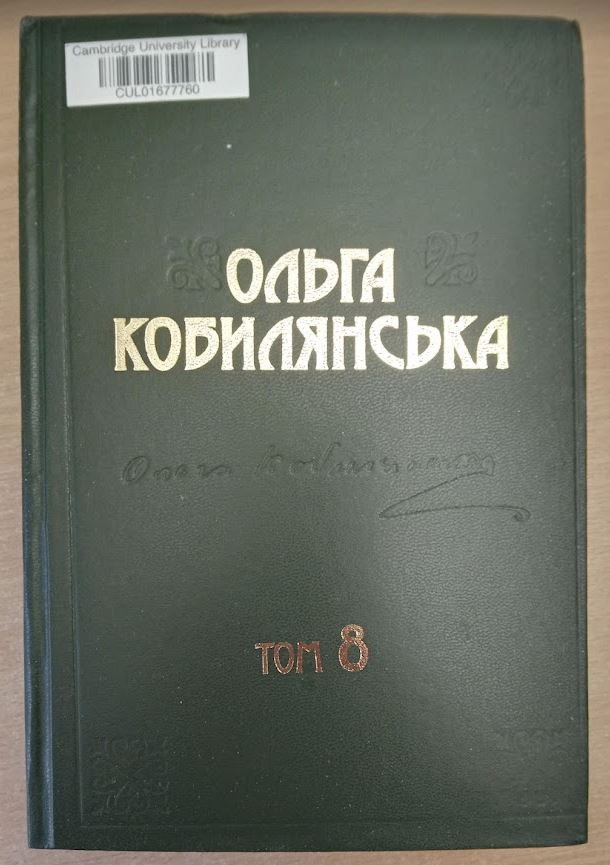 Firstly, we had two additions to literary sets. The 8th volume of what is expected to be a 10-vol. set of works by Olʹha Kobyli︠a︡nsʹka (1863-1942) has now been added to the preceding 7 volumes at 758:63.c.201.2(1-8). Kobyli︠a︡nsʹka wrote chiefly in Ukrainian but also in German and was a prominent feminist writer and activist; the city of Chernivt︠s︡i, where she spent most of her life has a museum dedicated to her (English description here) and the book set is published with the involvement of the museum and Chernivt︠s︡i National University. The latest addition to the set contains the text of the novel Apostol cherni. Marko Pavlyshyn sets the scene in the start of his Harvard Ukrainian Studies article about the novel:
“Ol’ha Kobylians’ka worked long and hard on Apostol cherni (Apostle of the Masses, 1926-1928), a novel unlike any of her earlier works. Here was a broad canvas with many significant characters, instead of the usual three or four, and a time span of three generations, rather than part of a single lifetime … to a greater extent than any of the author’s previous works, Apostol cherni took the Ukrainian national question as a leading theme, a fact underscored by the explicitly patriotic sentiments articulated by many of the novel’s characters.”
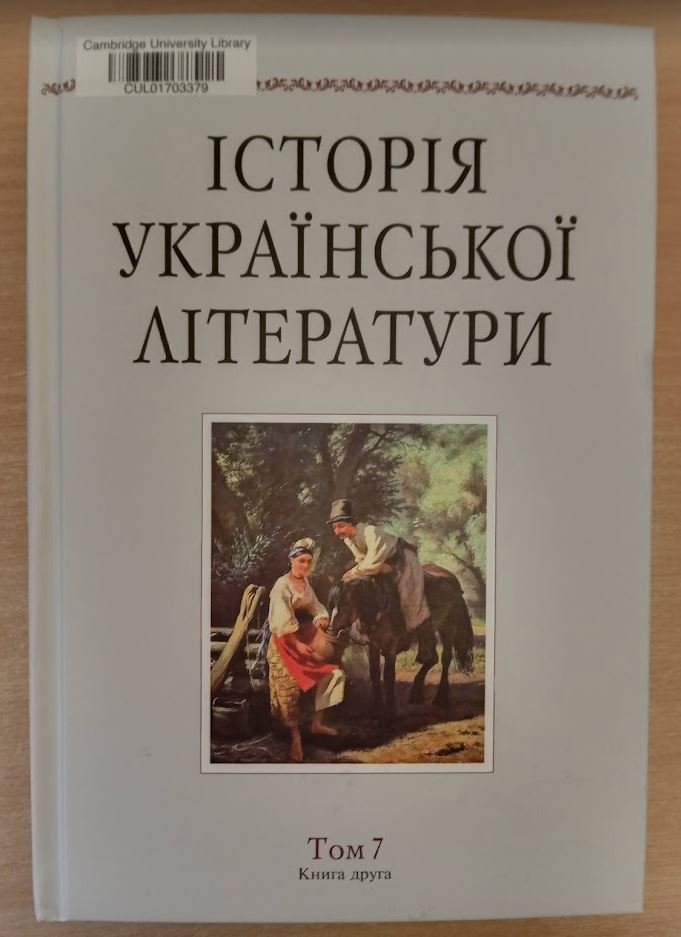 Volume 7(2) is the latest addition to our Istorii︠a︡ ukraïnsʹkoï literatury (History of Ukrainian literature) set published under the auspices of the Ukrainian National Academy of Sciences’ Taras Shevchenko Institute of Literature. The set’s volumes have been published out of sequence – not an uncommon situation – and volume 7(2) joins volumes 1-4 and 7(1) in North Wing 5. These together cover literature from the 10th century to 1830, a volume dedicated to the works of Taras Shevchenko, and literature of the 1880s and 1890s.
We have also had arrivals that build up our language/linguistics collections in the main Reading Room. One came through Legal Deposit – Yuri I. Shevchuk’s Ukrainian-English collocation dictionary for students of Ukrainian, much praised by the University’s Ukrainian Studies programme. Our copy now sits in the main Reading Room at R785.U14. We also received from our Ukrainian vendor the two latest volumes of Slovnyk ukraïnsʹkoï movy (Dictionary of the Ukrainian language), a major publication started in 2010 by the National Academy of Sciences. We now have the first 11 volumes, covering A-O.
The National Academy of Sciences, as so many other governmental, cultural, and academic institutions across the country, have very different concerns right now. At the time of writing, their front page (chiefly in Ukrainian) links to various pieces of documentation about Putin’s invasion.
In my last post, I mentioned initiatives by librarians and others outside Ukraine to support their Ukrainian colleagues, and I wanted to come back briefly to mention one: Saving Ukrainian Cultural Heritage Online (SUCHO). The progress SUCHO’s founders and volunteers have made is extraordinary and truly inspiring. They maintain a list of archived sites here: https://www.sucho.org/archives. Do have a look.
Mel Bach
 Languages across Borders