
Last month, the Humboldt Forum finally opened its doors to the public in the centre of Berlin on the Museumsinsel. The project was fraught with construction delays, and further pushed back by Covid: the official opening took place online in December last year. The building, designed by Franco Stella who won an architectural competition in 2008, consists of one modern facade alongside the river Spree with the three other facades being reconstructions of the former baroque palace which occupied the site earlier; the interiors are newly designed but match the dimensions of the original palace. Named after the brothers Wilhelm and Alexander von Humboldt, the building houses the overseas collections of the Staatliche Museen zu Berlin, in particular the ethnological and Asian art collections, previously housed in Dahlem.
It is fair to say that the idea of reconstructing the former palace provoked strong feelings and much bureaucratic wrangling – the Bundestag voted in favour of reconstruction long before building work began in 2013. Many people baulked at the cost (almost €700 million) and the more recent decolonisation movement has led to further questions about the appropriateness of placing looted colonial art behind an imperial facade (the collection includes a large number of Benin bronzes taken by British soldiers and subsequently acquired by Germany through auctions; Germany has pledged to start returning these to Nigeria from next year). The controversy surrounding the Humboldt Forum is reflected by the large amount that has been written about the project in the last 30 years including:
- The Humboldt-Forum in the Berliner Schloss: planning, processes, perspectives (2019.11.622) which presents designs and plans and provides a glimpse behind the scenes
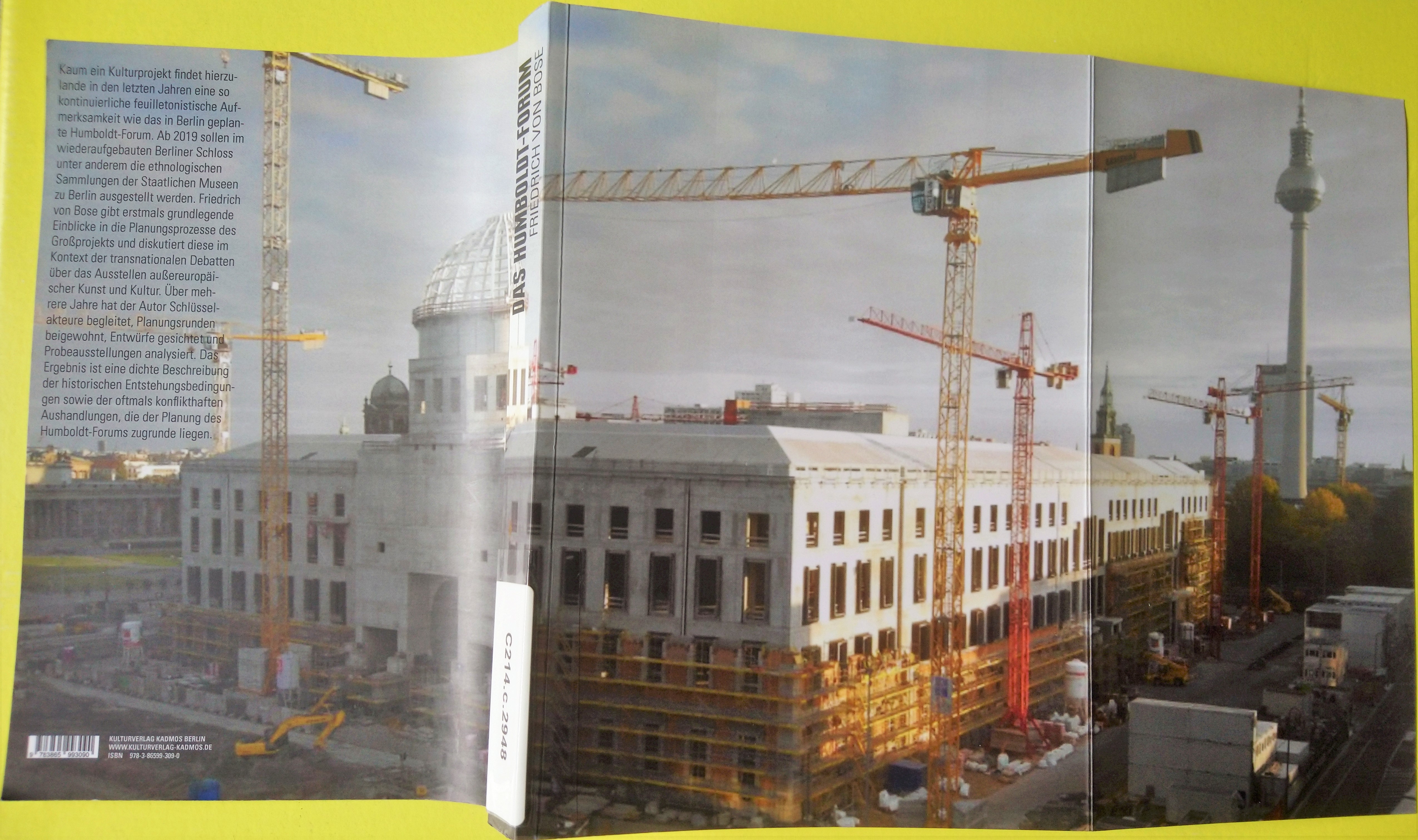
- Das Humboldt-Forum: eine Ethnografie seiner Planung by Friedrich von Bose (C214.c.2948), product of a five year ethnographic study of the planning process
- Das Humboldt Forum: die Wiedergewinnung der Idee edited by Horst Bredekamp and Peter-Klaus Schuster (C206.d.1339)
- Rekonstruktion am Beispiel Berliner Schloss aus kunsthistorischer Sicht (C208.c.8268), proceedings of a 2010 conference with contributions from some of the experts closely involved
- Schloss – Palast der Republik – Humboldt-Forum: Mitte Spreeinsel in Berlin – ein Ort historischer Brüche by Bruno Flierl (2010.11.1015), a useful concise summary of the debate with lots of pictures
- Das neue Berliner Schloss : von der Hohenzollernresidenz zum Humboldt-Forum by Rainer Haubrich (2012.8.2791), describes the historic palace and the difficult route to the reconstruction decision, documents alternative designs to Stella’s with many colour photos
- Die Berliner Schlossdebatte–Pro und Contra edited by Wilhelm von Boddien and Helmut Engel (2001.11.2303)
- Das Schloss?: eine Ausstellung über die Mitte Berlins (S401:7.b.9.960), a 1993 exhibition already thinking about whether to rebuild or not
- Das Berliner Schloss: Geschichte und Wiederaufbau by Hartmut Ellrich (C203.d.23), focuses particularly on the interior of the palace but also has computer generated pictures imagining how reconstruction would look (published 2008)


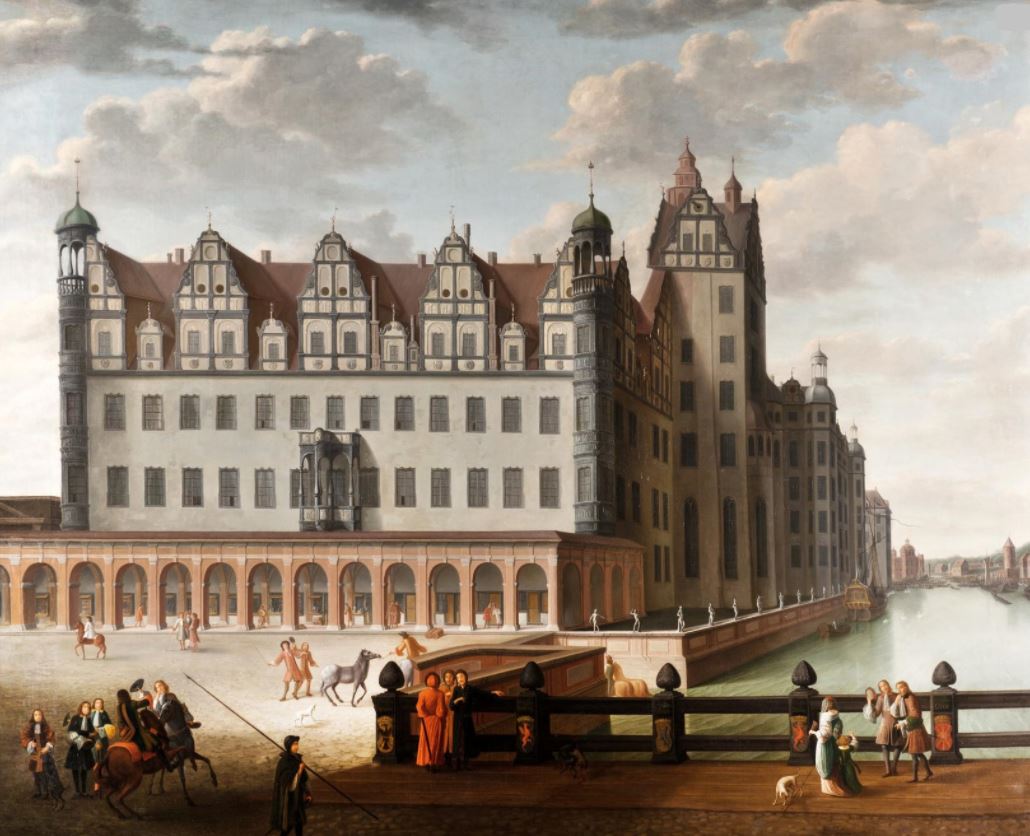
Turning to the history of the site, there are surviving sections of building on show in the basement which date back to a medieval Dominican monastery. From the mid 15th century the site became the residence of the Hohenzollern dynasty, ruling house of Brandenburg-Prussia, first as a Renaissance palace as depicted in the painting below, and then by the 18th century turned into a Prussian baroque palace with the 19th century addition of the dome designed by Schinkel. It continued to be an opulent royal palace of the German Empire until 1918.
There are many books on different aspects of the baroque palace. Here are just a few:
 Das Berliner Schloss : die erhaltene Innenausstattung: Gemälde, Skulpturen, dekorative Kunst by Guido Hinterkeuser (2012.10.677), concentrating on the interior and contents
- Das Berliner Schloss: der Umbau durch Andreas Schlüter by Guido Hinterkeuser (401:7.c.200.178), looking at the baroque transformation
- Das königliche Schloss zu Berlin by Goerd Peschken (S401:7.a.9.204-207), a detailed work in four large volumes
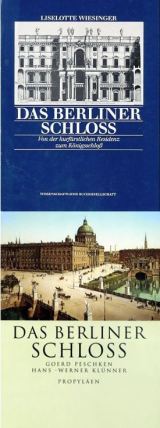
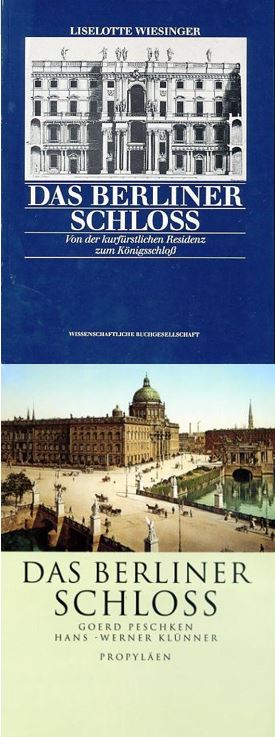
- Das Berliner Schloss: von der kurfürstlichen Residenz zum Königsschloss by Liselotte Wiesinger (S401:7.b.9.891)
- Das Berliner Schloss: das klassische Berlin by Goerd Peschken and Hans-Werner Klünner (S401:7.a.9.210), illustrated with lots of old photos
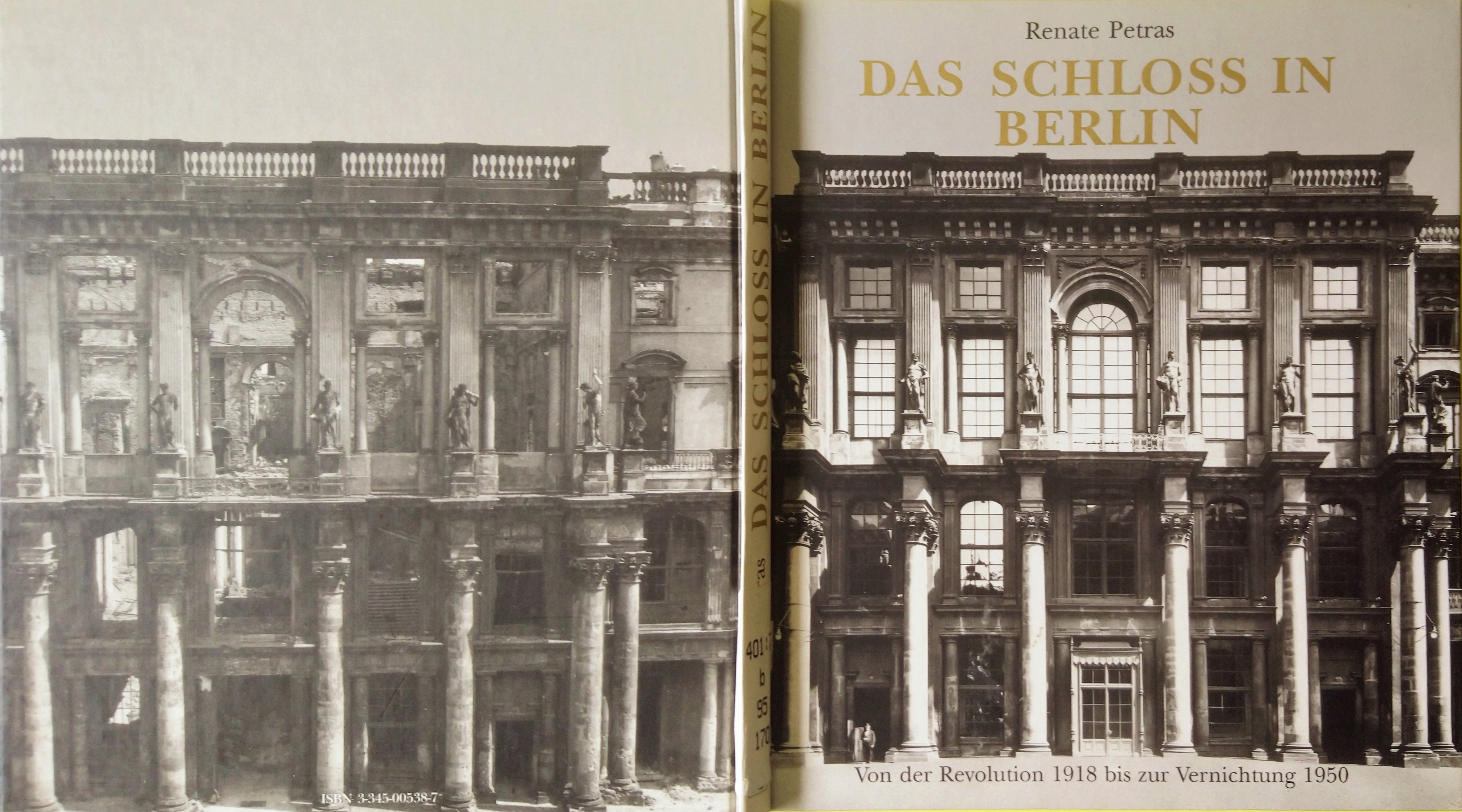
Between the wars, the Berliner Schloss, as it was known, could be visited by the public for the first time when it hosted the Schlossmuseum. The palace suffered bomb damage during World War Two and was somewhat controversially blown up by the GDR government in 1950. Some believed that it could have been saved and restored. Das Schloss in Berlin: von der Revolution 1918 bis zur Vernichtung 1950 by Renate Petras (401:7.b.95.170) documents the time from the end of World War One until the 1950 destruction with many illustrations. The photos on the front and back covers show the dramatic changes during this time:
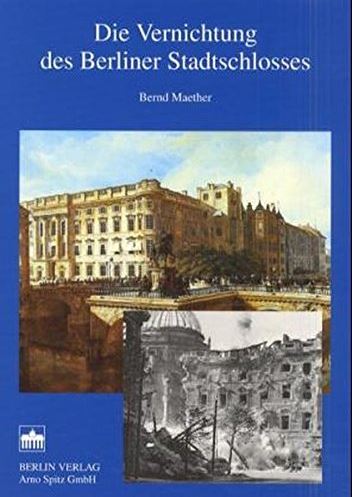 What happened in 1950 is also recorded in Die Vernichtung des Berliner Stadtschlosses: eine Dokumentation by Bernd Maether (401:7.c.200.114) and is the subject of a recent doctoral thesis, Denkmalpflege am Berliner Schloss by Anja Tuma (S400:01.a.135.38), looking in particular at salvage work done by a group of architects, art historians and conservationists who were granted access for a short time before demolition.
The site was used as a parade ground and car park until the modern Palast der Republik was completed in 1976, occupying half the site. This was home to the GDR parliament but also an important social and cultural centre for the people. I remember being impressed by it on visits to East Berlin in the mid 1980s, particularly by the ice creams in the riverside Milch Bar!


Photos of the Palast der Republik and Ludwig Engelhardt’s 1986 statue of Marx and Engels taken May 1987 by Katharine Dicks (click on images to enlarge)
Asbestos was discovered in the building in 1990 which led to its closure. It was subsequently demolished between 2006 and 2009 (some of the steel was reused in the construction of the Burj Khalifa in Dubai!) and inspired the publication of more books including:
 Palast der Republik: Utopie, Inspiration und Politikum (S950.a.201.6985), catalogue of a recent exhibition held in Rostock with good photos
- Palast der Republik: politischer Diskurs und private Erinnerung edited by Alexander Schug (573:5.c.200.128)
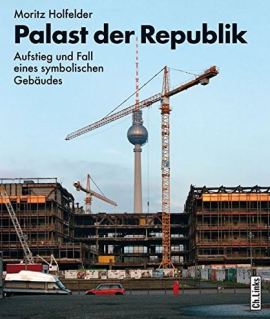
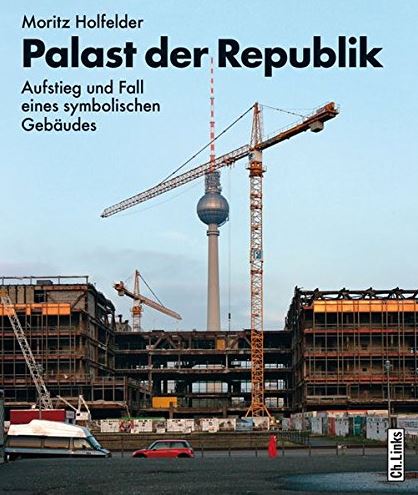
- Palast der Republik: Aufstieg und Fall eines symbolischen Gebäudes by Moritz Holfelder (C201.b.2392), including personal reminiscences
- Der Palast der Republik: Geschichte und Bedeutung des Ost-Berliner Parlaments- und Kulturhauses by Anke Kuhrmann (C200.b.8350)
- Von Erichs Lampenladen zur Asbestruine: alles über den Palast der Republik edited by Kirsten Heidler (9003.d.4237)
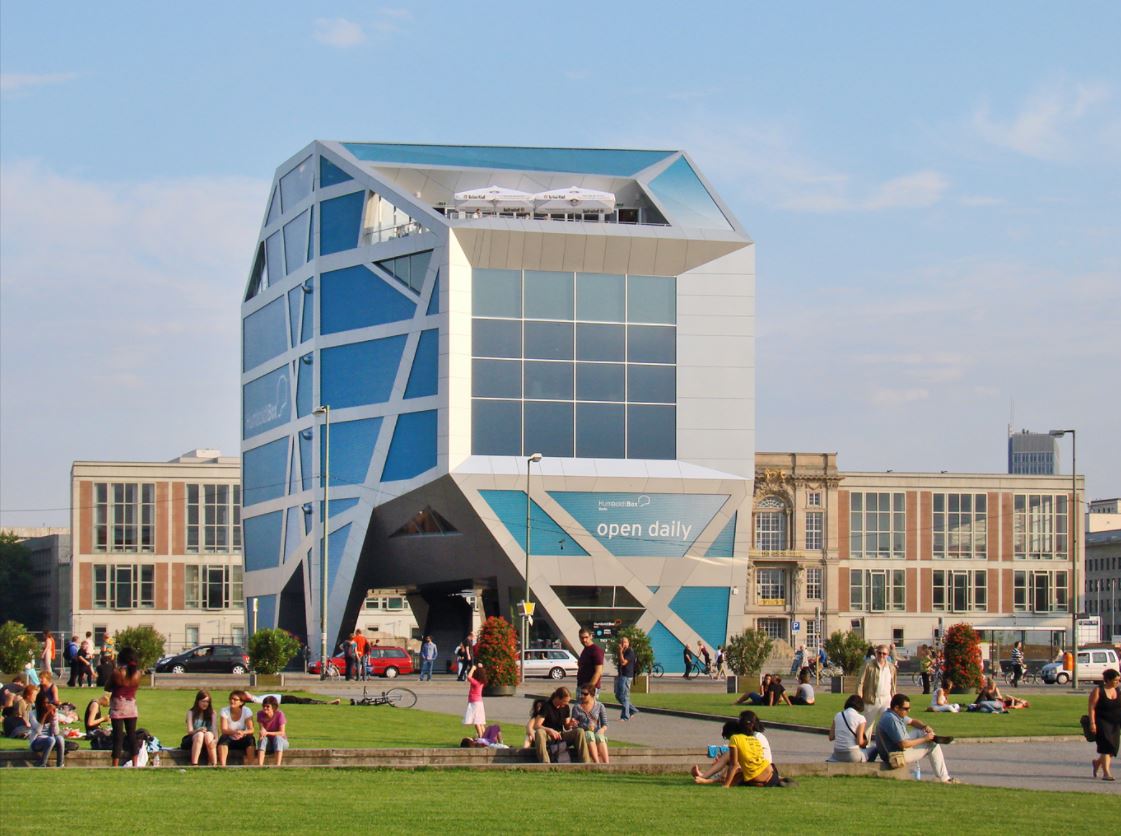
In the early 1990s, to initiate the debate on rebuilding of the palace, Wilhelm von Boddien, one of the major players in the push for reconstruction, hired the French artist Catherine Feff to create a life-size painting of part of the Schloss facade on plastic sheeting. This was then installed alongside the Palast der Republik to give an impression of what the rebuilt palace might look like and remained there for more than a year. A more recent temporary structure was the Humboldt Box, acting as an information centre for the project from 2011 until 2019.
The Humboldt Forum is now partially open to visitors with two floors and courtyard areas accessible; further areas will be opened from September. For the first 100 days entry is free, showing perhaps the influence of Neil MacGregor who was a founding director from 2015 to 2018 after he left the British Museum. For those of us unable to get to Berlin the museum’s virtual visit is most welcome.
Katharine Dicks
 Languages across Borders