
This is an unwittingly Olympics-related blog post. During a recent day spent processing new Slavonic arrivals in the UL, I kept an eye out for potential subjects for the July blog post – and the winner happened to be an album of sports medals and badges held by the Historical Museum in Moscow. Sportivnye zhetony i znaki Rossiĭskoĭ imperii iz sobranii︠a︡ Istoricheskogo muzei︠a︡ contains colour photos of the front and reverse of hundreds of sporting awards and sport society membership badges presented in the Russian Empire or to the empire’s citizens outside its boundaries. The pairs of images are accompanied by captions providing a physical description and brief context if known, along with the date of acquisition by the museum and inventory number.
To give an idea of breadth and depth of coverage, here are the various sections of the book complete with page numbers.
- Aviation and aeronautics (p. 18)
- Motor racing (p. 28)
- Cycling (p. 42)
- Aquatic sports (p. 106)
- Equestrian sports (p. 130)
- Skating and figure skating (p. 184)
- Athletics and gymnastics (p. 206)
- Skiing (p. 242)
- Hunting and fishing (p. 250)
- Shooting (p. 270)
- Tennis (p. 298)
- Weightlifting (p. 304)
- Fencing (p. 324)
- Football (p. 330)
- Olympic Games and other competions (p. 336; the following section starts on p. 350)
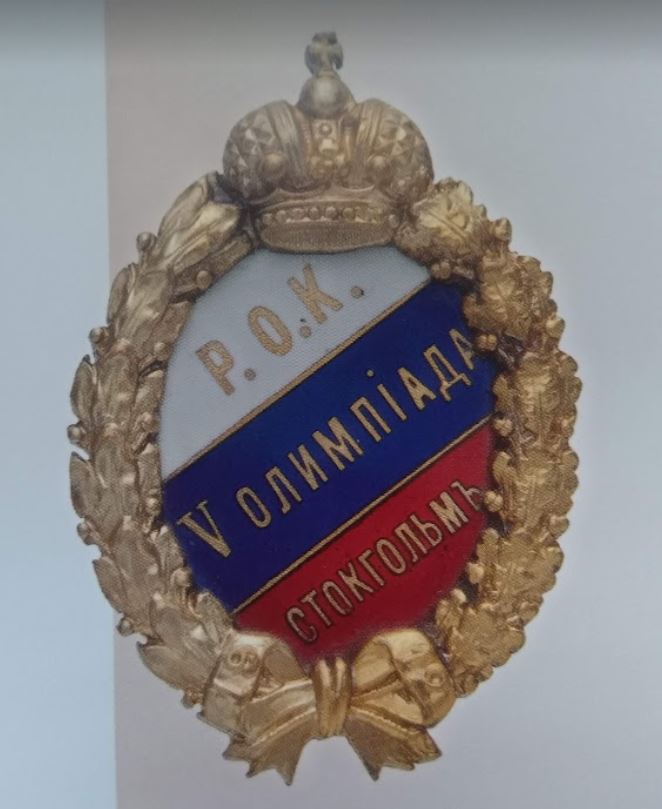
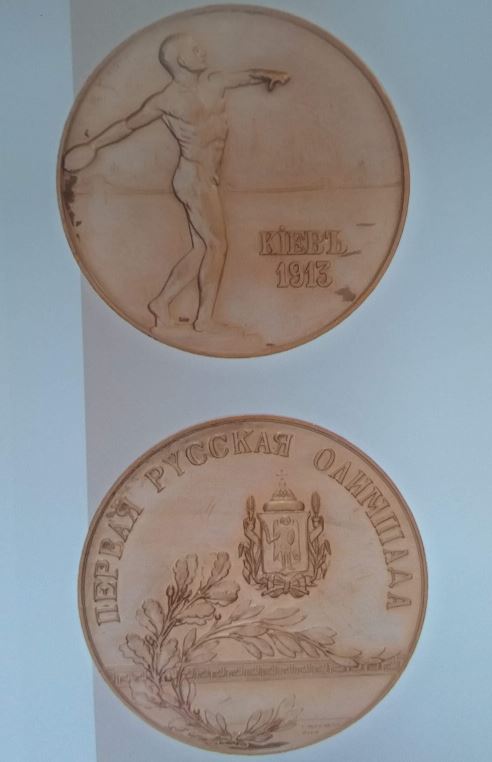
The images starting this post do relate to the Olympics. The first is a badge for Russian Empire participants in the 5th Olympic Games, which were held in Stockholm in 1912. Of 28 participating nations, 18 won medals. The empire came 16th, securing two silver and three bronze medals. The following year, the First Russian [Empire] Olympiada was held in Kyïv (remember that Ukraine, as well as much of Poland and other countries, was part of the Russian Empire), to help build up sporting strength and ensure recovery from humiliation in Stockholm before the 6th Olympics in Berlin in 1916. The latter were, of course, never held, with most countries due to participate instead fighting desperately with and against each other on the battlefields of World War 1. The next Olympics Games (officially named the 7th nevertheless) took place in Antwerp in 1920. By this point, the Russian Civil War and the Polish-Soviet War were in full horrific swing. Poland would join the 8th Games in Paris in 1924, where it managed to match the former empire’s exact 1912 medal haul. The Soviet Union would first appear only at 15th Games in Helsinki, in 1952 (finishing second in the medal chart).
I’ll end with some of the other images that particularly jumped out at me: an equestrian club badge from Warsaw from c. 1889; a 1908 jeton for otlichnyĭ glazomer (an excellent eye! [for measuring distance, etc]); an early 20th-century badge for the Kostromo Society of Cyclists (note the two styles of machine); a c. 1911 badge for the Warsaw Hercules Club; and a 1901 one for the Society of Skiing Enthusiasts.


Mel Bach
 Languages across Borders