
This is a guest post by our previous French assistant, who moved to Spain last summer.
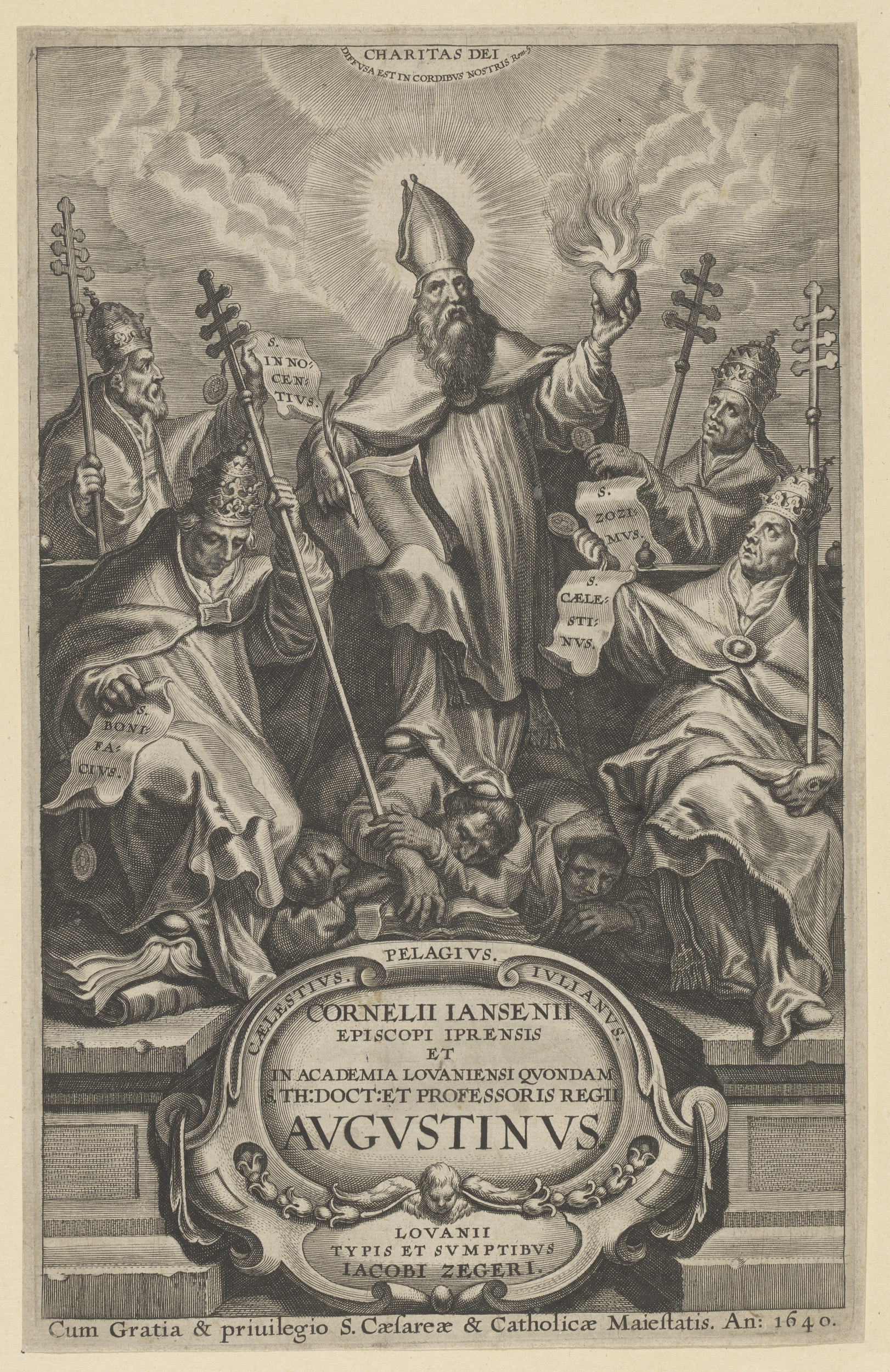
In 17th century France, Port-Royal des Champs was an abbey of Cistercian nuns famous for being home to a circle of religious dissenters, the Jansenists. Jansenism was a controversial religious movement with political overtones inspired by the work of the Flemish bishop and theologian Cornelius Jansen. It was condemned by both the Catholic Church and the French monarchy. Jansen’s main work is Augustinus, a treatise on the theology of St. Augustine published posthumously in 1640. Jansenists criticised both the spiritual and the secular authority, seeking a return to the origins of the Church. For them, good works and faith did not necessarily lead to salvation: it was a matter of divine grace. In the theological debate about the reconciliation of providence and human freedom, Jansen supported the doctrine of irresistible or efficacious grace, usually connected with Calvinism. He emphasised the necessity of grace for any good act and believed in predestination. The Jesuit Luis de Molina contradicted Jansen. He promoted the concept of free will, arguing that divine grace needed to be accepted or refused by each individual. When Pope Alexander VII promulgated the “Formula of Submission for the Jansenists” in 1665, though, some intellectuals refused to condemn Jansenism for its heretical beliefs.
Jean du Vergier de Hauranne, Abbot of Saint-Cyran, and friend to Jansen, introduced the latter’s ideas in France. He became spiritual leader (1633-36) and confessor to the nuns at Port-Royal. The community of nuns gave lodging to seculars, and the atmosphere of study and retreat attracted important figures to join them, including several members of the Arnaud family.
Several intellectuals taught at the Petites écoles de Port-Royal (1637-60) such as the Abbot of Saint-Cyran, Blaise Pascal, Claude Lancelot, Pierre Nicole and Jean Hamon. Jean Racine, one of the three great playwrights of 17th-century France alongside Molière and Corneille, was among the important figures of the Port Royal circle. He was a student at the schools of Port Royal.

Another of the key figures of Port Royal was Antoine Arnauld (1612-1694), a theologian, philosopher and mathematician. We can highlight three influential works by him: 1. De la fréquente communion (1643) where he supports Jansen’s postulates, particularly on the matter of divine grace; 2. Grammaire générale et raisonnée (1660) co-written with the monk and grammarian Claude Lancelot, and commonly referred to as the Port Royal Grammar: it is considered a foundational text for the normalization of the French language; 3. Port Royal Logic, commonly known as La logique, ou l’art de penser (1662), published anonymously and co-authored by Pierre Nicole.
Jansenist philosopher and theologian Blaise Pascal wrote his influential Lettres provinciales (1556-57) in defence of Antoine Arnauld, under the pseudonym Louis de Montalte. King Louis XIV banned Pascal’s book.
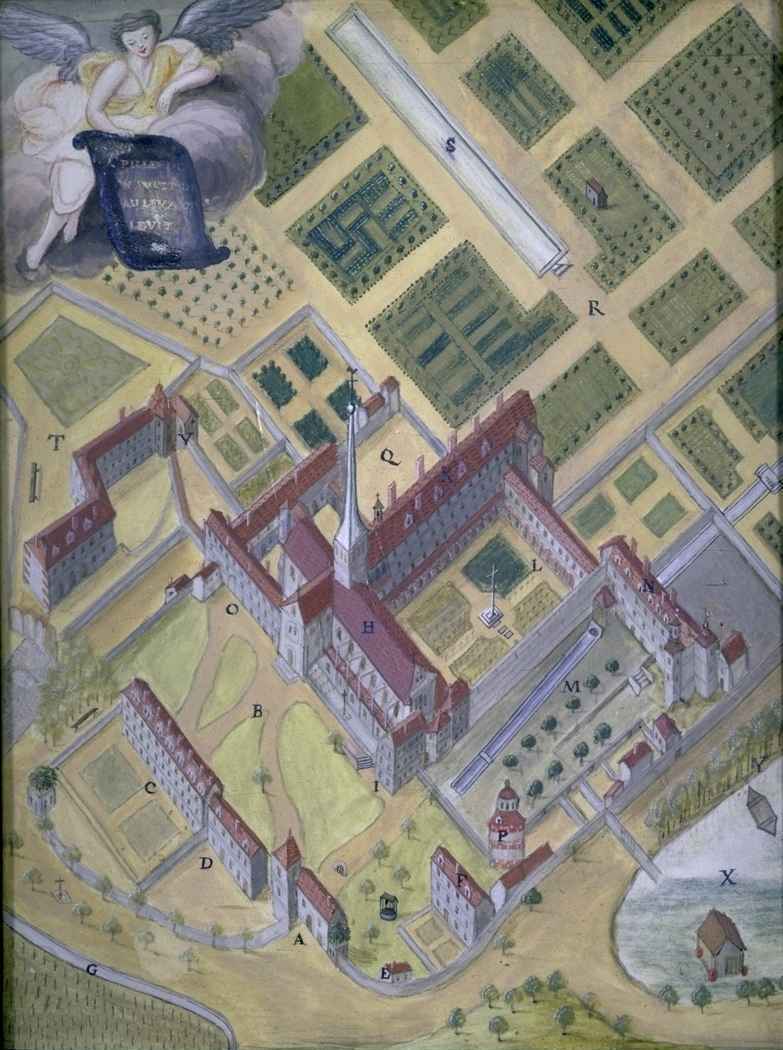
The King was not happy with the religious and intellectual dissidence of Port Royal. Some of the Jansenists also criticised the monarchy’s excesses, while the Jesuits, who were close to the French monarchy and influential in France and Europe, attacked the Jansenists, accusing them of heresy. The monastery’s school was closed as a result of a papal bull in 1660, although the monastery was not dissolved until the early 18th century by another papal bull. Despite these persecutions, Jansenism survived until the 19th century. In fact, according to Monique Cottret (see C211.c.1405) persecution helped Port Royal to spread its teachings to a wider audience.
Nowadays almost nothing remains of the monastery. The Musée national de Port-Royal des Champs, located on the site, includes the ruins of the abbey. It is difficult to adequately sum up the importance and impact of Port-Royal, connected as it is with so many facets of French culture: philosophy, religion, literature, arts…
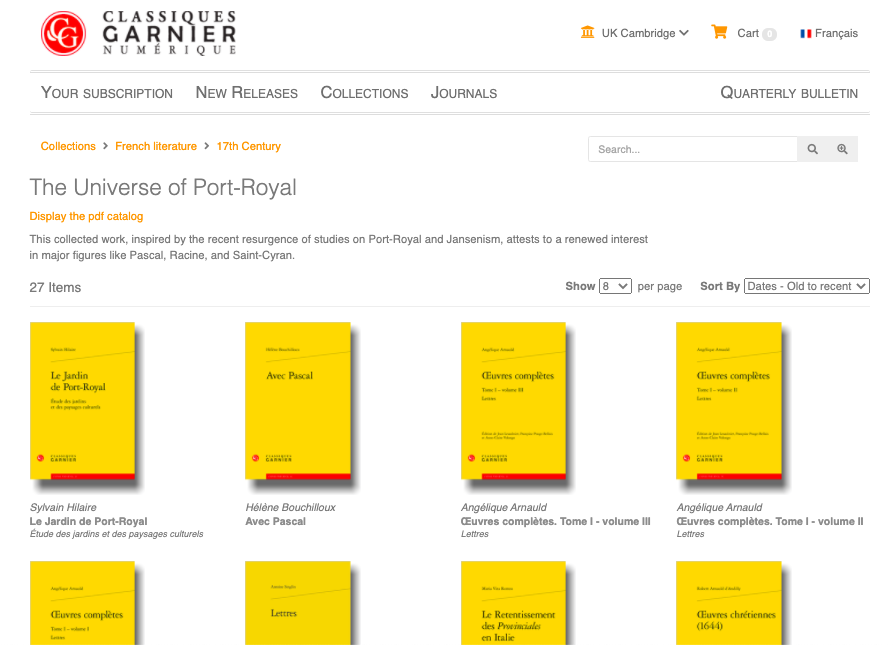
Cambridge University Library has a print subscription to the Classiques Garnier series Univers Port-Royal, which totals 27 volumes to this date [search iDiscover here].
Manuel del Campo
Further reading
Cottret, M. Histoire du jansénisme : XVIIe-XIXe siècle. Paris : Perrin, 2016. C211.c.1405
De Franceschi, Sylvio Hermann. Entre saint Augustin et saint Thomas : les jansénistes et le refuge thomiste (1653-1663) : à propos des 1re, 2e et 18e « Provinciales ». Paris : Classiques Garnier, 2017. C214.c.3105
Kostroun, Daniella. Feminism, Absolutism, and Jansenism Louis XIV and the Port-Royal Nuns. Cambridge: Cambridge University Press, 2014. E-book version.
Van Kley, Dale K. The Jansenists and the expulsion of the Jesuits from France, 1757-1765. New Haven : Yale University Press, 1975. 500:01.c.4.107
Strayer, Brian. “Jansenism: Its Key Figures, Themes, and Relevance Today“, video-recording of a lecture given at DePaul University in 2014 (accessed 17/12/2020)
 Languages across Borders