
The Martin Stone collection of French poetry
Martin Stone was an English guitarist and rare books collector who had a strong interest in French poetry. Cambridge University Library bought his French poetry collection this year through the bookseller Justin Croft after Stone’s death in 2012.
This collection of French poetry contains 225 books.[1] The oldest one is Odes et ballades by Victor Hugo, published in 1841, the most recent is Sept, written by Andrée Chedid and illustrated by Erik Bersou, published in 2009. Martin Stone focused on purchasing illustrated books, first editions and rare works by authors now long forgotten.
In the past three months, while cataloguing these books, I wanted to showcase the features of these books which appeal to a bibliophile clientele. I will now describe here these characteristics with some examples from this collection.
Copies designed to be unique
Most of the books from the Martin Stone collection include one particularly interesting page, often facing the title page or situated at the end of the book, as a colophon. On this page are recorded details about the material design of the book, mostly the different kinds of papers used for the printing, and the copy’s unique number.[2] The photograph below of Maurice Dekobra’s Luxures is a typical example. First, a list of the different sorts of papers, from the most to the less luxurious ones,[3] with the numbers of copies printed with each one. Details are added about the distribution of these copies: the majority were numbered and designed to be sold, but some were reserved for the author and the publisher to be given to friends and colleagues. Then, each copy was given its number, printed or hand-written, and in some cases signed by the author.[4] Other features can give some of the copies even more value, for example an original plate by the illustrator or a manuscript note by the poet, also recorded on this page.
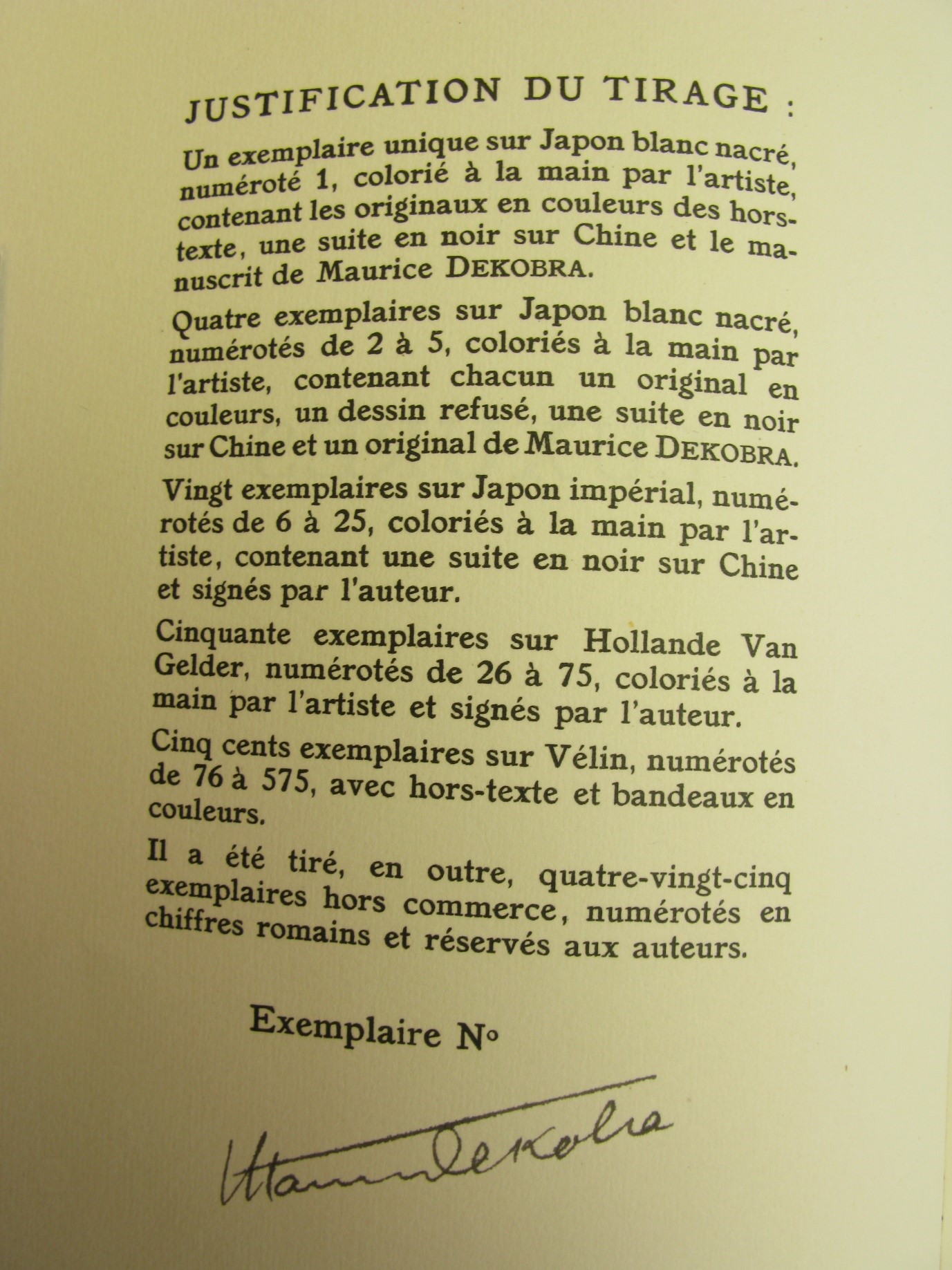
Maurice Dekobra, Luxures, Paris, Éditions du Loup, 1928, p. 2.
At the crossroads between letters and pictures
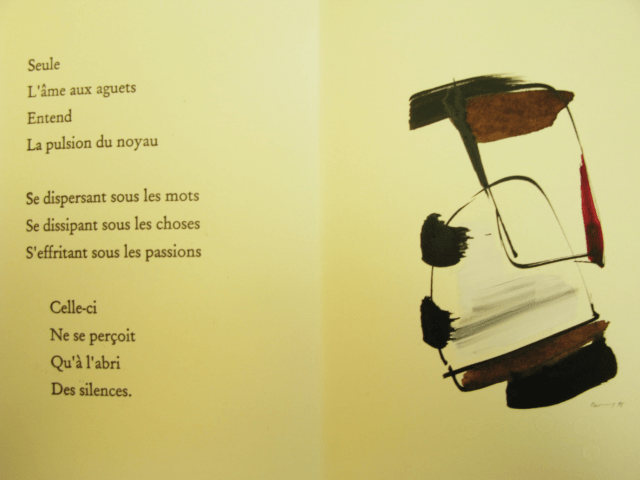
Another sign of the great care put into these editions is the illustrations. An important part of the collection is illustrated. Later books have more illustrations. It can be a supplementary figurative work, or an actual ‘artist book’, the product of a collaboration between a writer and an artist.[5]
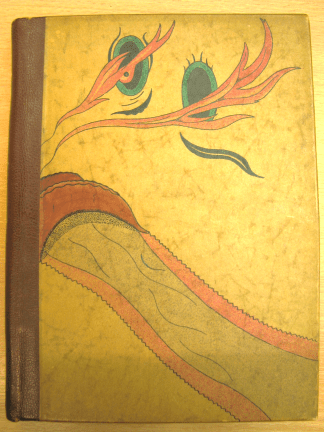
Another striking aspect of these books is their packaging. Whether a binding, a slipcase or a chemise encompassing loose leaves, the cover of these works is of interest. These covers may have been designed by the publisher during the print run, or the books may have been bound by a later owner.[6] Some of them possess beautiful bindings, such as Tristan Tzara’s Où boivent les loups[7] on the photograph below.
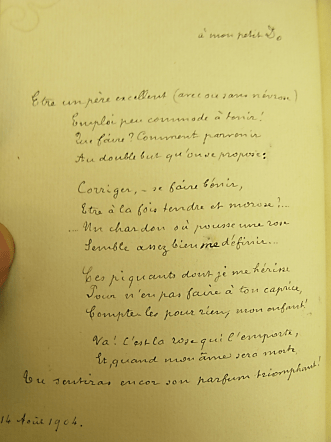
Autographs are another major and unique feature of the books in this collection. These include not only the authors’ signatures in the colophon, but also their dedications to the first owner of the copy. Most of them follow a standard neutral form: name of the addressee, formal salutation, author’s signature, sometimes the date and place. These small inscriptions make me think (I may be wrong!) that they were written with the idea of encouraging bibliophily around these books, whose value would of course rise from having an autograph inscription. However, other inscriptions are much more intimate, sometimes humorous, with puns or warm thanks for a service provided…
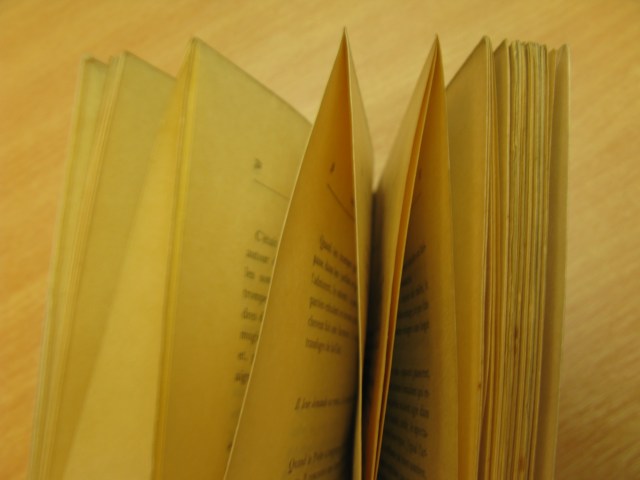
Finally, I must write about a trait characterizing many books in the Martin Stone collection: their pages are uncut! And yet they have been acquired by at least two people, their first owner and Martin Stone, before the sale of the latter’s collection to Cambridge University Library. As they are uncut, they have clearly not been read, and indeed, have barely been flipped through. This supports the idea that some bibliophiles buy these books more to own them than to actually read them. A bibliophile’s book is more than a medium: it is an object, sometimes luxurious, and is part of a décor, the bookcase, or the private library. However, this life is now over for the 225 books of the Martin Stone collection, which are now available for study to our readers in the UL Rare Books reading room (they are searchable online on the iDiscover catalogue with the keyword “Martin Stone former owner”)!
Pierre-Marie Bartoli (visiting student from the Ecole des Chartes)
[1] There are some Belgian poets writing in French, some translations in French and one untranslated Breton poetry collection.
[2] Of course, this can vary from one publisher to another, but this is the most usual content.
[3] Japanese Nacre, Imperial Japan, Dutch Van Gelder and Vellum, in this order.
[4] In this example, unfortunately, no number is given, but the copy is still signed by the poet. Sometimes, instead of the number are the letters “H. C.”, which mean “hors commerce”, not to be sold.
[5] Or several of each.
[6] On the contrary to the other features of bibliophily displayed before, this one is not originally planned by the creators of the edition (writer, artist, publisher…).
[7] “Where the Wolves Drink”.
 Languages across Borders