
As the 50th anniversary of men first setting foot on the moon is observed across the world, it is only right that this blog highlights some of the European moon-related items in our collections.
First is Sidereus nuncius by Galileo, dating from 1610. This groundbreaking work was the first publication to be based on observations using what was then a new instrument, the telescope. Indeed, Galileo had built his own telescope and what it revealed to him was an irregular surface. His descriptions of what he saw and his comparisons with Earth challenged the then standard belief, dating back to Aristotle, that the moon was smooth:
“It is most beautiful and pleasing to the eye to look upon the lunar body … Anyone will then understand with the certainty of the senses that the Moon is by no means endowed with a smooth and polished surface, but is rough and uneven and, just as the face of the Earth itself, crowded everywhere with vast prominences, deep chasms, and convolutions”
[Galileo’s words translated into English in a recent translation with commentary by Albert van Helden]
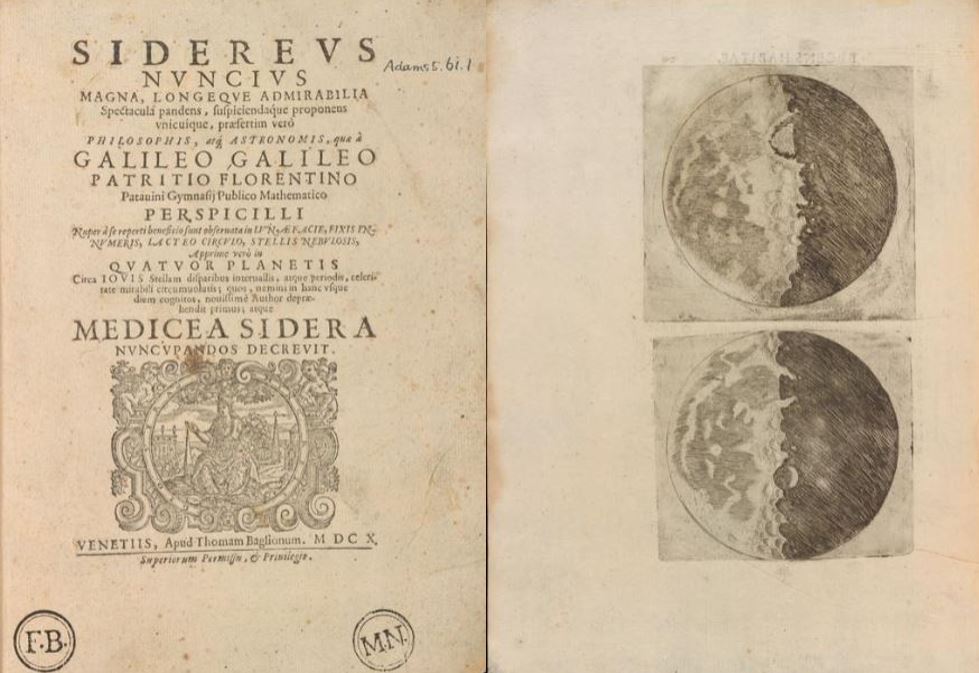
The University Library copy of Sidereus nuncius has been digitised and can be viewed here.
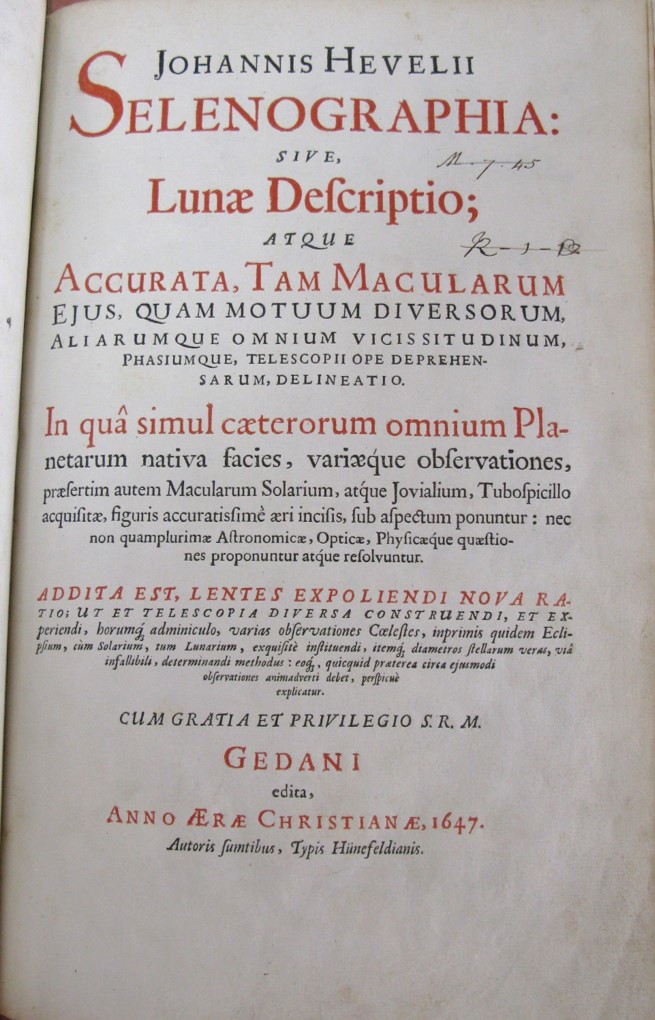 Another 17th century treasure in our collections is Selenographia by Johannes Hevelius who was a wealthy merchant and city official in Danzig (now Gdańsk) and also an astronomer. Having inherited his family brewing business, he had the financial freedom to build a fine observatory containing a large telescope which he used to look at the moon. Between November 1643 and April 1645 Hevelius observed the various phases of the moon and made 40 drawings. Selenographia contained these along with three maps of the full moon, thus giving a comprehensive account of lunar geography and representing a turning point in the history of lunar cartography. It became a standard work and was praised towards the end of the century by William Molyneux in his Dioptrica Nova:
“Galileo with his telescope first discovered great ruggedness in the moon’s face… but the noble Hevelius in his curious and costly work of Selenography has perfected this affair, perhaps beyond amendment”
[from A world in the moon by Marjorie Nicolson]
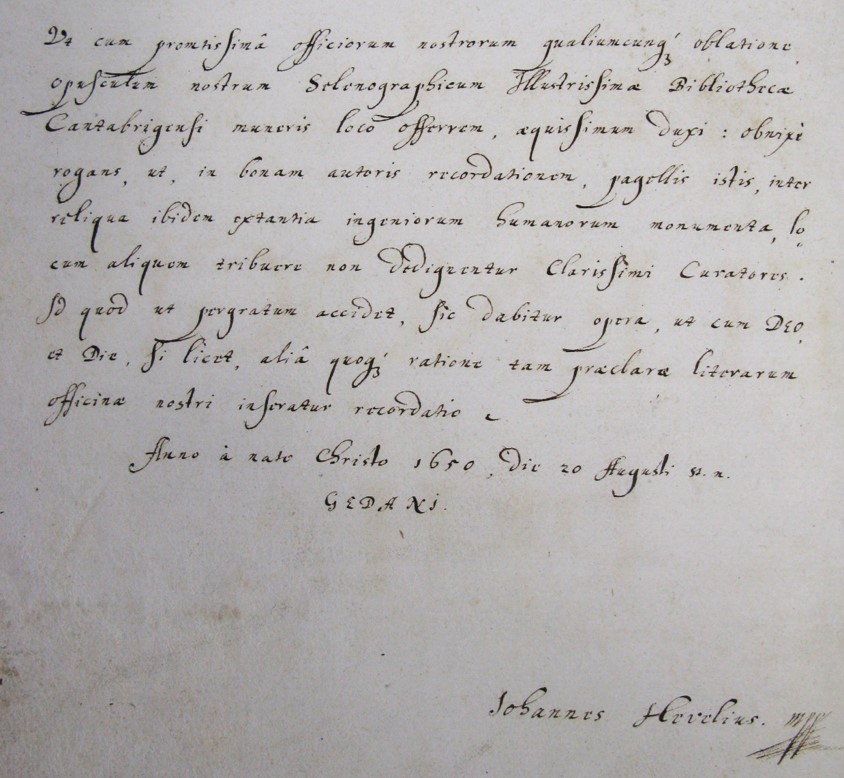
I was thrilled to discover that the University Library has a copy of Selenographia that was given to the University by Hevelius himself in 1650 with the following inscription:
 The images below show the frontispiece to the book (showing al-Haytham, the Arab astronomer, and Galileo holding the banner) and Hevelius’ three lunar maps. I particularly like the cherubs in the corners with their scientific instruments. Click on each image to see a larger version.


Ten years ago, an exhibition was held at the Wallraf-Richartz-Museum in Cologne to mark both 40 years since the moon landings and the 400th anniversary of Galileo’s observations. The accompanying exhibition catalogue is chiefly devoted to artwork depicting the moon but it also contains for the first time excellent reproductions of all 40 of Hevelius’ drawings of the phases of the moon.
Telescope observations of the moon in the early 1600s helped to excite ideas that the moon could be habitable. This theme and that of voyages to the moon became popular subjects to write about, for example in The Discovery of a World in the Moone, or a discourse tending to prove that ’tis probable there may be another habitable world in that planet in 1638 by John Wilkins. In 1744 the French author Charles Pinot Duclos wrote a satirical fairytale, Acajou et Zirphile, in which Prince Acajou travels to the Moon to recover the severed head of Princess Zirphile and return it to her body.
By the late 19th century in De la terre à la lune (1865) and its sequel Autour de la lune (1870), Jules Verne wrote perhaps the first fictional works about trips to the moon based on contemporary scientific knowledge and came close to accurately predicting later technological developments in space travel. The University Library did not buy French language editions at the time of publication but they were quickly translated into English and we have several English language translations, reflecting how popular these works were.


Covers and illustration from some of our 19th century translations of Verne’s books
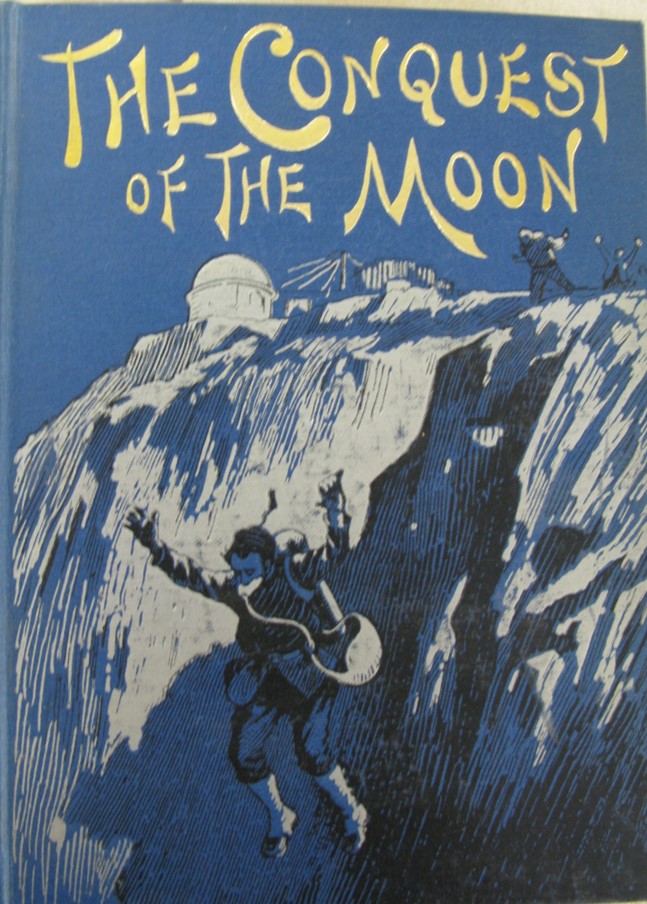 An associate of Jules Verne was Paschal Grousset who in 1887 capitalised on the interest in emerging science fiction, writing Les Exilés de la Terre under the pseudonym André Laurie. We have the English translation of this, The conquest of the moon (1889), with its striking cover. This novel does rather stretch the realms of imagination: a whole Sudanese mountain made of iron ore is turned into an electro-magnet and catapulted to the moon. The protagonists then proceed to have various adventures before returning to Earth.
Exactly eighty years after this imagined moon landing was depicted, men on the moon became a reality as Neil Armstrong and Buzz Aldrin stepped out of the Apollo 11 lunar module.
Katharine Dicks
Further reading:
- Moon: a brief history by Bernd Brunner
- The book of the moon by Rick Stroud
- The moon: a biography by David Whitehouse
- Moon: nature and culture by Edgar Williams
 Languages across Borders
Fascinating post. Thank you for compiling these illustrations as well. I love to read about astronomy but the articles are typically too advanced for my novice level. Your article was perfect! Also, Jules Verne is my favorite. I am currently re-reading “Twenty Thousand Leagues”.
The Galeries nationales du Grand-Palais in Paris held the exhibition, “La lune – Du voyage réel aux voyages imaginaires”, 3 April-22 July 2019. Its catalogue is in Cambridge University Library at S950.a.201.7041 http://idiscover.lib.cam.ac.uk/permalink/f/t9gok8/44CAM_ALMA21586902900003606.
The book features a beautiful cover made of several images of the moon, a collage from different works (including Miro and Chagall), see https://www.boutiquesdemusees.fr/fr/catalogues-d-exposition/la-lune-catalogue-d-exposition/15502.html
Irene Fabry-Tehranchi