

Our departmental blog is now over five years old and while, most of the time, it is easy to find subjects to write about (we have, after all, in the Library’s collections many interesting books and are constantly taking receipt of more), sometimes it is difficult to find inspiration. I must confess to consulting various anniversary websites on occasion and when I last did this, I discovered that it had recently been the 130th anniversary of Johannes Itten’s birth. This was not a name I was familiar with but I learnt that he was an important teacher at the Bauhaus School. Itten was influential in the field of colour theory and was one of many artists and scientists to develop a colour wheel to address the issue of how best to organise colours into a scheme. This post looks at colour wheels in more detail and investigates our relevant holdings from the last 300 years.
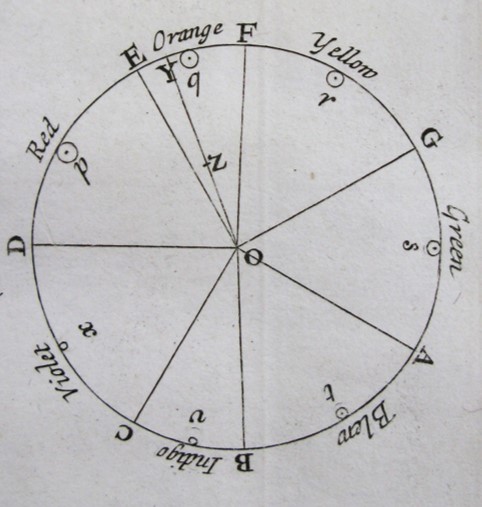
Significant 18th century colour wheels start with Sir Isaac Newton. He is widely thought to be the first person to visualise a bar of colour in circular form in his 1704 work Opticks. He shone white light through a prism and observed seven colours in different proportions. Four years later in a French artist’s manual, Traité de la peinture en mignature, the first known coloured wheels were published. Later in the 18th century the entomologist Moses Harris published his Natural system of colours in which he explored how a range of colours can be made from red, blue and yellow, building on the ideas of Jakob Christoph Le Blon. Copies of this book are very scarce and we do not have one. We do, however, have the 1772 Versuch eines Farbensystems by Ignaz Schiffermuller, also an entomologist, which features a fine wheel with 12 continuous colours.


Click on the images throughout to see enlarged versions
In the early 19th century the painter Philipp Otto Runge designed a colour sphere where pure colours would be found around the middle, scaled up to white (at the top), down to black (the bottom) and in towards grey at the core. Around the same time the famous German writer Goethe (with whom Runge corresponded) produced a major work on colour, Zur Farbenlehre, in which he challenged some of Newton’s ideas on colour. We also have the naturalist James Sowerby’s 1809 A new elucidation of colours which is more of a defence of Newton.


Colour wheels based on red, blue and yellow (RBY) continued to dominate through the 19th century and were influential for artists and the mixing of pigments. Here are a few more from our collections:


Towards the end of the 19th century other models evolved which had different numbers of divisions. For instance, the physicist Wilhelm von Bezold imagined a cone with ten divisions. The upper wheel in the image to the right would be the base of the cone and the lower wheel would be the outer surface of the cone as seen from above. The artist Albert Munsell also developed a circle with 10 divisions which could be further subdivided into 100 hues whereas the chemist Wilhelm Ostwald created a colour wheel based on four fundamental colours subdivided to 24 hues. Johannes Itten himself, a student of the influential artist Adolf Hölzel, came up with a wheel based on 12 colours, primary, secondary and tertiary (see very first image) and dismissed the need to divide colours further.
One major element of the colour wheel is the concept of contrasting complementary colours standing opposite each other.


There is a distinction to be made between RBY colour wheels and ones where the primary colours are red, blue and green, based on light rays rather than pigments. The first of these was developed by the physicist Ogden Rood and is demonstrated in The colorist : designed to correct the commonly held theory that red, yellow, and blue are the primary colors, and to supply the much needed easy method of determining color harmony by J. Arthur H. Hatt.
As a non-scientist I have come to realise that the varying and conflicting theories behind colour wheels are very complex and too lengthy to go into in a single blog post. However, all of them result in being visually pleasing representations of the relationships between colours. If you would like more detail than I have been able to give here I would recommend the following:
- The creation of color in eighteenth-century Europe by Sarah Lowengard
- Who invented the color wheel? by Parkhurst and Feller in Color research and application 7, p. 217-230
- Bright earth: the invention of colour by Philip Ball
- Color ordered: a survey of color order systems from antiquity to the present by Rolf G. Kuehni and Andreas Schwarz
Katharine Dicks
 Languages across Borders
The UL also has a number of original editions by Chevreul, who was a revolutionary in the domain (for instance https://idiscover.lib.cam.ac.uk/primo-explore/fulldisplay?docid=44CAM_ALMA21466833250003606&context=L&vid=44CAM_PROD&search_scope=default_scope&lang=en_US)
A few years ago the Musée d’Art Moderne de la Ville de Paris organised an excellent exhibition centred on Chevreul because of the influence of his colour wheel theory on Robert Delauney (and the neo-impressionists):
http://www.mam.paris.fr/en/oeuvre/rythme-ndeg1
The Musée National d’Histoire Naturelle organised a conference on the topic, of which the UL has the proceedings:
https://idiscover.lib.cam.ac.uk/primo-explore/fulldisplay?docid=44CAM_ALMA21382956360003606&context=L&vid=44CAM_PROD&search_scope=default_scope&tab=default_tab&lang=en_US
the organiser of the conference published a history of the colour wheel (among other things):
https://idiscover.lib.cam.ac.uk/primo-explore/fulldisplay?docid=44CAM_ALMA21389799570003606&context=L&vid=44CAM_PROD&search_scope=default_scope&tab=default_tab&lang=en_US
Yes, thanks for this extra information. I’m afraid I skimmed over Chevreul with just one image of his colour wheel from a later work as my blog post was in danger of becoming unmanageably long.