
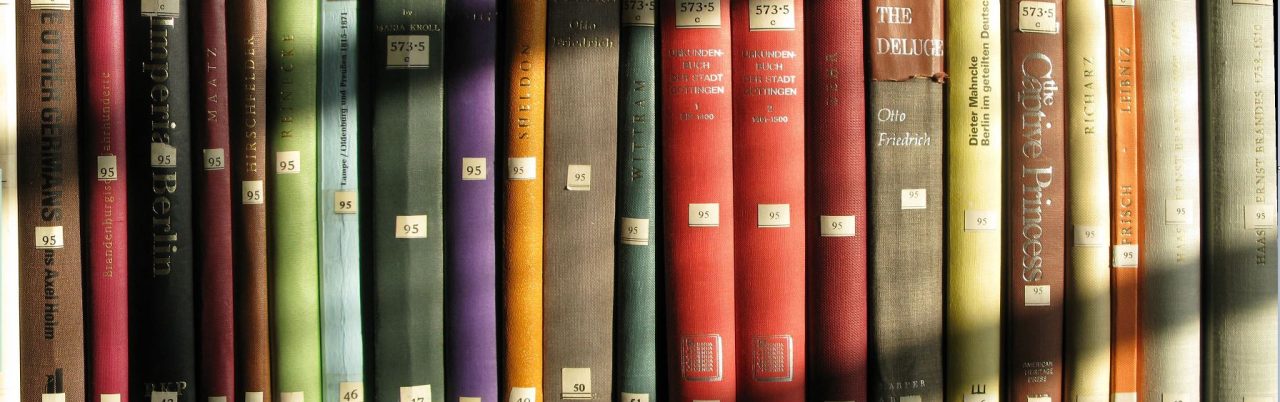
Cyrillic became the chief alphabet of the Mongolian language in Mongolia in the 1940s and has remained so to this day. “Mongolia” here refers to the independent country, an area also known as Outer Mongolia. Inner Mongolia, within Chinese borders, still uses the classic Mongolian alphabet – which, rather mind-bendingly, derives from a Semitic script. The transition to Cyrillic in Soviet Mongolia from the traditional alphabet took in Latin on the way, in the 1930s. In 1932, the famous linguist Nikolai Poppe published a text book on the Mongolian language in which he employed both the classic (here shown horizontally but normally written vertically) and Latin alphabets:


The UL holds 250-odd books in Mongolian, published chiefly in Mongolia, China, and Russia. Mongolian publications continue to be found in the shrinking Soviet-era exchange backlog mentioned in a blog post earlier this year about Georgian. One example, now catalogued, is a 1969 examination of Mongolian laudatory poetry and salutations by Pureviin Khorloo (Mongol ardyn erȯȯl; 9009.c.2846). On its title page we can see examples of the two characters which are additional to the standard Cyrillic alphabet – the straight “y” which features twice towards the end of the first line below (transliterated as a “u” with a dot above) and the theta-style letter which features twice towards the end of the second line (transliterated as “o” with a dot above). The Library of Congress provides a transliteration guide for extra Cyrillic letters employed for non-Slavic languages; this can be found here.
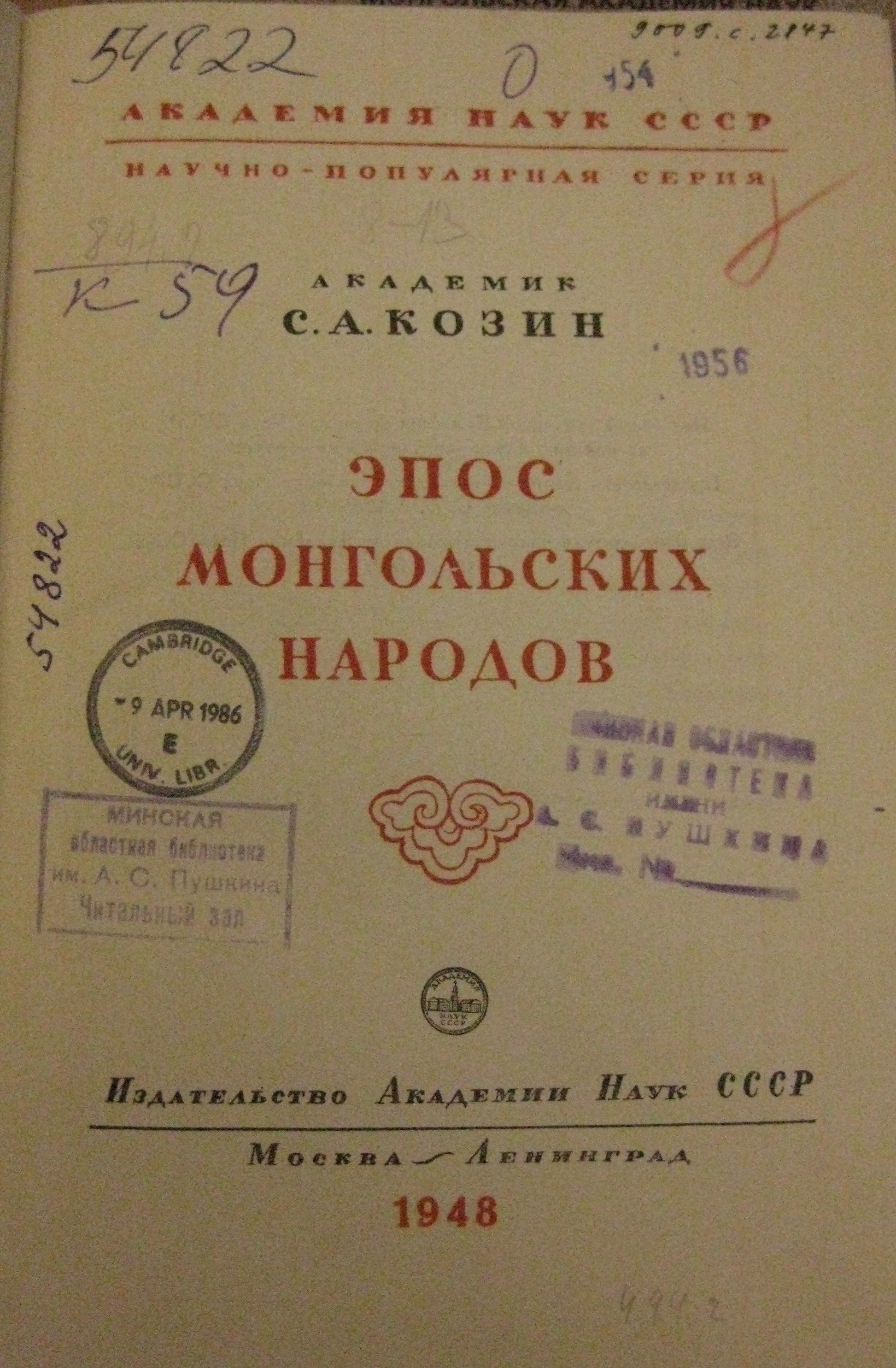
 Another book now added to the catalogue from that backlog is a 1956 Russian publication by S.A. Kozin about Mongolian epic literature. This I could not resist including here for its title page, rather beautifully vandalised over the years by many librarians adding their mark. Library stamps and classmarks proliferate, with the chief culprit the A.S. Pushkin Minsk Regional Library, from whose collections the more retiring UL was fortunate enough to receive this volume.
Very few books in Mongolian enter the Library’s collections today. In the past 10 years, 13 titles have been added. Among the most recent is a striking Mongolian-English bilingual book called ‘Valuables of Xiongnu Empires and Bronze Age’, full of pictures of treasures (see below; classmark to be added). The archaeology that helped find so many of them is an area which sees significant continued expenditure on Russian books about Mongolia. Soviet-era (and earlier) archaeological work in East and also Central Asia was widespread and highly regarded, as were area studies in ethnology and other social science disciplines, and the Soviet academics’ successors continue to lead much of the most significant work on this part of the world. These strengths are reflected in the UL’s impressive Russian holdings on the subjects. Among recent examples are ‘Aktual’nye voprosy arkheologii i etnologii TSentral’noi Azii’ (Topical issues of archaeology and ethnology of Central Asia (2015); to be catalogued shortly) and ‘Tiurko-mongol’skii mir v proshlom i nastoiashchem’ (The Turko-Mongol world past and present (2016); C213.c.3421).


Mel Bach
 Languages across Borders
Lots of comments to this post, discussing inaccuracies and oversimplifications as well as going off on interesting tangents, are here.