
On 25 April this year Italy celebrates the 70th anniversary of Liberation Day, now a national holiday commemorating the end of the Nazi occupation and of the Second World War.

The Nazi occupation of Italy followed the armistice between Italy and the Allied armed forces on 8 September 1943. Whilst the German army was fighting to get control of the main cities of the Italian peninsula, the antifascist movements, which had been secretly operating against Mussolini’s regime for over 20 years, gathered under the umbrella of the Comitato di Liberazione Nazionale or CNL (National Liberation Committee). The CNL eventually represented the Italian Resistance movement: all the partisan forces active on mountains, in the countryside and in urban areas, for a total of 70,000-80,000 people by May 1944. These groups were all moved by different ideologies – communists, monarchists, socialists, liberals, republicans, anarchists, Catholics – but they were all antifascist. They took the form of underground movements in cities and of guerrilla on mountainous regions and carried out actions of various kinds such as sabotages, armed attacks, occupations of villages and small cities, with the support of civilians and of the Allied forces through air supply dropping operations.
Meanwhile, the Allies organised an invasion of the Italian mainland (they had already taken Sicily in July) and by October 1943 they gained the whole of Southern Italy; they liberated Rome in June 1944, and Florence in August. The North of Italy officially became a satellite state of Germany (Repubblica Sociale Italiana) led by Benito Mussolini, while the Italian royal family fled south. The long winter of 1944-45 led to the offensive of spring 1945 and finally to April 25, when two of the main cities in the North, Milan and Turin, were liberated. The rest of the country was free by 1 May, although 25 April was later chosen as a day representing the end of the war, the end of fascism and the beginning of the path that led to the referendum of 2 June 1946 in which Italians voted for the end of the monarchy and in favour of the creation of the Italian Republic.
The Italian Resistance movement, or Resistenza, was made up of hundreds of young men and women who voluntarily decided to put their lives at risk between September 1943 and April 1945. The Resistenza is the subject of countless novels, often written by those who had been partisans themselves, depicting the tragic experience of the civil war. The UL holds many of those novels which became classics such as:
-
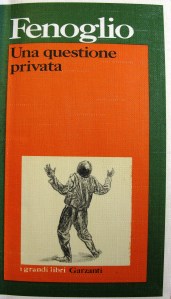
Una questione privata by Fenoglio (741:39.d.95.11) Elio Vittorini’s Uomini e no (1945), an experimental and complex novel on the Milanese partisans;
- Italo Calvino’s Il sentiero dei nidi di ragno (1947; and a 1973 English translation), the coming-of-age story of a child among fascists and partisans;
- Luigi Meneghello’s I piccoli maestri (1964), an account of Meneghello’s experience on the mountains of Veneto;
- Beppe Fenoglio’s short stories and masterpieces Una questione privata (1963, and a 1988 English traslation) and Il partigiano Johnny (1968, and a 1973 English translation), set on the Langhe hills in the north west of the country.
The Library has recently acquired In territorio nemico, a novel on the Resistenza published in 2013. In territorio nemico was written with a technique called scrittura collettiva, or collaborative fiction: with its 115 participants, it has more authors than any other novel.
The Italian resistance movement and the partisan war is a chapter of Italian history which is not free from controversies. Not only was the Resistenza a fight against the German invaders but also a civil war amongst Italians, between fascists and anti-fascists: this is one of the reasons why it is still at the centre of historical research. The bibliography on this subject is vast, but it’s worth having a look at the latest trends. Among the books published in 2014 the UL holds items on:
- Relationships between Partisans and Allies: La Resistenza italiana e lo Special Operations Executive britannico (1943-1945) by Mireno Berrettini;
- Urban underground movements: Storie di Gap: territorio urbano e Resistenza by Santo Peli;
- Case studies: Il caso Facio: eroi e traditori della Resistenza by Luca Madrignani;
- Anarchists: Gli anarchici nell’età repubblicana: dalla Resistenza agli anni della Contestazione, 1943-1968 by Pasquale Iuso;
- Alternative interpretations of the civil war: Bella ciao: controstoria della Resistenza by Giampaolo Pansa;
- Resistance in the Abruzzo region: Dalla Maiella alle Alpi by Costantino Felice;
- Memoir of a woman partisan: Partisan diary: a woman’s life in the Italian Resistance by Ada Gobetti, translated and edited by Jomarie Alano (Italian original: Diario partigiano).
If you feel like you want to know more on the Resistenza but don’t know where to start, Philip Cooke’s The legacy of the Italian Resistance is a good introduction; an excellent interpretation of Italy’s approach to its own history is provided by John Foot in his Italy’s divided memory.
Federica Signoriello
 Languages across Borders