
In 2008 Brepols began to publish the 75 notebooks used by Marcel Proust between 1908 and his death in 1922 – Marcel Proust : cahiers 1 à 75 de la Bibliothèque nationale de France. The notebooks consist of some 8,000 handwritten pages, which are of fundamental importance for any study of the genesis of À la recherche du temps perdu. Barely a quarter had been published previously.
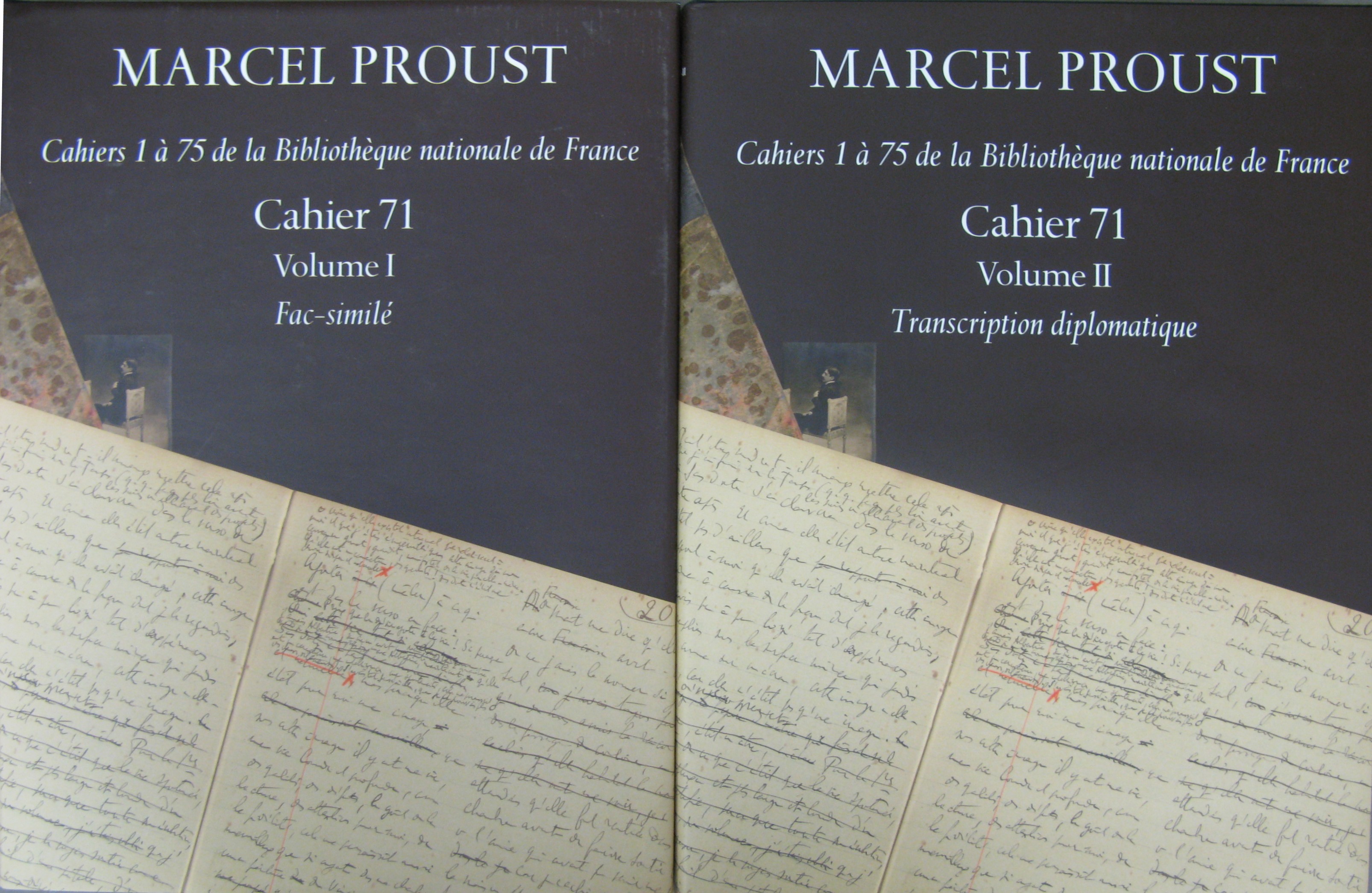
The cahiers are not being published sequentially. First to appear was cahier 54, which dates for the most part from 1914, approximately halfway through the composition of À la recherche du temps perdu. It deals almost entirely with the disappearance of Albertine and its aftermath. Three more cahiers have been published subsequently, numbers 26, 53 and 71.
Each notebook is published in 2 volumes. Volume 1 is a high-quality colour facsimile of each handwritten folio of the cahier, complete with the paperoles, fully unfurled, and the papiers collés, which Proust pasted into the margins and over existing text, as he obsessively reworked individual passages of the novel. Volume 2 consists of an exhaustive typographical representation and a detailed critical apparatus, introduction and index.
In her review in the Modern language review Margaret Topping comments –
The importance … of the cahiers for scholars working in the field of genetic criticism is immeasurable. These volumes also offer a fascinating addition to Proustian scholarship more generally by making such high-quality and meticulously annotated reproductions accessible outside the BnF.
In his review in French studies Thomas Baldwin writes –
The importance of this work cannot be overstated. It will be of interest to anyone working on Proust (and not only to the more ‘genetically’ inclined scholars) and on modern European literature in general. It also sets a clear standard for future manuscript transmissions.
Some users may be surprised that it has taken Cambridge six years to take out a subscription to a publication of such fundamental importance. Our tardiness is solely on grounds of cost. The two volume set of each cahier costs between 200 and 250 euros. Given the expenditure, the set has been placed on closed access, standing at S950:01.b.154.1-, and will be fetched to the West Room. We sincerely hope that this will not inhibit use.

Scholars may lament the slow rate at which the notebooks are being published. Thomas Baldwin writes –
One is left wondering how many volumes in the series will appear in one’s lifetime and frustrated by the prospect of not living long enough to see the complete set.
For the Head of European Collections the slow rate of publication is rather a relief, affording Cambridge the opportunity to build up the set without imposing too great a dent on the French budget in any one year.
David Lowe
 Languages across Borders