Ukraine, Gorbachev, and nuclear power

This week, the news from Ukraine has been tentatively positive, as the concerted counter-attack against the Russian army in the south of the country has been getting under way.  But ongoing concerns about the situation at the Zaporizhzhia Nuclear Power Plant have also been in the headlines as, of course, has been the death of Mikhail Gorbachev.

Gorbachev was adored and hated for the actions he took and for the events that happened during his time as Soviet leader.  It was Yeltsin who formally acknowledged Ukrainian independence, but Gorbachev’s time that saw the circumstances of the Soviet Union shift towards that possibility.  Largely praised abroad for bringing the Cold War to a close, Gorbachev is remembered in some former Soviet countries chiefly as the overseer of violent suppressions of pro-independence activities in 1989 and 1990.  For those who mourned the loss of the Soviet Union, Gorbachev was also a guilty party.

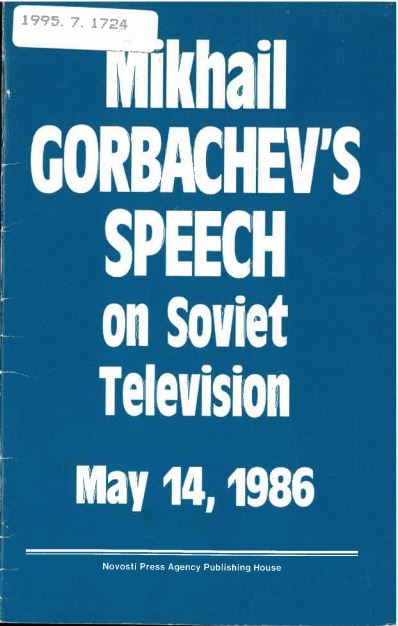
The fears about the Zaporizhzhia nuclear station, currently occupied by Russian forces. are of course particularly troubling in the context of the nuclear disaster in Ukraine 36 years ago.  The item shown here, Mikhail Gorbachev’s speech on Soviet television, May 14, 1986, contains the translated text of the speech he made in the light of the appalling accident that had occurred on 26 April at Chornobyl’ (Ukrainian; Chernobyl’ in Russian).  The 14 May speech was the first full statement by the Soviet leader about what had happened weeks before. Continue reading “Ukraine, Gorbachev, and nuclear power”
Ukrainian Independence Day

З Днем Незалежності України! = Z Dnem Nezalez︠h︡nosti Ukraïny! = Happy Ukrainian Independence Day!  We have three books in the catalogue with the specific Library of Congress subject heading Ukraine–History–Independence proclamation, 1991 (August 24):

But we have hundreds more under the headings Ukraine–Politics and Government–1991- and Ukraine–History–1991-, many of which could arguably have the specific proclamation LCSH added. Continue reading “Ukrainian Independence Day”

Russian ‘publications provocateurs’ and the war against Ukraine

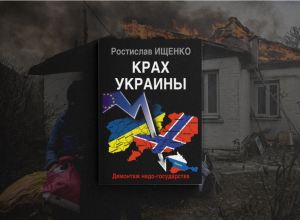
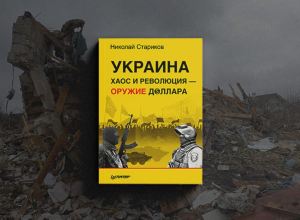
In a previous post, I referred to the years-long pattern of publishing in Russia of “popular” titles undermining Ukrainian sovereignty.  I was reminded of the subject in an excellent seminar held yesterday called On the Cultural Front: Ukrainian Publishers in the Time of War, which saw three Ukrainians prominent in the publishing world – Iryna Baturevych, Yulia Kozlovets, and Halyna Lystvak – interviewed by Ksenya Kiebuzinski of the University of Toronto.  A recording of the seminar has been put online here: https://www.youtube.com/watch?v=QTnBj0stpzc

Iryna is the co-founder of Chytomo (literally ‘Let’s read’) which now has its site in English too.  Chytomo provides important, useful, and interesting news and information about Ukrainian publishing and more – including advice and suggestions about how Ukrainian material might be made available abroad in the original Ukrainian and in translation.  During yesterday’s seminar, Iryna provided a link to a Chytomo piece about the kinds of Russian publications that I had referred to previously, called Fifty anti-Ukrainian propaganda books: How Russian publishers stoke hatred against Ukrainians.  The article is topped and tailed with analysis, but its main body provides the quite shocking blurb of each of the 50 books in English and shows each book cover with an image from the Russian war in Ukraine as the backdrop, as the sample screenshots here show.

Continue reading “Russian ‘publications provocateurs’ and the war against Ukraine”

Ukraine and films in the Klassiki database : the August 2022 Slavonic items of the month

Last year, Cambridge University Libraries started providing access to the Klassiki database of films from Eastern Europe, Russia, the Caucasus, and Central Asia.  The subscription was started specifically to support courses taught under the auspices of Film Studies and/or Slavonic Studies.  In its own words: “Klassiki hosts a highly curated permanent collection of films that represent the best of classic filmmaking from the region. We also offer a brand new ‘Pick of the Week’ contemporary title, selected by the curatorial team. Each of our films are accompanied by programme notes, journal essays, newly commissioned subtitles and online interviews with the best filmmakers from the region.”

In terms of Ukraine, the Klassiki database currently has 6 films in its Ukraine section.  It did have a 7th – the documentary film Mariupolis (2016) directed by Mantas Kvedaravičius.  As readers will probably already know, that film was about the experience of Mariupolʹ under fire from Russian-backed separatists, and its director was tragically murdered there this year in March, a victim of the 2022 full-scale war.  He had been in the city to make a sequel.  The 2016 film is no longer on Klassiki, since ARTE.tv have been able to license it to make it fully and freely available on YouTube here.  Kvedaravičius’ 2013 Cambridge PhD thesis, Knots of absence : death, dreams, and disappearances at the limits of law in the counter-terrorism zone of Chechnya, is at the Haddon Library and in the Library Storage Facility, and here is his home department’s tribute to him.

The Ukrainian films on Klassiki were made in Ukraine and chiefly by Ukrainian directors, with one in Ukrainian (and Hutsul), two silent, and three in Russian.  They include two films by Kira Muratova, two by Oleksandr Dovz︠h︡enko, one by Serhiĭ Paradz︠h︡anov (Sergei Parajanov here), and one by Marlen Khut︠s︡iev (who Cambridge was fortunate enough to host in a 2014 visit).  The films’ descriptions from Klassiki follow. Continue reading “Ukraine and films in the Klassiki database : the August 2022 Slavonic items of the month”

Ukraine and anti-war Russians in ‘Novaia Gazeta’

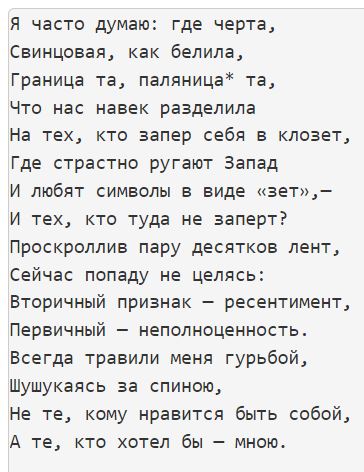
The first stanza of Bykov’s poem.

Subscribers to this blog will have seen a reblog earlier in the week from the CUL Electronic Collections Management site announcing access to the Russian-language newspaper Novaia Gazeta.

The Russian war against Ukraine was not only the focus of the paper in its final weeks in Russia before it closed but of course also the reason for its closure, as Russian governmental pressure relating to the so-called “special military operation” made it impossible for the newspaper to perform its duties properly.

The paper appears three times in our A-Z databases list (all three here) because East View, the platform via which we have access, provides the years 1994-2021 as a single digital archive, while providing access to the first few months of 2022 as another, and the new Europe edition as a third.  The Europe edition started in Riga in early May, while the last Russian edition appeared in late March, a few days before the atrocities committed in Bucha were revealed.  The latest horrors, including the torture of a Ukrainian POW, are now covered in the most recent Europe issue (but note that an ’18+’ tag is applied to articles with distressing images – take the warning seriously). Continue reading “Ukraine and anti-war Russians in ‘Novaia Gazeta’”

Vpered, Ukraïno! = Forward, Ukraine!

This brief blog post looks at a publication produced in France which we hold in the Library in the Peter Yakimiuk collection.

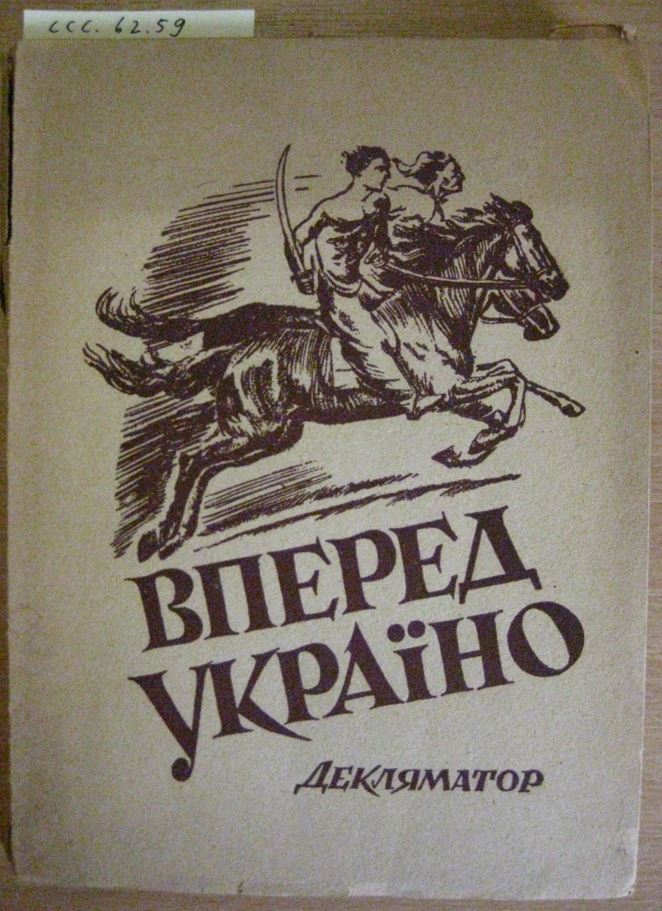
Vpered, Ukraïno! (note the vocative form of the country name) was published in Paris by the group Ukrainian National Unity in France, in their Library of Self-Enlightenment, and describes itself in its sub-title as a narodnyĭ deklamator, a folk reciter.

The book contains Ukrainian poems by Taras Shevchenko, Ivan Franko, Oleksander Olesʹ, and many more.  Lesi︠a︡ Ukraïnka (1873-1913) has the greatest number of poems in the compilations.  Brief biographical notes of the authors follow the body of poems, and looking at these more closely today, I see that the approximate date of publication given to the book (1945) must be wrong – the writer Leonid Mosenda’s entry refers to his death in 1948 – so I will update it it in the catalogue now.

The book has come up in connection with preparations for a small exhibition we hope to curate in the autumn with the local Cambridge refugee community – more details when we know them! – which will celebrate Ukrainian culture and history.  The cover is fairly eye-catching, but it’s the encouragement of the title that understandably attracts us in 2022 as Ukraine fights on.  Vpered, Ukraïno!

Mel Bach

A couple of Ukrainian music titles

The week before last, I wrote about a small guide to the Museum of Ukrainian Culture in the Slovak village of Svydnyk.  Today, I bumped into two related books, one of which needed a major overhaul of its catalogue record.

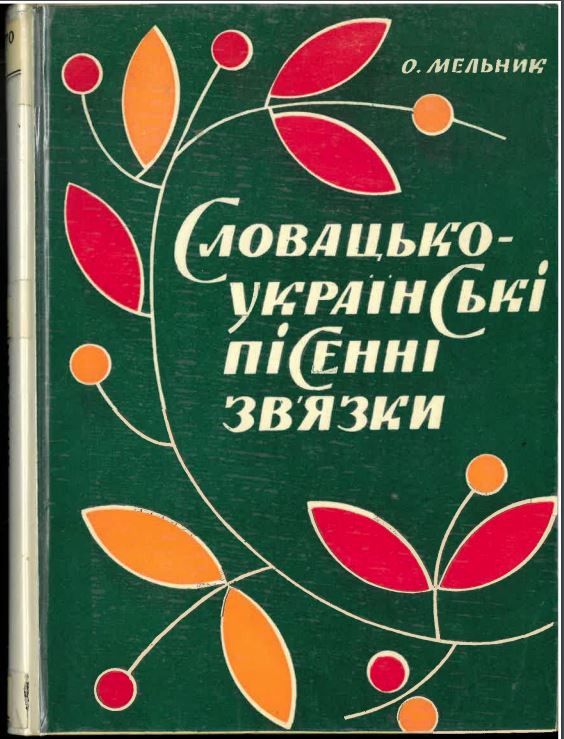
Slovat︠s︡ʹko-ukraïnsʹki pisenni zv’i︠a︡zky (Slovak-Ukrainian song links/connections), written by Oksana Melʹnyk and published in 1970, even had a typo in its first three letters, with SLO provided as SOL. Continue reading “A couple of Ukrainian music titles”

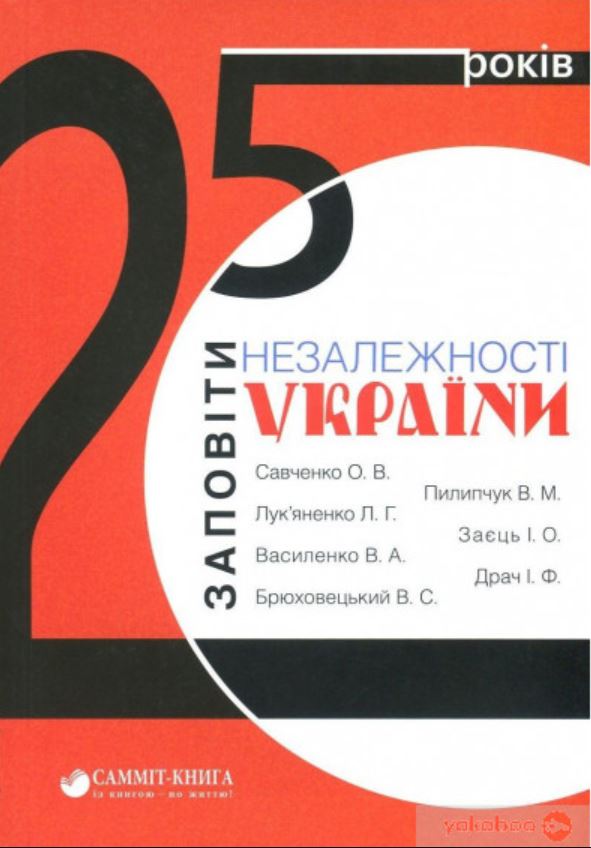
New Ukrainian books about the world before 2022

To our joy, several boxes of Ukrainian books were received recently from our supplier.  They are largely publications from 2020 and 2021, so the 2022 full-scale invasion of the country by Russia is not yet reflected.  That said, some of these new arrivals are of course books about the state of post-Soviet Ukrainian politics and history, Ukrainian-Russian relations, and the events of 2014 onwards.  A selection of such titles, newly in the catalogue, is briefly described below.

Continue reading “New Ukrainian books about the world before 2022”

Slovakia’s Museum of Ukrainian Culture

The Ukrainian-Slovak border is 60 miles long and lies largely in the Carpathians.  Communities near the border on both sides often reflect in their demographics the ethnic history of the area, with Ukrainians, Slovaks, and Rusyns present.  There are also more institution-based signs of this diversity; another 60 miles or so on the Slovak side of the border is the village of Svidník (Свидник/Svydnyk in Ukrainian), where the Museum of Ukrainian Culture is to be found.

Continue reading “Slovakia’s Museum of Ukrainian Culture”