A passport to the lands of the tsar : the December 2014 Slavonic item of the month

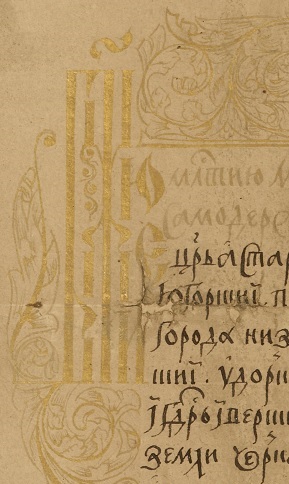
The gilt lettering which starts the text of the passport.

The December Slavonic item of the month is a 1652 travel permit issued in the tsar’s name to English merchants.  A star piece in the Library’s small Russian manuscript collection, it was the subject of a recent informal session with Slavonic Studies postgraduates during which we grappled with handwriting, abbreviations, and an anno mundi date.

This week, three postgraduate students in the Department of Slavonic Studies came to the University Library to look at our early Russian manuscript holdings.  There are only a few of these, but it was a fascinating session.  Most of our time was spent studying a Russian travel permit (referred to in the catalogue and also in this piece as a passport) granted in 1652.
Continue reading “A passport to the lands of the tsar : the December 2014 Slavonic item of the month”
‘Rivers of blood’ : illustrating violence and virtue in Russia’s early modern empire

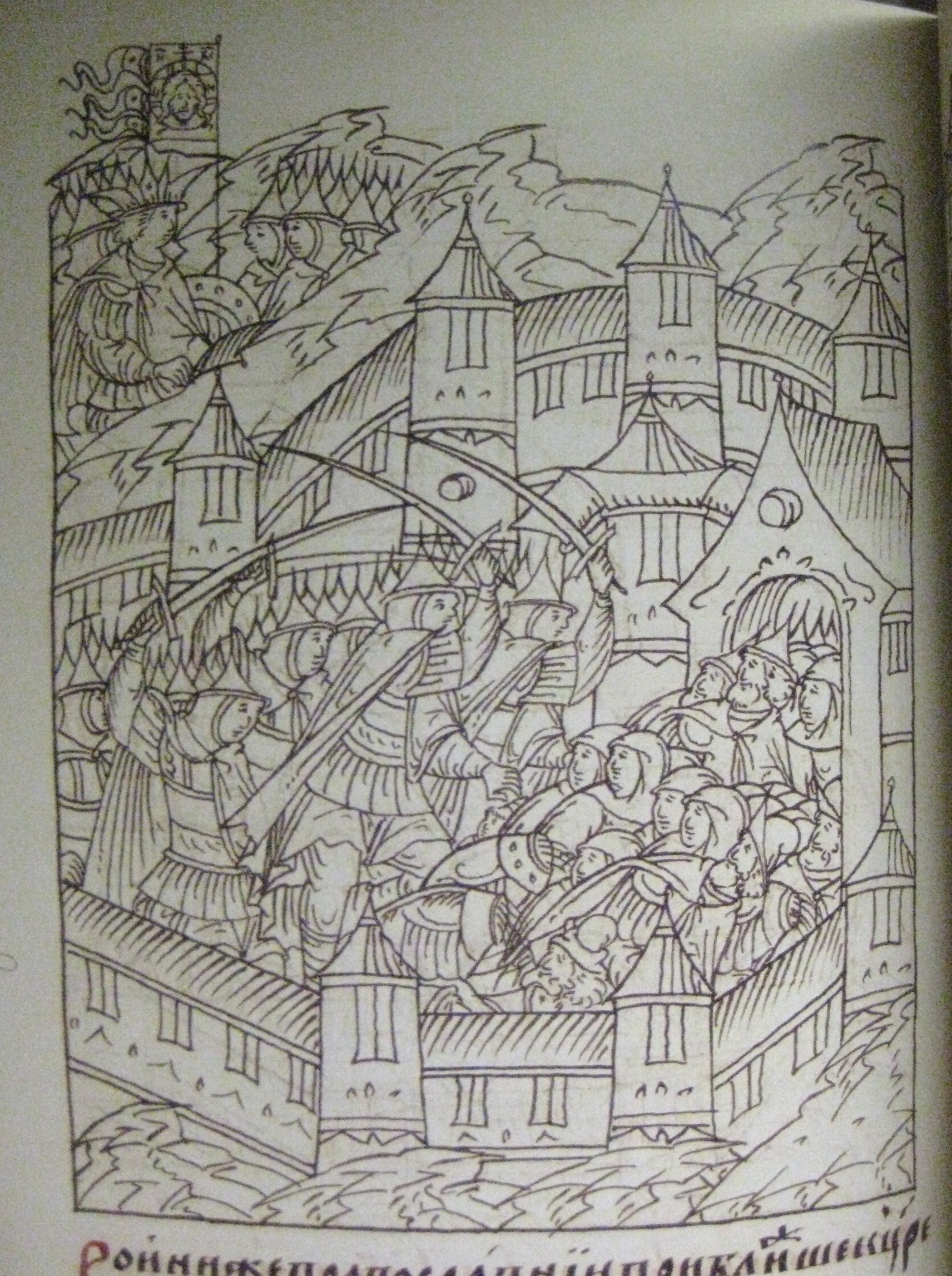
The Kazan slaughter, in v. 21 of the
The Kazan slaughter, in v. 21 of the Litsevoi letopisnyi svod (F200.a.14.21)

The latest CamCREES seminar saw Professor Kivelson of the University of Michigan discuss depictions of just and unjust violence in early illustrated histories of Muscovite Russia.  The bibliographical notes go on to look at the 40-volume Litsevoi letopisnyi svod chronicle, one of the University Library’s most significant Slavonic purchases (in facsimile reprint) of recent years.

The first three of the four CamCREES seminars this term have seen a march back in time.  From the Soviet films of the first seminar we moved to the 18th century in the second, and Professor Kivelson took us all the way back to 16th-century Muscovy and its eastward expansion in the most recent talk.  Russian writers from the period, she explained, didn’t pursue the kinds of moral consideration about conquest that can be seen in the work of western writers such as Hobbes and Locke.  Some of this gap, though, might be filled to some degree by close examination of visual depictions of imperial expansion. Continue reading “‘Rivers of blood’ : illustrating violence and virtue in Russia’s early modern empire”

The persistence of the eighteenth century in the Russian cultural imagination

wewewe
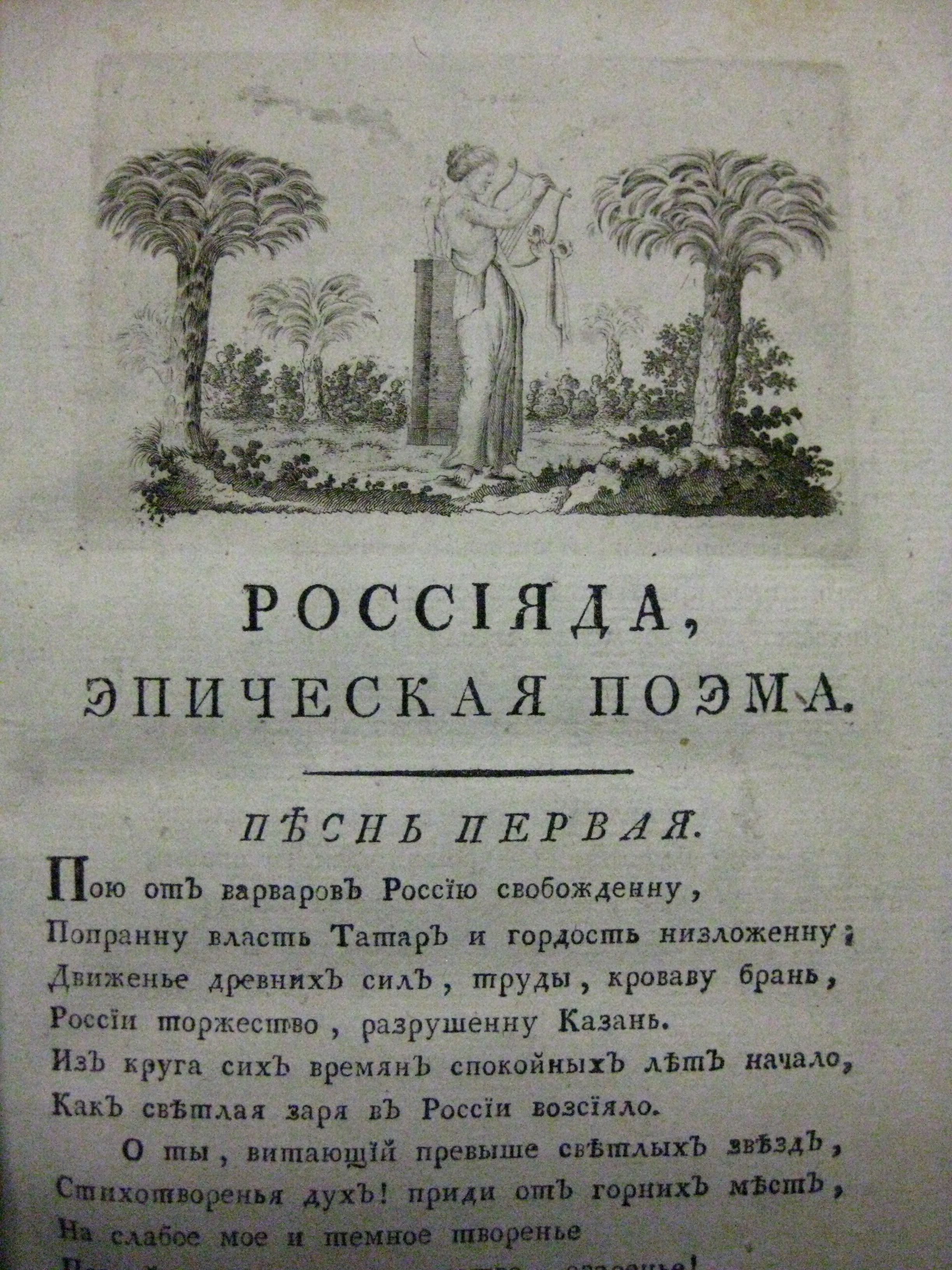
The first lines of Rossiiada by Mikhail Kheraskov (7756.c.1)

The second 2014/15 CamCREES seminar saw Professor Luba Golburt of UC Berkeley speak about the paradox of the obscurity and tenacity of the 18th century in the Russian cultural and historical imagination.  These notes go on to look at her question of the Russian 18th century’s true length, in terms of classification and subject headings.

Russian literature’s “Golden Age” was the 19th century, exemplified by Pushkin, the poet described to this day in Russia as nashe vse (our everything).  Professor Golburt’s absorbing talk looked at the way in which the epoch which preceded it, the 18th century, both fell into undeserved obscurity and yet also cast an enduring shadow long after it ended.  The talk was based on Professor Golburt’s recently published book, The first epoch : the eighteenth century and the Russian cultural imagination (the University Library’s copy is electronic and can be accessed by Library readers from this LibrarySearch record). Continue reading “The persistence of the eighteenth century in the Russian cultural imagination”

Modeling Moscow : life, architecture, and the composite shot in Soviet films of the 1930s

Professor Anne Nesbet opened the new academic year’s CamCREES seminar series with a wonderful talk on Moscow architecture and Soviet films.  In these bibliographical notes for the talk, we take the opportunity to look at books about the legendary Palace of the Soviets, the megalithic giant planned for central Moscow but never completed.

Frame diagram of the Lenin statue to stand at the top of the Palace of the Soviet (Atarov, Dvorets Sovetov; CCC.54.383)
Frame diagram of the Lenin statue to stand at the top of the Palace of the Soviets (Atarov, Dvorets Sovetov; CCC.54.383)

The 2014/15 set of CamCREES seminars started on 14 October with a fascinating talk by Professor Nesbet, in which she demonstrated that close readings of the “complicated composite shots” some 1930s Soviet films contained of Moscow’s architectural future could tell us “not only about the techniques used to construct such visions of the future, but also about cinema’s relationship to architectural history and architecture’s reciprocal interest in animation” (text taken from the talk’s abstract).  Professor Nesbet works in the Department of Film & Media at UC Berkeley.  Her 2007 book Savage junctures : Sergei Eisenstein and the shape of thinking is in the University Library’s South Front (415:3.c.200.1917).

Continue reading “Modeling Moscow : life, architecture, and the composite shot in Soviet films of the 1930s”

Slavonic item of the month : July 2014

The Russian and Ukrainian publishing markets have been quick off the mark to produce books which relate to the ongoing Ukrainian crisis.  For this month’s feature, we look at two specific examples, one from each country, and we also look at how library catalogue subject headings might be used for material on events in Ukraine.

Euromaidan and Crimea have become major subjects in the Ukrainian and Russian book markets, and the ongoing crisis in eastern Ukraine will no doubt follow suit as soon as manuscripts can be found which fit the bill.  The speed with which publications have appeared certainly make the University Library’s Slavonic book selector cynical, but the importance of our collections containing examples of books published in immediate reaction to such extraordinary events is not in doubt.

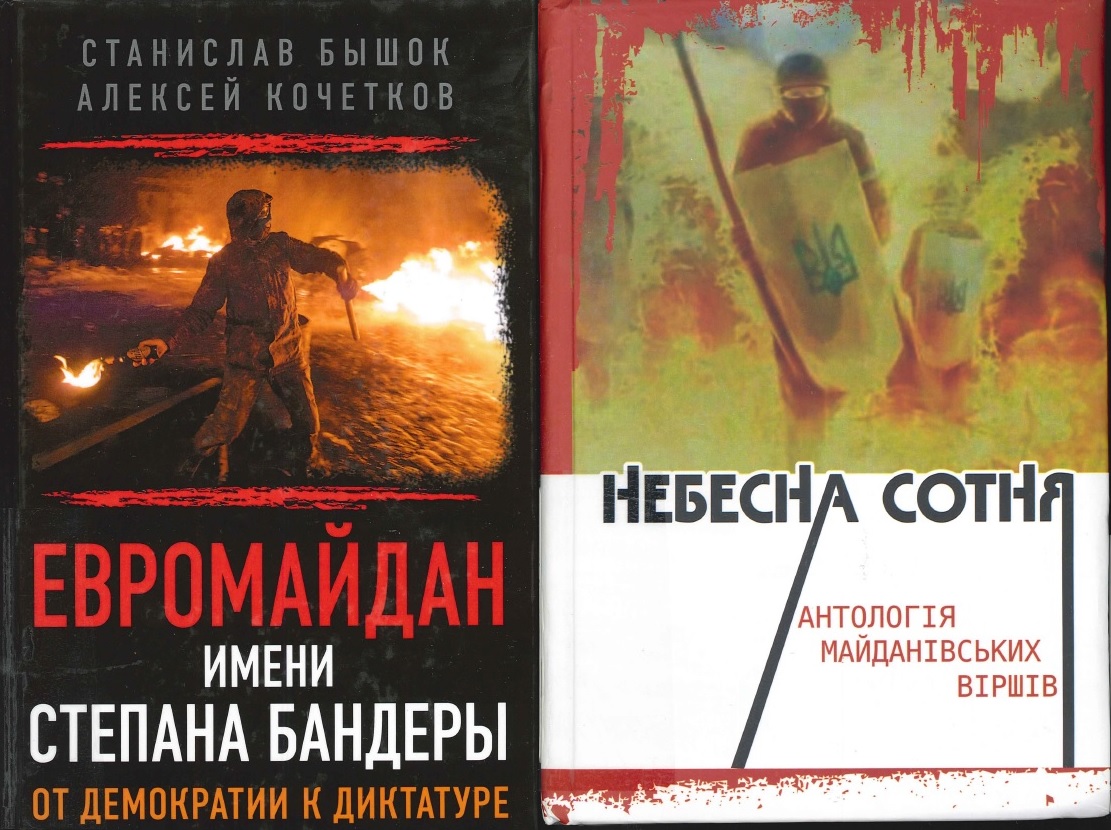
The front covers of Evromaidan imeni Stepana Bandera (left) and Nebesna sotnia (right)
The front covers of Evromaidan imeni Stepana Bandery (left) and Nebesna sotnia (right)

The two main examples featured here both relate to the Euromaidan protests which ultimately led to Ianukovych’s removal as president of Ukraine.  Through their covers, they are immediately illustrative of the extremely diverse views of the Maidan – were the protestors violent fascists or patriotic defenders?  The book on the left is Evromaidan imeni Stepana Bandery : ot demokratii k diktature (The Stepan Bandera Euromaidan : from democracy to dictatorship; C203.d.7080), a Russian-language study of right-wing extremism in Ukraine by Stanislav Byshok and Aleksei Kochetkov.  The book on the right is Nebesna sotnia : antolohiia maidanivs’kykh virshiv (The heavenly hundred : an anthology of Maidan poems; C203.d.7081), a volume of poems collected in memory of those who died during the Euromaidan protests.  The Molotov cocktail and bat in the hands of the protestor in the first have turned into a spear and a shield showing the Ukrainian trident in the second.  While the first is surrounded by fire and anarchy, the second marches with a companion – presumably towards the Berkut, the loathed riot police.

Continue reading “Slavonic item of the month : July 2014”

Slavonic item of the month : June 2014

The subject for June 2014 is Iurii Andropov, the Soviet head of state in the wake of Brezhnev’s death, who was born 100 years ago in June 1914.  When Andropov died nearly 70 years later, in February 1984, he had been in power for only 15 months. We look at two fictional works about him.

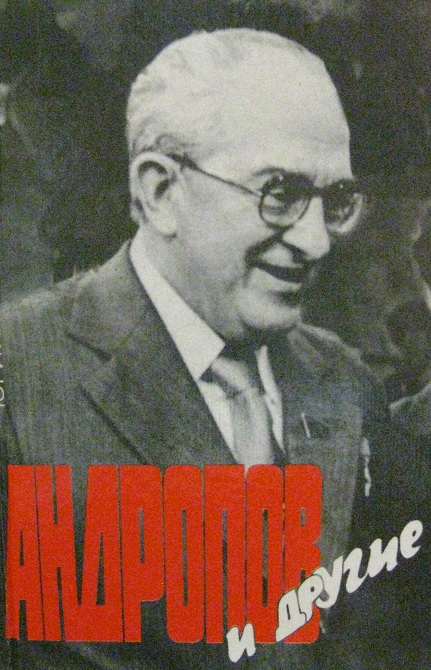
Cover of Iurii Teshkin's /Andropov i drugie/(Andropov and others; 9003.d.1849 )
Cover of Iurii Teshkin’s Andropov i drugie (Andropov and others; 9003.d.1849

Although Iurii Vladimirovich Andropov led the Soviet Union for only a short time, his was already a well-known name when he took power in late 1982.  He had been linked to the repression of the Hungarian Revolution in 1956 (Andropov was the Soviet ambassador to Hungary from 1953 to 1956) and to other international military interventions such as the putting down of the Prague Spring in February 1968.  By 1968, Andropov had become the head of the KGB, a position he was to hold for 15 years.

On the basis of Andropov’s pre-leadership career, then, he was seen as a Soviet hawk – and one with a KGB background to boot.  Stories from his leadership, though, suggest a possibly more liberal side.  A search for Andropov Gorbachev on our LibrarySearch+ catalogue of electronic resources, for example, comes up with a hit for a Guardian article from 1991 which reports a revelation by a government aide that Andropov saw the progressive Gorbachev as his successor and not the conservative Chernenko.

The uncertainty of what Andropov might have achieved had he not died so quickly after coming to power might, then, explain why two of the University Library’s holdings about Andropov are works of fiction.

Continue reading “Slavonic item of the month : June 2014”

‘Sovetskaia kul’tura’ digital archive

Thanks to strong support from academics and students following the February blog post advertising trial access to the Sovetskaia kul'tura digital archive, the University Library's Accessions Committee agreed to purchase permanent access to the archive, with financial support from money left to the Library by Dr Catherine Cooke.  The purchase was made later in the spring, but it is only in the last few weeks that the digital archive has been fully updated from the pre-purchase state it had been in.

SK stamp section_20140624
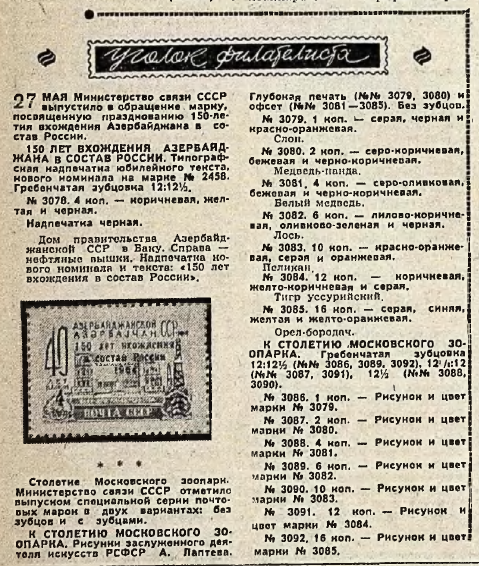
Screenshot of the philately section of the 25 June 1964 issue of Sovetskaia kul’tura.

The archive contains as full a set as East View have so far been able to amass of the various titles under which the current weekly newspaper Kul'tura has been published.  The earliest title was Rabochii i iskusstvo (Worker and art), which started in 1929, followed by Sovetskoe iskusstvo (Soviet art); this title ran from 1931-1953, with the exception of some of 1942-1944 when Literatura i iskusstvo (Literature and art) was used instead), and Sovetskaia kul'tura (Soviet culture; this ran to 1991, after which the current name, Kul'tura (Culture), was adopted).  Any gaps in the collection are detailed within each title's main page, but East View assure us that the search for all remaining copies and also for better copies of issues which have scanned poorly will continue.  As with other East View digital archives, the Sovetskaia kul'tura archive contains scanned pages which are text-searchable in Cyrillic and in transliteration.

Continue reading “‘Sovetskaia kul’tura’ digital archive”

Slavonic item of the month : May 2014

This month, we look at a 2011 set of poetry by Lev Rubinshtein printed on hundreds of index cards, replicating Rubinshtein’s own kartoteka (card catalogue) approach to the physical recording of his poetry.  The piece starts off with a reflection on this year’s Victory Day and Rubinshtein’s role as a dissident figure in modern Russia. 

Cards from Lev Rubinshtein's Chetyre teksta iz Bol’shoi kartoteki (2014.6.85-88)
Cards from Lev Rubinshtein’s Chetyre teksta iz Bol’shoi kartoteki (2014.6.85-88)

This month saw Victory Day on May the 9th, originally the Soviet annual celebration of the end of World War II and still celebrated by many post-Soviet states, Russia primary among them.  Given the appalling military and civilian losses caused by the Eastern Front and its attendant atrocities, this day of celebration is always painfully underscored by the unparalleled cost of victory.  For many in Eastern Europe, memory of the war has the awful added dimension of a particularly complex relationship with the Soviets and Nazis.  The continued turmoil in Ukraine has shown both how little the ghosts of the 20th century seem to have been put to rest and also how quickly people jump to exploit them, using sweeping generalisations and heightened emotional language to cause further division and mutual resentment.

The 2014 Victory Day was therefore a source of concern and nervousness for many, with the emphasis on WWII history having been a major factor in the stirring up of public opinion over the Ukrainian upheaval and the incorporation of Crimea into Russia.  On the day, news agencies focused on the prolonged Red Square military parade and Putin’s visit to Crimea.  With headline-grabbing political posturing and extreme public opinions on offer, there was little appetite in the press to focus on the more thoughtful and sober marking of an emotional and difficult day of remembrance by ordinary people.  And this is where Lev Rubinshtein comes in.

Continue reading “Slavonic item of the month : May 2014”

Slavonic item of the month : February 2014

Pesenka shkol'nogo uchitelia (CCD.54.315)
Pesenka shkol’nogo uchitelia (CCD.54.315)

Russia’s recent PR hasn’t been good, despite (and sometimes because of) the Sochi Olympics.  Sochi itself was even the location of the Putin/Ianukovych meeting often considered the catalyst for the shocking events we have seen unfold in Ukraine.  So what did the Olympic opening ceremony have to say in favour of Russia?  Rather a lot.

The Sochi 2014 opening ceremony did not attract total approval.  Many news sites and commentators focused on the failure of the fifth snowflake to turn into an Olympic ring (a technical failure nicely taken off in the closing ceremony held last night, with a will-it/won’t-it sequence mirroring the original).  Many also focused on the surprising/unsurprising involvement of Alina Kabaeva, rumoured to be Putin’s partner, in the finishing stages of the torch relay.  Others, though, found more interesting food for thought.  This University of Nottingham blog post, for example, looks at the way in which the ceremony’s representation of Russian history and culture played to domestic and international audiences.

The ceremony opened with the azbuka, the Russian alphabet.  Each letter was paired with someone or something related to it, even if not always straightforwardly (the use of Pushkin for the letter ъ (the hard sign, a letter whose use was significantly curtailed by the early Soviet orthography reforms but which had previously been very common (Pushkin’s own name would have ended with it during his lifetime)) was a bit of a stretch).  The azbuka sequence works well as a section to look at in more detail, since its make-up is representative of the broader issues of a ceremony which celebrated Russian history and culture – including the choices the organisers made about what to include.

Continue reading “Slavonic item of the month : February 2014”

Anthropology in the Russian language

The latest CamCREES notes cover the panel session on 4 February at which four anthropologists discussed being published in different languages and countries – a fascinating insight into linguistic practicalities and also into something rather deeper: the different worlds that anthropology inhabits in different places.  The notes then consider acquisitions of translations and regional publications.

The CamCREES panel session ‘Anthropology in the Russian language’ started with Tatiana Safonova and Istvan Santha, Cambridge anthropologists from Russia and Hungary respectively, telling the story of the book they wrote about the Evenki people who live in the region of the great Siberian Lake Baikal. It was first drafted by Tania in English, but the opportunity to publish it first came up in Hungary, so Istvan translated it and it was published first there. A UK publisher then took an interest, but Tania’s English version was re-worked by a native speaker (the Haddon Library holds a copy; record here). Finally, a Russian publisher also took interest, and Tania produced a version in Russian. Among the examples Tania and Istvan gave of the differences in terms of approaches in anthropology in different countries, a simple one was the way in which the identity of the human subjects of their research was treated. While it is absolutely standard in the west to anonymise subjects by giving them false names, the Russian approach is that you MUST use real names in order to make your research real!

Continue reading “Anthropology in the Russian language”