Alphonse Mucha, master of Art Nouveau

Alphonse Mucha (1860-1939) was one of the most relevant Art Nouveau artists. He created the “Mucha style” that had a great influence in decorative arts and advertising illustration. Several exhibitions on this artist have taken place recently, both in the UK and other European countries; all have been promoted by the Mucha Foundation. There is also a permanent collection at the Mucha Museum in Prague, opened by the foundation in 1998.
IMG_2526
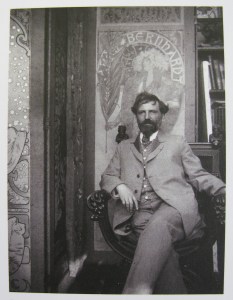
Self-portrait with Gismonda‘s poster in the background. Ca. 1896. S950.a.201.2411

Mucha was born in Ivančice (near Brno) in 1860, when it was part of the Austrian Empire (now Czech Republic). He lived his youth in Brno in a growing atmosphere of Czech nationalism. Despite having artistic talents from a very young age, he was not able to gain a place at the Academy of Fine Arts in Prague. Mucha worked for a major theatrical company in Vienna, but the theatre burnt down. Then he ran out of money, but he was lucky enough that his portraits were appreciated by the Count Khuen Belasi in Moravia. Thus, the Count Khuen and his brother, Count Egon, decided to commission him to paint some murals. The latter was so fascinated by his works that decided to become his patron. Thanks to his benefactor Mucha received two years of training at the Munich Academy of Fine Arts before moving to Paris in 1887. There he continued his formal art training and worked for a magazine creating advertising illustrations. He met Paul Gauguin in 1891; they become friends and Mucha offered Gauguin his studio, which they shared for some time. Continue reading “Alphonse Mucha, master of Art Nouveau”
A tale for healthy living in 1920s Czechoslovakia : the November 2015 Slavonic item of the month

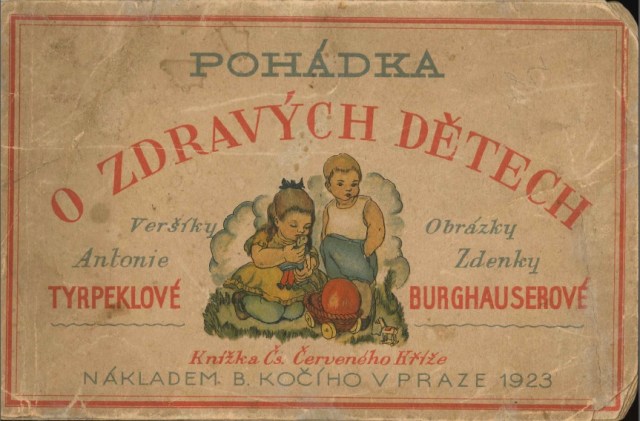
The November 2015 Slavonic item of the month is a small Czech addition to the Waddleton collection of colour-printed books.  Pohádka o zdravých dětech (A tale of healthy children; Waddleton.e.7.33) was printed in Prague in 1923.  Its verse and drawings tell its young readers of the importance of a healthy way of life.

201511_cover
Front cover (and title page) of the book.

The story is framed by a doctor telling children about a country where small children never get ill, “where every child has laughter in their eyes and rosy cheeks”.  He then goes on to describe the healthy lifestyle of these children, with cleanliness, exercise, rest, and good diet much promoted.

Continue reading “A tale for healthy living in 1920s Czechoslovakia : the November 2015 Slavonic item of the month”

The Czech twentieth century in new donations : the February 2015 Slavonic item(s) of the month

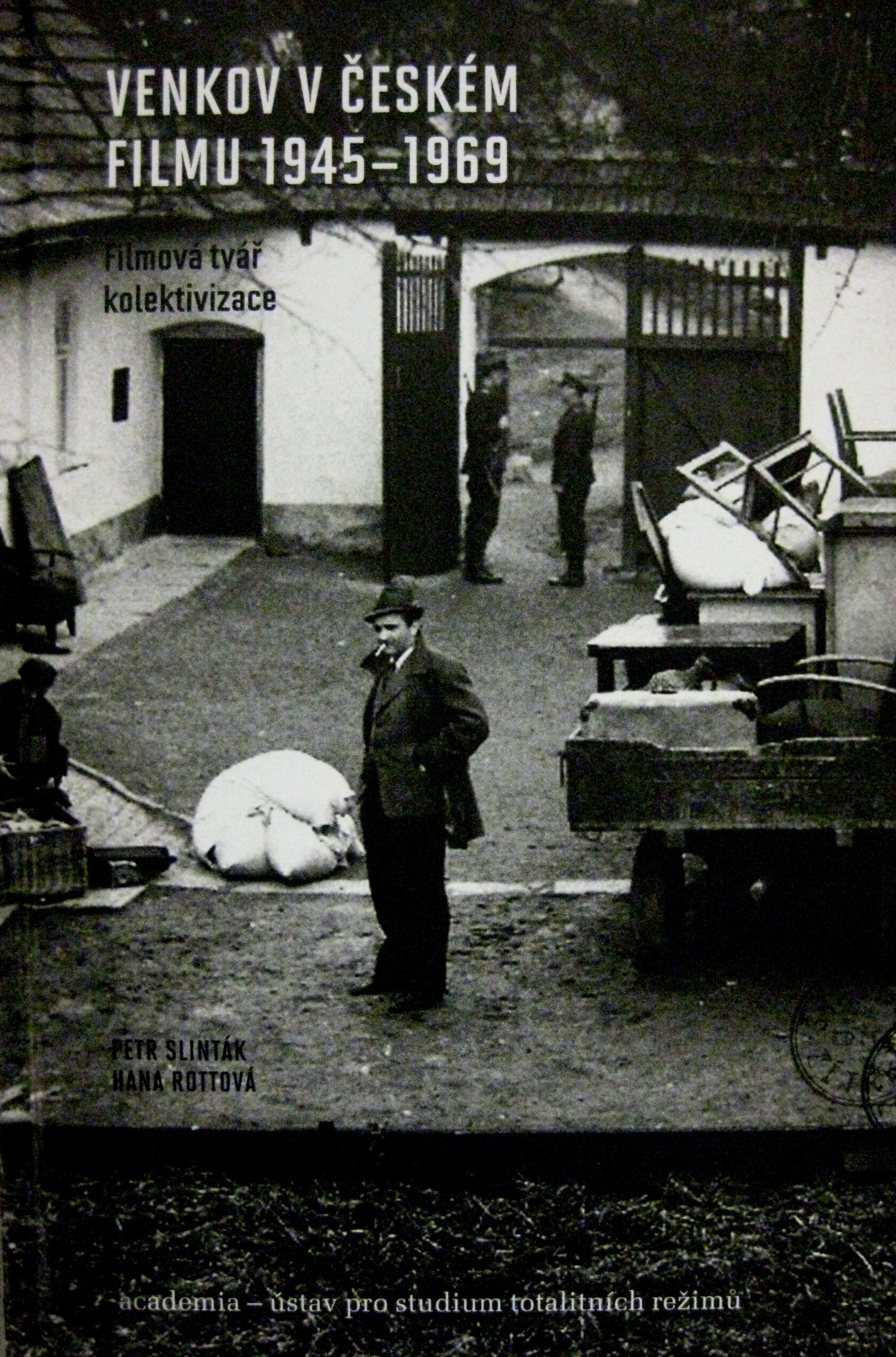
Front cover of Venkov v českém filmu 1945-1969 (The countryside in Czech film 1945-1969; C203.d.9215)

While the University Library no longer actively buys Czech-language material, it has since 2012 been the very fortunate recipient of donations from the library of the Ústav pro Studium Totalitních Režimů (Institute for the Study of Totalitarian Regimes) in Prague.  Most address 20th-century Czech history and all are valuable additions to our collections.

The focus of the Library’s Slavonic acquisitions budget is of necessity on material produced in languages currently taught in the University – Russian, Ukrainian, and Polish.  In the past, two other East European languages in particular were well catered for; these were Hungarian (we have over 8,000 Hungarian items in the Library) and Czech (over 15,000).  When these languages ceased to be taught in the University, the Library also wound down active collection in them.  East European material in languages other than Russian, Ukrainian, and Polish, then, is normally received nowadays only through donations.  As with all such languages, we are very glad of material which looks at the history or culture of the country in question.

In terms of Czech, we have been very fortunate to become the regular recipients of donations from the Ján Langoš Library of the Ústav pro Studium Totalitních Režimů (USTR; Institute for the Study of Totalitarian Regimes) in Prague.  Since 2012, we have very generously been sent several dozen items.  The research section of the USTR focuses on the “examination and impartial evaluation” (quotation from their website) of the Czech experience of fascism and Communism, and most publications received by Cambridge concern this area.  Almost all feature lengthy bibliographies, and every item is a welcome addition to the catalogue. Continue reading “The Czech twentieth century in new donations : the February 2015 Slavonic item(s) of the month”