
This week saw the 150th anniversary of the birth of David Josef Bach. This blog post starts with a background to the University Library’s Bach collection, written by David Lowe in 2013 as then-Head of Department and German Specialist, and follows with an update.
“Bach was a leading social democrat, journalist and “Kulturpolitiker” in early twentieth-century Vienna. After Bach’s death in London in 1947 his library passed to his nephew Herbert, whose widow presented the books to Cambridge in 1975. This donation added approximately 1,900 new titles to the collection and considerably enriched the library’s holdings of German literature from the period 1900-1930. The particular strengths lie in its collection of Austrian authors, in plays and in works on theatre history. It thus complements the Schnitzler Papers. The collection includes a significant number of inscribed presentation copies, and works from other literatures in German translation are well represented.
“The University Library only accepted volumes which did not duplicate existing holdings. Provenance data is gradually being added to the appropriate catalogue records, but it is not currently possible easily to identify all of David Bach’s library. Some titles from the collection are also to be found in the library of Gonville and Caius College, and like the University Library’s holdings, are distinguished by a book plate. Some duplicates were sent to the British Library.
- A biography of David Bach by Henriette Kotlan-Werner stands at M515.c.95.124
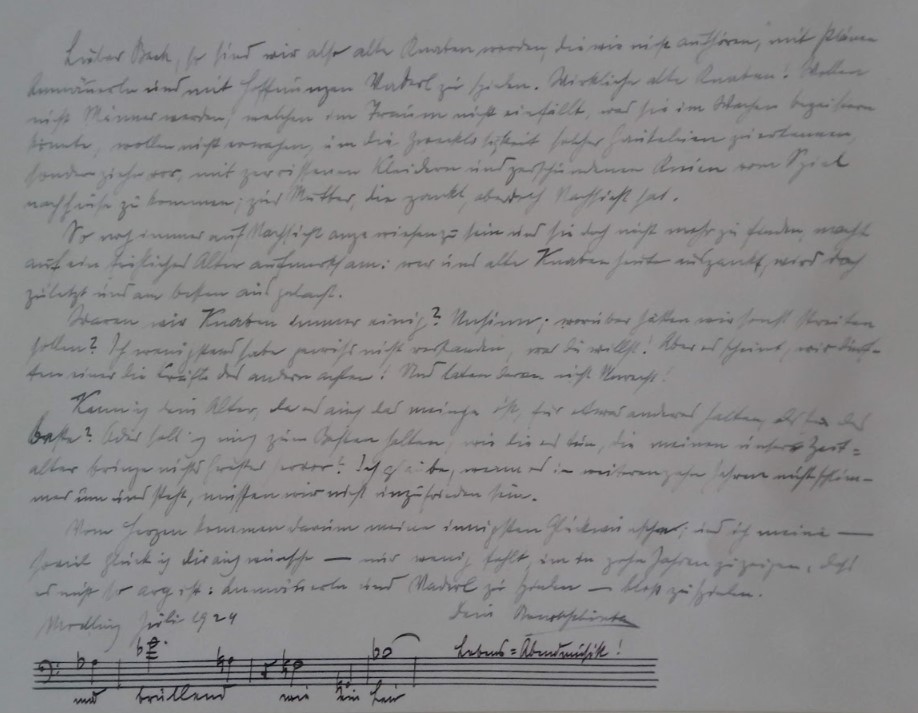
- An article in the Sunday Times Magazine for May 13 2001, entitled Box of delights, described the collection of autographs and music manuscripts presented to David Bach on his 50th birthday August 10th 1924, including contributions by Kokoschka, Schoenberg, Korngold, Zweig, Galsworthy, Webern, Richard Strauss, Bartok, Schnitzler, Kraus, Hofmannsthal and others. This was subsequently exhibited at the Austrian Cultural Forum from February 13 to March 5 2003.
- An article by Jared Armstrong and Edward Timms, Souvenirs of Vienna 1924 : the legacy of David Josef Bach, published in Austrian studies, Vol. 14 (2006), p. 61-98, quotes from Bach’s property declaration of April 1938. His Büchersammlung is valued at RM 80.-, whilst the Geburtstagsaddressen in Mappenform were deemed to be “wertlos”. Several other articles in this volume of Austrian studies are devoted to David Bach. They originated as papers presented at a two-day workshop on ‘David Josef Bach and Austrian culture between the wars’, organized by Edward Timms and Judith Beniston at the Austrian Cultural Forum and the Institute of Germanic Studies in London in February 2003.” [end of David Lowe’s summary]
Born in L’viv (then Lemberg), Bach grew up in and lived and worked in Vienna until forced into exile for his prominence and left-wing politics and his Jewish identity. That not only Bach and his wife and his late brother’s son but also his library and “box of delights” made it safely out of Vienna to London in 1939 is extraordinary. He was aided by his close friend, Arnold Schoenberg, and by his surviving brother who was already in London. (Their sister, married to Schoenberg’s cousin, stayed on in Austria with her husband; both were murdered in the Holocaust.)
David Josef Bach passed away in London in 1947. Millicent Bach, the widow of his nephew, Herbert, who sadly died in 1971, offered David’s library to Cambridge in 1975, with the sorting and processing done between Gonville and Caius College and the University Library. I understand that the Bach collection proved a kind of turning point for the Library in terms of donated foreign-language collections. A large donation, full of quite amazing treasures, David Josef Bach’s library had been divided up rather than kept together, with no provenance note provided in the catalogue records to match the bookplate that the books bear. After its accession, with a general acceptance that it should have at least had better provenance treatment in the catalogue and, ideally, stood together as a physical collection, other collections of that kind now started to be treated rather differently.
Some 600 of the 2,000-odd records for books from Bach’s library were later given provenance notes. During lockdown, some of our German team in the department started to add further notes, working from printed lists from the time of the original Caius/UL accession work. There are now just over 800 entries for David Josef Bach as a former owner in the catalogue. These in fact include over 50 recent additions, when some more Bach books were happily found in a Caius library office. A blog post about some of these new additions will follow in due course from our German Specialist, Christian.
Some additional material about David Josef Bach can be found in the form of the 2007 book Eredità della musica : David J. Bach e i concerti sinfonici dei lavoratori viennesi : 1905-1934 by Piero Violante and the 2008 article “Soul Is But Harmony”: David Josef Bach and the Workers’ Symphony Concert Association, 1905–1918 by Jonathan Koehler.
Some years after I started at the UL as its Slavonic Specialist, David Lowe asked me if my Viennese Bach family (my great-grandfather emigrated fairly early in the 20th century) might have included a person called David Josef Bach. It seemed hardly likely, given the frequency of the name. By chance, my mother announced when I next went home that she had recently taken to genealogy and was busy pursuing my father’s roots, so I asked her idly if by any chance she’d come across that name. And of course the world is small. The London-based brother of David Josef was my great-grandfather, Maximilian Bach.
By further coincidence, a lack of available drivers later saw me drive Christian and the UL van to the house of the late Edward Timms to bring some books back from his collection. We were invited to look around the house, and I discovered several large folders of… pristine facsimiles of the contents of the box of delights. Prof. Timms’ widow generously gave me the folders for my family. Among the later correspondence that accompanied the box was a letter from my own grandfather, written to David Josef Bach’s widow, sending his condolences on his uncle’s death.
Among the papers, I also found the email address of Jared Armstrong, Timms’ co-author of the Austrian studies article. Jared in turn put me in touch with Philip Marriott, Herbert and Millicent Bach’s adopted son. It is amazing to be in contact with a newly discovered part of our fairly small family, and I hope to meet Philip and also Jared before too much longer.
Mel Bach, with huge thanks to David Lowe for use of his Bach summary and to Philip and Jared for checking this post for glaring errors, and to Anne Lacour for the image at the top of the page
 Languages across Borders
Thank you, this was an interesting read.