Today, the day when Putin added to his illegal annexation of Crimea in 2014 the illegal annexation of four more Ukrainian regions (not fully even under temporary Russian control) following further referenda not worth the paper they were falsified on, our weekly Ukrainian blog post promotes new writing about Russia’s war against Ukraine made possible by the Ukraine Lab initiative, led by the Ukrainian Institute in London.
The news about Russia’s war against Ukraine gives us each week new names and/or new vocabulary. This week, we’ve heard a lot in Russian about mobilizat︠s︡ii︠a︡ (mobilisation) but some of us might also have seen the rise of the term mogilizat︠s︡ii︠a︡, a grimly wry portmanteau of the words mobilisation and – mogila (the grave). The name for a call-up paper is simply povestka, a word related to “telling” (eg povestʹ means a story). Judging by news coming from Russia, povestki are arriving in huge numbers and not only to those within the parameters Putin set out that; the scale of mobilisation is far greater than the president will openly admit.
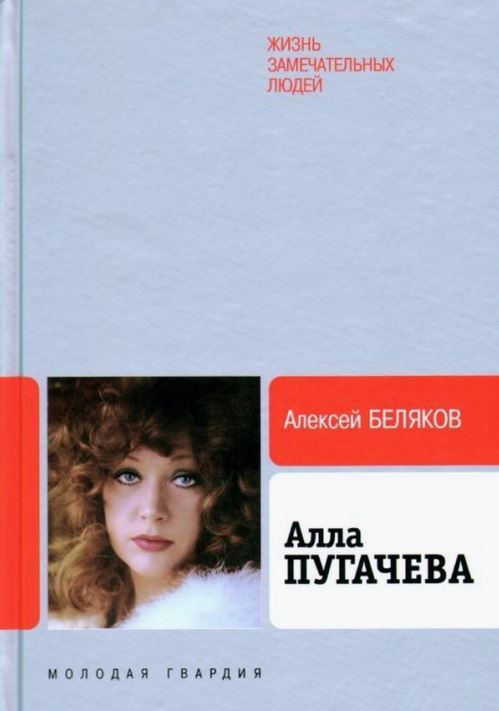
The cover of ‘Alla Pugacheva’ by Alekseĭ Beli︠a︡kov (C202.d.4981)
In terms of names, Alla Pugacheva will either have been abundantly known to you already or also a new thing this week. Pugacheva was an absolutely huge music star in Soviet times and has remained so in modern Russia (she gets her own two chapters in David MacFadyen’s Red Stars : Personality and the Soviet Popular Song, 1955-1991; you can find other Cambridge library books, not all of them, admittedly, highly academic, about her here). Earlier this week, Pugacheva wrote an open letter to the Russian authorities requesting that she be added to the list of inoagenty (from inostrannye agenty – foreign agents) to which her husband, Maksim Galkin, a consistent opponent of the “special military operation”, had just been added. Pugacheva’s dramatic stand against the war may have come over 6 months after Russia invaded Ukraine, but it was pretty seismic. Until, that is, Putin outdid her with his address about “partial” mobilisation, about the referenda that (properly stage-managed) will allow him to claim parts of Ukraine under Russian control as parts of sovereign Russia, and about the possibility of using a nuclear bomb (no ‘blef‘, he said – no bluff)…
We should end on a light note. Alla Pugacheva’s husband, Maksim Galkin, became famous as a comedian, singer, and much more around the year 2000. He won my delighted respect in 2002 when, in response to the rather self-admiring singer Nikolaĭ Baskov’s release of an album called ‘I’m 25!’, Galkin released a rather less earnest album named ‘Well, I’m 26!’ Not many images can be found of the latter, sadly, but here is Baskov’s.
CAIRN is a Francophone online platform originally founded by four French and Belgian publishers: Belin, De Boeck, La Découverte and Erès, focusing on social sciences and humanities periodicals. More recent partners include the Bibliothèque Nationale de France, the University of Liège and the Centre National du Livre. In the past few years, especially since COVID (when the platform offered the library free access to all their ebooks for the month of May 2020), we started acquiring CAIRN ebooks, as well as receiving statistics about our readers’ attempts to access ebook titles on the platform.
Based on these information, and in order to continue diversifying the range of French and Francophone material available to our readers, while also taking into account the pricing of the ebooks, we recently made a bulk purchase of more than 200 titles selected from the Cairn catalogue, including both new and older publications that we did not already have in print. Members of Cambridge University Library now have access to about 450 CAIRN ebooks titles, available through Raven, either on iDiscover, or directly on the CAIRN platform and other websites, if you use the Lean library plugin. We are now in the process of upgrading online catalogue records for the newly acquired ebooks, which includes adding subject headings. Continue reading “New CAIRN Francophone ebooks available through Cambridge University Library”→
Some work on Ukrainian donations earlier this year threw up a few inscriptions that have bamboozled me – most in Cyrillic, but one in the Latin alphabet. Forgive the blurriness of some of the images. If anyone might be able to decipher any of the writing, please do get in touch! Continue reading “Handwriting in Ukrainian donations”→
In my previous blog post, I examined a selection of the texts in the Bibliotheca Hermetica series, a recent addition to our catalogue. In this post, I wish to take a wider view of alchemy, and how the material connects people of different time periods. History is inherent to each manuscript, not only detailing the provenance and creation of each work, but also how the content shaped the lives of the people who read it. In this way, the collection of alchemical texts in the UL is a rich fabric of interwoven connections and textual interpretations, which spans centuries of academic understanding, creating almost a visual mind-map of human curiosity and giving the impetus to discover and learn more.
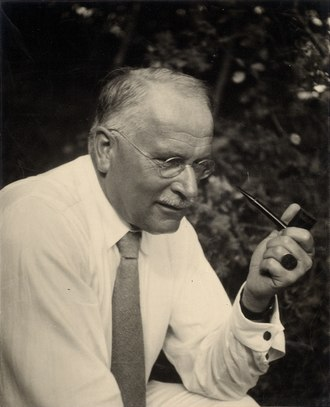
Carl Jung, circa 1935.
One particular example of how ideas interconnect across time, is Carl Jung, the Swiss 20th century psychiatrist, and The Secret of the Golden Flower(9840.b.17). Although psychology and alchemy may appear to be vastly different fields of enquiry, Jung’s approach to his specialism had a lot in common with the historical alchemists he researched. Like them, he was concerned with the unification of opposites, focusing primarily on the conscious and the unconscious, a theme he noted in a variety of Eastern archetypical images. Jung’s concept of individuation is also reminiscent of Western alchemical practices. In differentiating the self into conscious and unconscious elements, Jung was applying to psychology techniques which alchemists had applied to early approaches to natural science. Continue reading “Alchemical Connections in the UL: Jung and Eastern Alchemy”→
It crossed my mind today to look up in our staff cataloguing system books published in Ukraine and coded as being in Russian, to see whether any of them had been incorrectly coded. The fifth result was exactly that – a Ukrainian title mangled in transliteration performed in keeping with the rules for Russian:
I wrote in an earlier blog post about John Heartfield and Kurt Schwitters who shared the experience of being interned during World War Two. This post will highlight two more artists interned by Britain because they were foreign nationals: the Austrian Hugo Dachinger and the German Hellmuth Weissenborn. After the war both men made Britain their home until their deaths much later in the 20th century. Continue reading “Interned artists (2): Hugo Dachinger and Hellmuth Weissenborn”→
This week, the news from Ukraine has been tentatively positive, as the concerted counter-attack against the Russian army in the south of the country has been getting under way. But ongoing concerns about the situation at the Zaporizhzhia Nuclear Power Plant have also been in the headlines as, of course, has been the death of Mikhail Gorbachev.
Gorbachev was adored and hated for the actions he took and for the events that happened during his time as Soviet leader. It was Yeltsin who formally acknowledged Ukrainian independence, but Gorbachev’s time that saw the circumstances of the Soviet Union shift towards that possibility. Largely praised abroad for bringing the Cold War to a close, Gorbachev is remembered in some former Soviet countries chiefly as the overseer of violent suppressions of pro-independence activities in 1989 and 1990. For those who mourned the loss of the Soviet Union, Gorbachev was also a guilty party.
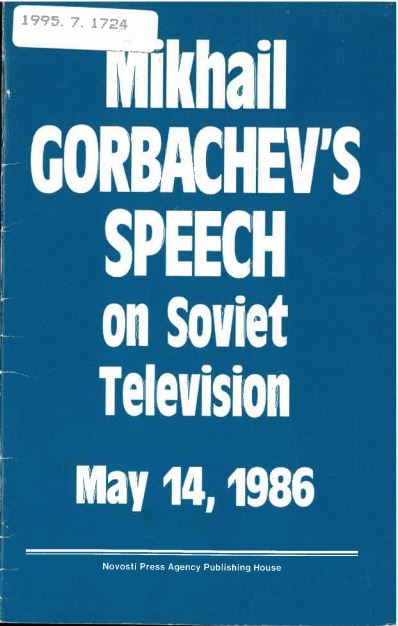
The fears about the Zaporizhzhia nuclear station, currently occupied by Russian forces. are of course particularly troubling in the context of the nuclear disaster in Ukraine 36 years ago. The item shown here, Mikhail Gorbachev’s speech on Soviet television, May 14, 1986, contains the translated text of the speech he made in the light of the appalling accident that had occurred on 26 April at Chornobyl’ (Ukrainian; Chernobyl’ in Russian). The 14 May speech was the first full statement by the Soviet leader about what had happened weeks before. Continue reading “Ukraine, Gorbachev, and nuclear power”→



 Languages across Borders