

This week marks the 75th anniversary of the death of Hans Fallada, pseudonym of Rudolf Ditzen (1893-1947), the writer perhaps best known for the novels Kleiner Mann – was nun? (Little man, what now?) and Jeder stirbt für sich allein (Every man dies alone/Alone in Berlin). In this post I will look back at the short and difficult life he led, and explore how his literary reputation has changed over time. Initially considered to be a popular writer and perhaps therefore neglected by academics, it seems that more recently he and his writings have received renewed interest and sparked research. This is certainly borne out by the fact that the vast majority of the UL’s holdings of both editions of his works (in German and translation) and critical works date from the last thirty years.
Fallada’s life was dramatic and marked by much instability; at various times he was dependent on alcohol or drugs and he spent time in both psychiatric units and prison. Significant events early in his life doubtless shaped him:
- aged 16 he was run over by a horse-drawn cart, leaving him with long-lasting painful injuries
- aged 17 he contracted typhoid
- aged 18 he survived a suicide pact duel in which his friend died, only escaping murder charges by being declared insane (he was subsequently declared unfit for military conscription, thus avoiding active service in World War One)
Later, he was beset by more tragedy – the death of his younger brother in World War One and the loss of a baby at birth. Unlike many contemporary writers who emigrated, the apolitical Fallada chose to stay in Germany when the Nazis came to power, but living under the regime was a struggle, especially after 1935 when it was decided that he was an “undesirable author.” In 1938 he came close to emigrating but changed his mind at the last minute. The last few years of his life were chaotic: first, in 1944, came divorce from his first wife, followed by a drunken altercation with her which led to a spell of confinement. Then in 1945 he remarried, this time to a woman much younger than him who turned out to have a morphine addiction, and it was not long before he also had drug problems again.
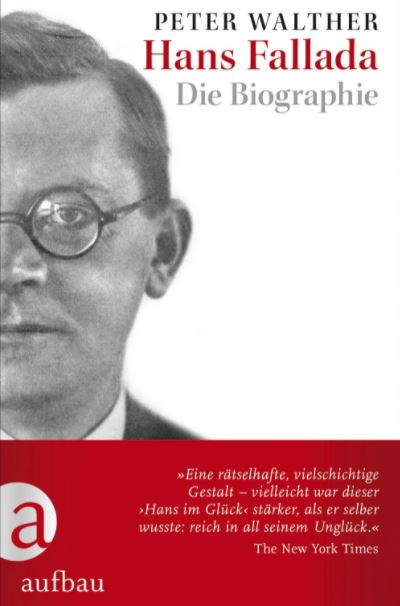
Five years ago, to coincide with the 70th anniversary of Fallada’s death, a long and detailed biography was published using archival material never seen before: Hans Fallada: die Biographie by Peter Walther (C212.c.6121). Earlier, in 1998 (and updated in 2012), an English language biography was written by the Irish academic Jenny Williams: More lives than one: a biography of Hans Fallada. Our knowledge of Fallada’s life has also been enhanced by recently published volumes of letters exchanged with family members and with his publisher.
Literary aspirations came early to Ditzen (as he then was). In 1912, while in a sanatorium for the mentally ill, he was encouraged by his aunt Adelaide (devoted to furthering his education) to write to the French author Romain Rolland, asking permission to translate some of his works (more details in Jean Full’s article Hans Fallada et Romain Rolland: trois lettres inédites de Fallada in vol. 3/1973 of Recherches germaniques). Nothing came of this but his ambitions to become a writer began to take shape as he spent his days doing farm work. His debut novel was published in 1920 and it was at this point that he adopted his pseudonym (from two Grimm fairy tales) as his real name might have stirred up publicity linked to the earlier killing of his friend.
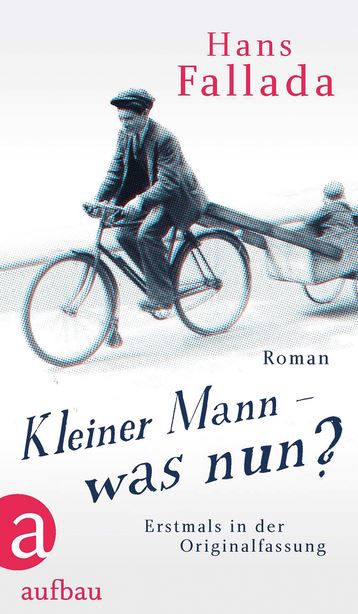
Fallada did not have any real success until the early 1930s when his breakthrough came with the novel Bauern, Bonzen und Bomben, closely followed in 1932 by the instant bestseller Kleiner Mann – was nun?. This tells the story of a young couple trying to survive during the Great Depression and is a keenly observed depiction of everyday life. It was serialised in many provincial newspapers, was a hit in the United States and Britain and was made into films in both Germany and Hollywood. It also saved Fallada’s publisher, Rowohlt, from bankruptcy. In 2016 the original version was published for the very first time, adding about 100 pages to the novel, increasing it by about a quarter.
Fallada’s literary output continued steadily throughout the years of the Third Reich despite wartime paper rationing. His other big hit, Jeder stirbt für sich allein, was written very quickly in autumn 1946 and published posthumously in 1947. It is a fictionalised version, based on Gestapo files given to him, of the true story of a couple who tried to overthrow the Nazi regime through their acts of resistance. Remarkably, while translated into other languages soon after, this novel did not appear in the English language until 2009 when it became a bestseller and was followed by a film version. As with Kleiner Mann – was nun? a new unabridged version, based on a typescript found in the publisher’s archives emerged in 2011.
The University Library has a number of Fallada editions dating back to the 1930s and 1940s, including two first editions with splendid covers which in 2016 featured in a blog post about the Trude Good donation. Here are some others:


Katharine Dicks
Further reading
- Hans Fallada Handbuch (2019, online) – deals comprehensively with his life, works and impact; the bibliography is more than 100 pages long
- Der andere Fallada: eine Chronik des Leidens by Klaus-Jürgen Neumärker (2014, C209.c.6531)
- Es war wie ein Rausch: Fallada und sein Leben by Cecilia von Studnitz (1997, 748:37.c.95.1275)
- Hans Fallada: sein Leben in Bildern und Briefen edited by Gunnar Müller-Waldeck und Roland Ulrich (1997, 748:37.c.95.1279)
 Languages across Borders