The nativity in Ukrainian puppet plays : the December 2021 Slavonic item of the month

The Institute of History of Ukraine in its online encyclopedia (in Ukrainian) explains that the vertep, a telling of the Christmas story through puppet theatre, is thought to have appeared in the second half of the 17th century and lasted until the early 20th century.  In 1929, I︠E︡vhen Markovsʹkyĭ published a book about vertep which was due to be the first volume of a set but which was never added to.  The UL’s copy has its record here.
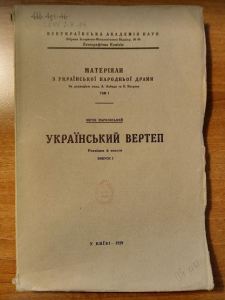
The front cover of the book, with two pages showing puppets and a stage.

The vertep stage was often a two-storey house, with the story of the nativity taking place on the higher floor while the other provided other religious or secular puppet plays, with a strong strain of comedy running through the secular plays.  The Museum of Theatre, Music, and Cinema of Ukraine shows a beautiful array of vertep houses on this page.

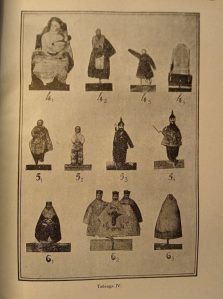
Secular stories involved stock characters, among which often featured a Ukrainian peasant couple, a Zaporozhian Cossack, clerics, a Jewish character, a Polish character, Russian soldiers, and various animals.

Continue reading “The nativity in Ukrainian puppet plays : the December 2021 Slavonic item of the month”

Remembering Stefan Heym

Picture by Marcel Antonisse/Anefo via Wikimedia Commons

Twenty years ago, on December 16, 2001, the renowned Jewish-German author Stefan Heym died while visiting Israel. Heym is regarded as one of the most important 20th century German authors and is particularly significant to Cambridge University Library as it holds the Stefan Heym Archive, acquired from the author in December 1992. The archive is extensive and includes manuscripts, correspondence, first editions, newspaper cuttings, audio cassettes and video tapes. The acquisition of the archive was marked with an exhibition held at the Library in 1994.

In his life Stefan Heym witnessed some of the key events of the 20th century. Born in 1913, he grew up in Chemnitz, Saxony, and had to flee from Nazi Germany in 1933, emigrating via Prague to the United States. Continue reading “Remembering Stefan Heym”

  Good things come in small packages

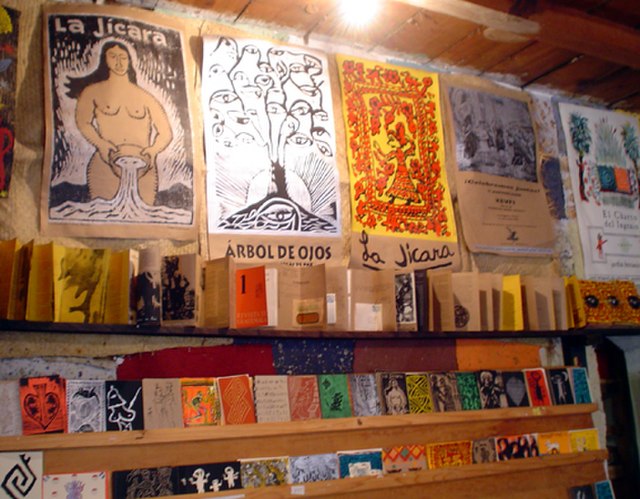
A colourful display of books at Taller Leñateros (from Wikimedia Commons)

This post is about two small, beautiful publications that come packed with great significance. These are two books by the publishing collective Taller Leñateros (translated as ‘Firewood Collectors/Peddlers Worskhop’) in San Cristóbal de las Casas, Chiapas, Mexico. Taller Leñateros publishes the first books produced, written, illustrated, printed and bound entirely by Mayan people in 400 years1, and was founded in 1975 by Mexican poet Ambar Past.

Chiapas, as the perifery of the perifery, is known to the world because of the EZLN (the Ejército Zapatista de Liberación Nacional, or Zapatista Army of National Liberation) who democratically control a substantial part of this Southern Mexican territory in the name of local indigenous rights. The geographical position of Taller Leñateros in this rural area is of high importance in this context2, considering as well that most of the publishing industry of the country is located in Mexico City, where literary production is mandated by big national publishers, some of them linked to mainstream publishing multinationals. 

Continue reading ”  Good things come in small packages”

Celebrating Albrecht Dürer’s travels

S950.a.202.300

Dürer’s Journeys: Travels of a Renaissance Artist is a new exhibition at the National Gallery which opened last month and runs until the end of February. It allows us to gain an insight into the artist’s travels across Europe and his encounters with other artists and patrons. On show are paintings, drawings and prints as well as written documents, many of them on loan from museums and private collections around the world.

The exhibition has been organised in partnership with the Suermondt-Ludwig Museum in Aachen which hosted a different version of the exhibition earlier this year, concentrating on just one year-long trip around the Low Countries. The Aachen exhibition was originally intended to open in autumn 2020, coinciding with the 500th anniversary of Dürer visiting Aachen for the coronation of Charles V. We know so much about Dürer’s time in the Low Countries because he kept a detailed journal, and while only page fragments remain of the original journal (loaned to the exhibition by the British Library), two transcriptions survive. Continue reading “Celebrating Albrecht Dürer’s travels”