
December 6th is St. Nicholas’ Day on which many children in the Netherlands and other countries in mainland Europe wake up expectantly, hoping to find gifts in the shoes they left out the night before. In the Netherlands, the arrival in mid-November of Sinterklaas (as he is called there) on a ship from Spain, followed by a parade on a white horse, is a major (now televised) event and has been taking place for many years. It was depicted in the 19th century by Jan Schenkman in his Sint Nikolaas en zijn knecht.


December 6th is the likely death date of the real St. Nicholas. Accounts of the year of his death vary but it is thought to be around 343. “Facts” about him are hard to come by but it is believed that he was born in Patara, now in south-west Turkey, became the bishop of nearby Myra and during his lifetime performed many miracles. Indeed, the basis for today’s gift-giving is perhaps the story of how he saved three poor sisters from prostitution by secretly presenting them with dowries of gold.
After his death and burial in Myra many biographers chronicled his life and the wonders that he had worked. His veneration spread widely in the 10th and 11th centuries and this was bolstered in 1087 when his remains were seized from Myra by Italian merchants and transferred to Bari in southern Italy. A monumental basilica was soon built to house his relics and this still stands today, although doubts have recently been cast on whether the bones moved to Bari really belonged to Nicholas.
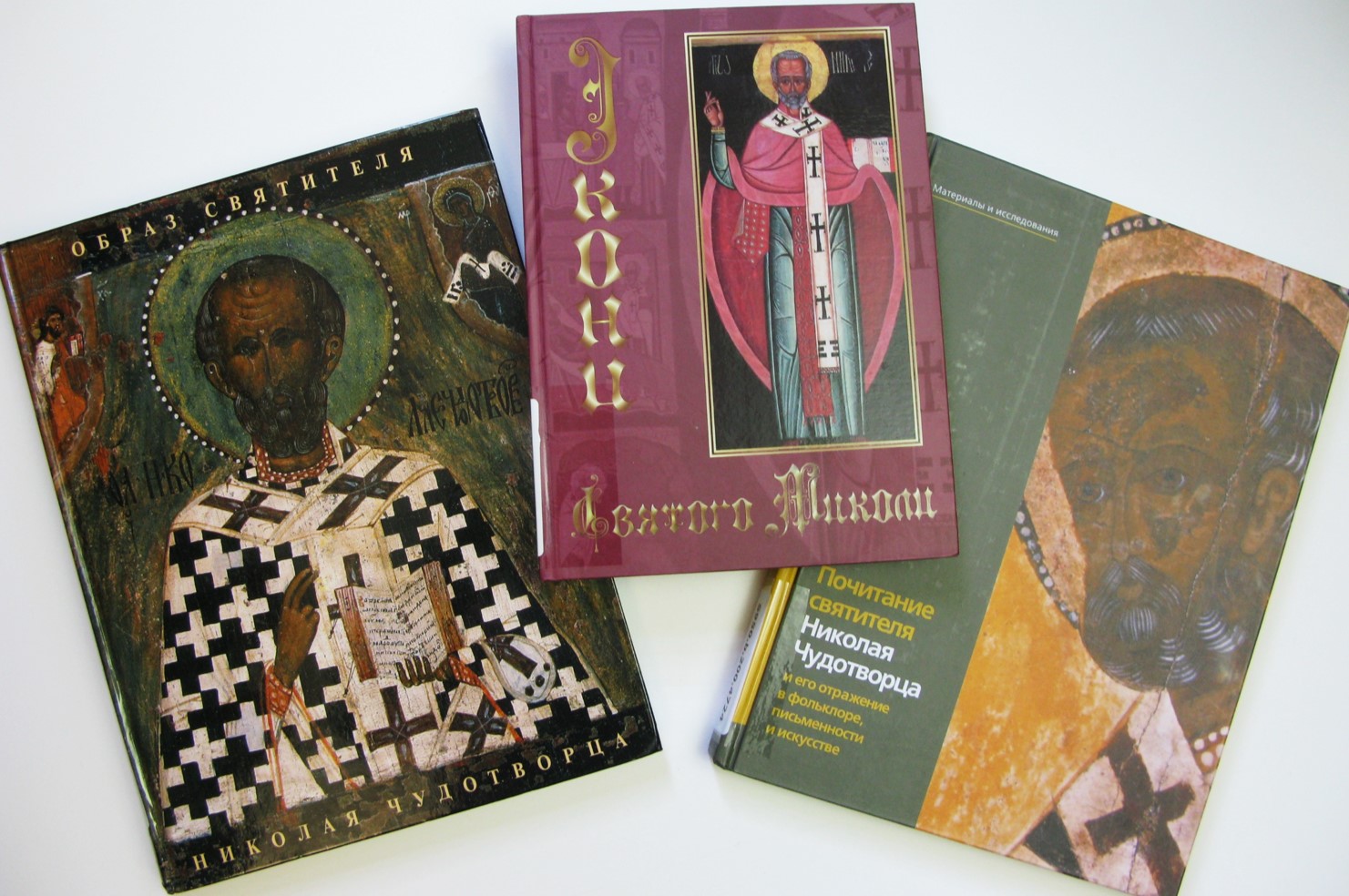
The cult of St. Nicholas spread into Russia from the earliest days of Christianisation by Byzantine missionaries, and he became the saint most treasured by Russians and the subject of huge numbers of icons. Of our many books on Russian and Ukrainian icons here are three devoted specifically to those of St. Nicholas:
By the 14th century the legend of St. Nicholas had reached Iceland and his life was written up and illustrated by a monk, Bergr Sokkason. This illuminated manuscript is now in the Royal Library in Stockholm but we have a facsimile edition in which can be seen the unusual wealth of illuminations depicting scenes from his life and death and miracles worked by him.


Click on the images to see enlarged versions
Dutch migrants to America would have taken their Sinterklaas traditions with them, and it was in America that he became Santa Claus. One of the first artists credited with creating the image of Santa Claus that we recognise today was Thomas Nast, an important political cartoonist of the 19th century who did drawings for Harper’s Weekly over a period of 30 years. In 1890 all his Christmas drawings were published in Thomas Nast’s Christmas drawings for the human race including drawings for the 1823 poem A visit from St. Nicholas, now better known as The night before Christmas, by Clement Clarke Moore (or Henry Livingston) in which the visitor is dressed in fur, has a white beard and a round belly. We have the 1978 Thomas Nast’s Christmas drawings for which the pictures were newly photographed from the original Harper’s Weekly editions for greater clarity and detail:


Returning to St. Nicholas, he has continued to be a popular subject for artistic works. In the 1940s Benjamin Britten wrote a cantata on the life and death of the saint. The seventh movement, Nicolas and the Pickled Boys, depicts a particularly gruesome legend: invited to dine with some travellers in an inn, he realised that the meat was the flesh of three boys murdered and pickled. He calls to the boys, “Timothy, Mark, and John, put your fleshly garments on!” and the boys come back to life, singing “Alleluia!”
The remarkable abundance and variety of the art devoted to St. Nicholas was the theme of a large exhibition in Bari in 2006-2007. The accompanying catalogue, San Nicola: splendori d’arte d’Oriente e d’Occidente, gives a taste of the exhibits which included a number of precious icons from St. Catherine’s Monastery at Mount Sinai which are the oldest surviving painted images of the saint.
Saint Nicholas continues to arouse interest as two more recent books demonstrate:
- En Orient et en Occident, le culte de saint Nicolas en Europe, Xe-XXIe siècle, proceedings of a conference held in 2013, and
- Heiliger Nikolaus: Leben und Wirkung des Nikolaos von Myra, catalogue of a 2014 exhibition held in Liechtenstein.
Further reading
- Who is Santa Claus?: the true story behind a living legend by Robin Crichton
- Sankt Nikolaus in Kunst und Volksbrauch by S. Metken
- St. Nicholas: his legends and iconography by Edward G. Clare
- Van Nicolaas van Myra tot Sinterklaas: de kracht van een verhaal by Rita Ghesquiere
- Sankt Nikolaus: zwischen Kult und Klamauk by Werner Mezger
Katharine Dicks
 Languages across Borders