369 plans of St Petersburg : the July 2018 Slavonic item of the month

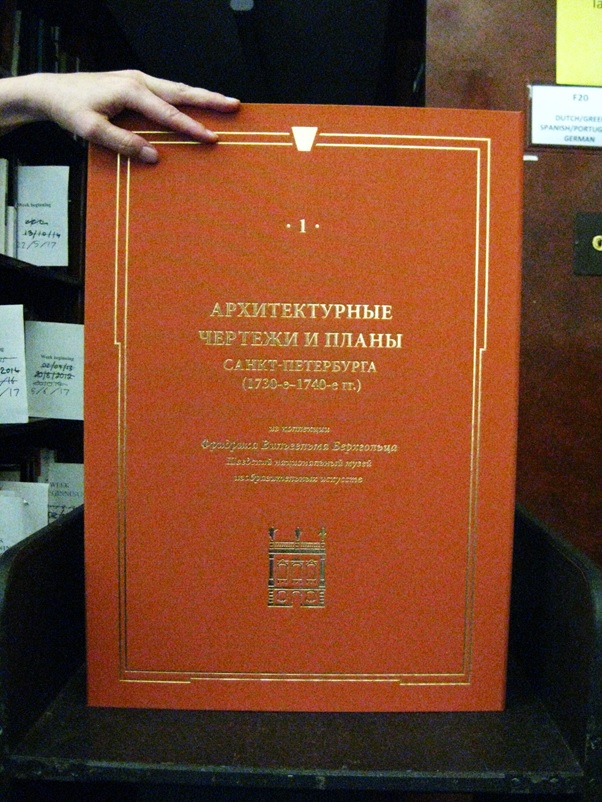
UL staff hand provided to show scale.

The University Library has recently acquired a huge facsimile set of architectural plans of St Petersburg dating from the 1730s and 1740s.  Arkhitekturnye chertezhi i plany Sankt-Peterburga (2017) consists of two 52 x 37 centimetre cases of loose-leaf pages showing plans made for Friedrich Wilhelm von Bergholz, and a smaller commentary book.  The publication is Russian but the plans and drawings come from the Nationalmuseum in Sweden, so the new purchase was made with money from the Slavonic and Scandinavian accessions budgets.

St Petersburg was founded by Peter the Great in 1703.  Bergholz spent several years in the 1720s visiting Russia from the Duchy of Holstein, and the drawings of the new city he later commissioned and which are reprinted in this new set will be of particular interest to those looking at the early history of St Petersburg.  The commentary volume gives the following English summary on its cover:

Drawings and blueprints of buildings, panoramas of streets and embankments of St. Petersburg and its suburbs from 1730s -1740s come from the collection of F.W. Bergholtz that was kept in the Swedish National Museum of Fine Arts, Stockholm. The blueprints (253 originals on 369 tablets) are mostly reproduced to scale, faithfully representing the color as well as notes made by Bergholtz himself. Almost all of them were not previously published.

Continue reading “369 plans of St Petersburg : the July 2018 Slavonic item of the month”
‘La nouvelle histoire’ or the French historical revolution

The French historical revolution (500:1.c.201.120) is a book by the Cambridge Professor and historian, Peter Burke, about the École des Annales, also known as Annales, a historiographic school which marked a turning point in the study of history. They focussed on social history rather than the previous predominance of political history and the power elites. Despite the fact that it had had some precedents (for instance Henri Berr), this school represented a radical change, undertaken in the first half of the 20th century by a small group of French historians –particularly Marc Bloch and Lucien Febvre– that set the basis of the methodological and theoretical approach of historical writing that was hegemonic from the 1930’s to the 1960’s; although its influence went much further and is embedded in the contemporary practice of history.

dav
Volumes of the Annales’ journal at the UL (P220.c.57)

The school started with the foundation of the academic journal Annales d’histoire économique et sociale in 1929. It is worth clarifying that the school was not fully homogeneous in its ideas from the start, and we can see differences among its members, called Annalistes. In addition, several generations of scholars followed this historiographical movement, adding ideas and changing their approach to the historians’ job. After the war, the movement was associated with the Sixth Section for economic and social sciences of the École pratique des hautes études in Paris (EPHE –precedent of the École des hautes etudes en sciences sociales– EHESS). A key concept of the school was the longue durée history, that is to say, they were keen on studying long-term historical structures. The school has also contributed to the history of mentalities, especially in the generations that followed. In general they were opposed to the class analysis of Marxist historiography. Interestingly, although Annales was not meant to cover a particular time in history, most of their members were experts in either Middle Ages, or early modern period. Continue reading “‘La nouvelle histoire’ or the French historical revolution”

New electronic resources with a European connection

The ejournals@cambridge blog publicises trial access to and purchase of various databases and ejournals, and it is certainly a blog worth following.  Several purchases over the last few months complement our European collections, so this post gives an overview.  The subjects of these new resources span philology, politics, art history, theology, migration studies, history, and bibliography, and their contents are in English and various European languages.

Composite of samples of ephemera from the Euromaidan Protests database

Continue reading “New electronic resources with a European connection”

Mário Cesariny: Between us and words

cp_poesia_cesariny
Poesia / Mário Cesariny. Assírio & Alvim, 2017.

The UL recently acquired Poesia by Mário Cesariny (1923 – 2006), the first comprehensive collection of poetry by the Portuguese Surrealist. The library began collecting Cesariny’s work in the late 1980s, when much of his poetry was re-published and gained a new audience – but by which time he himself had more or less abandoned writing to focus on painting.

Cesariny was born and lived his whole life in Lisbon, though during his early 20s he briefly studied art at the Académie de la Grande Chaumière in Paris. While he was there, in 1947 he met one of his major influences,  André Breton. Spurred on by this encounter, Cesariny and his circle, who regularly met at Lisbon’s cafe A Mexicana, formed the Grupo Surrealista de Lisboa later that same year. Before formalising the birth of Portuguese Surrealism, these young writers and artists, amongst them the poet Alexandre O’Neill, had already begun to reject the strict Neo-Realism that had formed the dominant artistic opposition to Salazar’s regime. Continue reading “Mário Cesariny: Between us and words”

Upside-down bells in mainland Europe

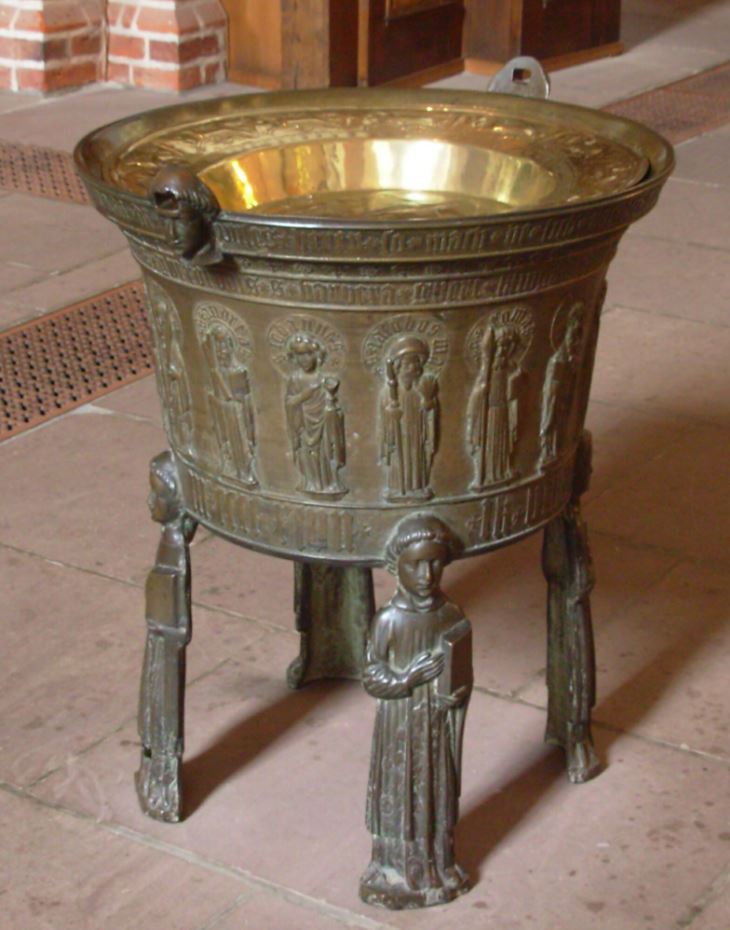
Segeberg font by Quoth via Wikimedia Commons

I was recently cataloguing a book on monasteries in Schleswig-Holstein (Klöster in Schleswig-Holstein: von den Anfängen bis zur Reformation by Oliver Auge and Katja Hillebrand).  As I was leafing through the pages I was struck by a double page spread on baptismal fonts, and in particular by a full-page photograph of the highly decorative one to be found in the Marienkirche in Bad Segeberg.

The most notable feature of these fonts to me is that they were made of bronze, often, it seems, as a sideline for bellfounders (they do perhaps resemble upside-down bells). After a little research I soon realised that unlike in Britain (where stone was the usual material for fonts) there are still many fine examples of bronze baptismal fonts in northern Germany and nearby. Continue reading “Upside-down bells in mainland Europe”