The Herbier peint of Rosalie de Constant

Contemporary accounts give a vivid impression of Rosalie de Constant (1758-1834), the cousin of Benjamin Constant, the French novelist, politician and political philosopher. She was hunchbacked, but she played the mandolin and clavichord. She was short-sighted, and her attention to detail was expressed in an extensive set of paintings of Swiss plants. IMG_0786She wrote sonnets, proverbs and an unfinished novel, but is most well known for her Herbier peint, a large work of 1245 plates, in which she painted illustrations of plants, wrote descriptions of their use, and classified them. Rosalie de Constant created this work between 1795 and 1832, and it was donated to the Musée cantonal in 1844, and is now held in the Musée botanique cantonal.

The University Library has two volumes of Rosalie’s letters, as well as a volume of her travel writing:

  • Voyage en Suisse en 1819 / Rosalie de Constant (739:4.d.95.27)
  • Lettres de Rosalie de Constant : écrites de Lausanne à son frère Charles le Chinois en 1798 / publiées et annotées par Suzanne Roulin (2003.7.598)
  • Benjamin et Rosalie de Constant : correspondance, 1786-1830 / publiée avec une introduction et des notes par Alfred et Suzanne Roulin (738:42.c.95.37)
Continue reading “The Herbier peint of Rosalie de Constant”

40 years of Portuguese freedom

Revolução_dos_Cravos
Image taken from Wikimedia Commons

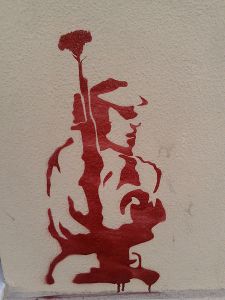
Friday 25 April marks the 40th anniversary of Portugal’s “Carnation Revolution” (Revolução dos Cravos or simply 25 de Abril). This was arguably the moment at which modern Portugal began to take shape, as the revolution led to the overthrow of the authoritarian and conservative Estado Novo regime, the introduction of genuine democracy in the country, and the withdrawal of Portugal from its African colonies. The Carnation Revolution was so-named because no shots were fired and, to celebrate its success, carnation flowers were displayed in the muzzles of army rifles and on the uniforms of military officers.

The revolution began as a military coup by the Movimento das Forças Armadas, a group of lower-ranked, left-leaning Portuguese army officers who opposed Portugal’s lengthy, expensive and unpopular Colonial War – and, in particular, new government legislation to fast-track militia officers into higher military ranks to take part in this war. The movement was initially planned and enacted by officers such as Vasco Gonçalves – Portugal’s prime minister following the revolution and interviewed in Vasco Gonçalves: um general na revolução (classmark: 585:5.c.200.10) – and Amadeu Garcia dos Santos, whose memoirs were published as General Garcia dos Santos: memórias políticas: um pouco do que vivi (classmark: 585:5.c.201.16). Continue reading “40 years of Portuguese freedom”

Slavonic item of the month : April 2014

The re-introduction of Polish Studies in Cambridge has recently come a step closer, with the recruitment of a temporary lecturer currently in progress. The University Library has long collected Polish material, albeit with a modest budget recently, and this month we look at an example of recent purchases – a set on art in post-war Poland.

T. 1-4 of Polskie życie artystyczne w latach 1944-1960 (S950:01.b.153.1-4)

The University Library holds over 20,000 items in Polish, stretching from the mid-sixteenth century to the present day. Since Polish ceased to be taught as a degree-level language in the early 2000s, Polish spending in the Library has been modest. The initiative to bring Polish Studies back to the Department of Slavonic Studies, however, has long been an added incentive to ensure that we do continue to build on our existing collection, and this initiative recently received a major boost when funding was made available for the four-year appointment of a lecturer in Polish Studies.

The main areas of focus in Polish-language acquisitions for the Library are literature, history (including a major emphasis on Polish Jewish history), art, and music. The latest consignment of material from Poland, which came through earlier this month, included the first few volumes of Polskie życie artystyczne w latach 1944-1960 (Polish artistic life in the years 1944-1960; S950:01.b.153.1-4), a set which will eventually run to over 10 volumes. The Library has received the four volumes which have been published so far; these cover the period 1944-1950. 1944 and 1945 are, unsurprisingly, represented relatively briefly. Continue reading “Slavonic item of the month : April 2014”

Griffithiana: a silent film and classic animation journal

Former University Library staff member Glynne Parker died in October 2011, and after his death his wonderful collection of printed matter and ephemera on film was presented to the Library. At the time of writing, about 50% of the 2800 items have been catalogued. The general collection will feature in a future blog post, but some material is particularly worthy of mention.

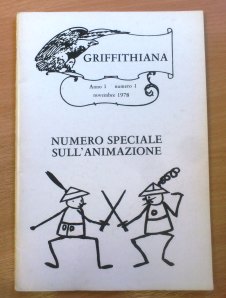
Griffithiana_anno_1
First issue of Griffithiana, 1978.

Friuli-Venezia Giulia is probably one of the lesser known Italian regions, but its position as one of Italy’s “most cinematic” regions attracts cinema lovers and experts from all over the world. It is home to seven major international film festivals (see list below) and to the Cineteca Nazionale del Friuli which, amongst other ventures -like film conservation-, published Griffithiana, a biannual journal named after D.W. Griffith, with articles and monographic issues related to the study of silent cinema and classic animation. Continue reading “Griffithiana: a silent film and classic animation journal”

Shrovetide carnival plays

The University Library has recently acquired a rare edition of three early dramatic pieces by Goethe, the Neueröfnetes moralisch-politisches Puppenspiel (7001.d.268), which like Werther was published for the Leipzig autumn fair of 1774, when Goethe was 25 years old. The Library’s copy, bound in later period vellum with red morocco lettering pieces, is in excellent condition with only minimal browning. The title-page has a vignette of a seated boy striking with a sword at a slate bearing letters of the alphabet.

Neueröfnetes moralisch-politisches Puppenspiel (7001.d.268)

The three works in question are a dramatic poem, Des Künstlers Erdewallen, and two Shrovetide carnival pantomimes, Jahrmarktsfest zu Plundersweilern and Ein Fastnachtsspiel vom Pater Brey. In his Goethe, the poet and the age, Nicholas Boyle summarises the Jahrmarktsfest zu Plundersweilern : “In a fairground setting a vivid and satirical kaleidoscope of figures, quacks, gypsies, peasants, pedlars from Nuremberg and the Tyrol, an Italian barrel-organist, and one or two more characters from the refined classes, all conversing in a lively rhyming farrago, form an audience for a play within the play: the biblical folk-story of Queen Esther and the villainous Haman”.

Continue reading “Shrovetide carnival plays”

Where is 21st century Latin American fiction heading?

A screenshot of the collaborative online translation project “Palabras errantes” presented at the seminar.
A screenshot of the collaborative online translation project “palabras errantes” presented at the seminar.

What are the new trends in Latin American fiction? Can we go beyond the general conviction that, after the ‘60s “boom”, Latin American fiction experienced a steady decline both in the quality and quantity of literary works produced? How are researchers, librarians and publishers reacting to this in the UK? These and many more questions were answered at the seminar 21st Century Fiction from Latin America  held on Wednesday 12th of February 2014 at Senate House, London.

The panorama of 21st Latin American fiction is hugely vast and exciting, as was evidenced by the very stimulating contributions presented at the Seminar. Here we mention some of them. Continue reading “Where is 21st century Latin American fiction heading?”

El Moudjahid

El Moudjahid is currently an Algerian French language newspaper, published daily (except on Fridays) and founded in 1962 at the end of the Algerian War of Independence. It had previously been used during the War as the title of the information bulletin of the FLN, the “organe central du Front de libération nationale”, which was widely circulated amongst resistance fighters. El Moudjahid was first published clandestinely from June 1956 in Algiers, then, for issues 8-10 in Morocco, and from November 1st 1957 in Tunis. An Arabic version was also produced, Al Mudjâhid, with somewhat different content.

El Moudjahid - T644.b.26.1-3
El Moudjahid – T644.b.26.1-3

In 1962 the content of El Moudjahid was reprinted as a three volume monographic set with analytical indices – by a printer based in Belgrade in Yugoslavia. This is indicative of the close ties which existed between Algerians and Yugoslavs at this time. Belgrade gave strong support to the provisional government in Tunis from 1957, and established a clinic for wounded soldiers of the Algerian liberation army, for example. Continue reading “El Moudjahid”

Modern Greek in the University Library

Cover of 'Thalassina eidyllia (1887-1891)' by Alexandros Papadiamantes (S706.d.94.14)
Cover of ‘Thalassina eidyllia (1887-1891)’ by Alexandros Papadiamantes (S706.d.94.14)

The University Library’s Modern Greek collection, which numbers over 13,000 items, is now represented on the Library’s language-specific webpages.  An introduction to the collection, with an explanation about transliteration and a guide to history and literature classmarks, has been put up on this page.  The text of that page is provided in this blog post.

The Modern Greek collection

The University Library has got over 13,000 items in Modern Greek in the electronic catalogue, stretching from the 16th century to the current day.  The 16th to 18th centuries are represented by over 400 books in total, and then the 19th century sees a leap up to over 1,000 items.  A greater leap still follows for the 20th century, with over 8,500.  The 21st century is so far represented by nearly 3,000 books.

  Continue reading “Modern Greek in the University Library”

World War 2 propaganda (2)

The second in our short series of posts on World War 2 propaganda features an interesting leaflet. Most of the propaganda leaflets in the University Library’s collections are examples of leaflets which the RAF dropped over mainland Europe. But this one is a leaflet dropped by the German Luftwaffe over Britain, in this case landing in the Essex village of Birdbrook, south of Haverhill.

The leaflet was sent to the Librarian by Herbert Richmond, then a 77 year old Fellow of King’s College, with an accompanying letter in which he related how a large number of the leaflets (which he described as ridiculous) were found in a cardboard box near to a small balloon which had come down in a hedge. His niece presumably lived in the village and had got hold of a copy for him to pass to the University Library.

Untitled Continue reading “World War 2 propaganda (2)”