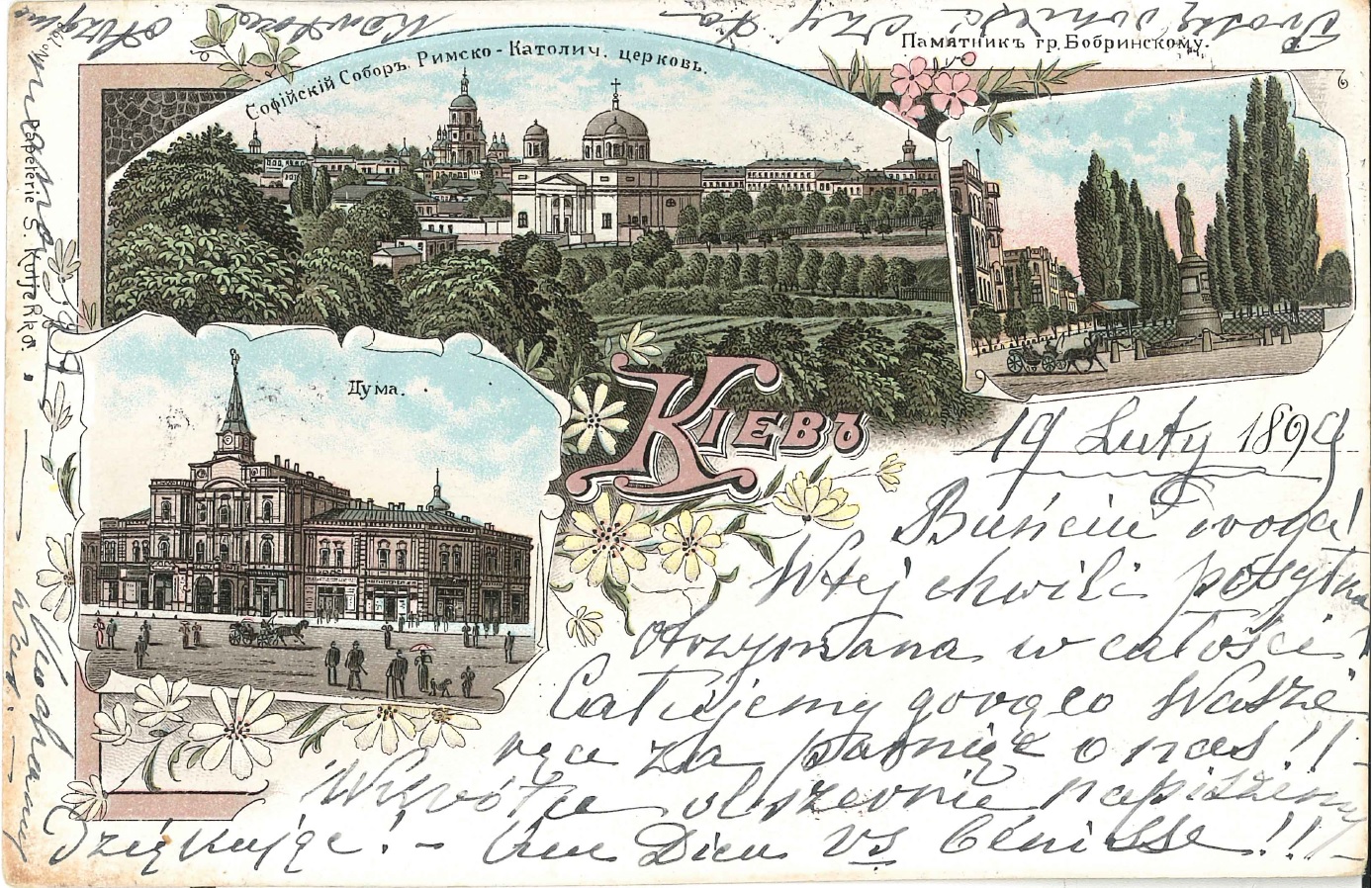
The December Slavonic item of the month is a postcard – the first of hundreds of postcards from the late Catherine Cooke’s collection which will gradually be added individually to the library catalogue. It shows three scenes from Kyiv (often called Kiev in the west), is written in Polish and French, and is addressed in Russian to a location in modern-day Latvia. As with so many items in the Cooke collection, there are a great many interesting details waiting to be found.
The year 2013 will surely be one not to forget for many Chileans. Just last Sunday 15th December, two women were rivals in the race for the presidency, producing an unprecedented democratic contest. Michelle Bachelet ran against her childhood friend, Evelyn Matthei, and won the second round of the election with 62.16% of the vote. With her, two other young women (Camila Vallejo and Karol Cariola, from the student movement) are going to join the government and advocate a better and fairer educational system, which has been the subject of protests since 2011. Things have not always looked that promising in Chile.
On December 19th 1983, exactly 30 years ago, poet Nicanor Parra published Coplas de Navidad (Christmas ballads or verses), of which our Library holds one of only 1000 copies printed (classmark: S743:3.b.9.73). Continue reading “A Chilean “anti-carol””→
The latest CamCREES bibliographical notes look at Dr Rosamund Bartlett’s talk on 3 December 2013 on Chekhov, Tolstoi, music, and English modernism. They end with explorations of a major new website about Tolstoi and the incredible literary resources offered by the online Fundamental’naia elektronnaia biblioteka (Fundamental electronic dictionary).
The end of Chekhov’s short story Student, showing the enormous 94-word concluding sentence, which Dr Bartlett mentioned in her talk (757:23.d.90.96)
The final CamCREES seminar of the Michaelmas term and the last of the seminars arranged as part of Dr Katia Bowers’ CEELBAS-funded project ‘Promoting the Study of Nineteenth-Century Russian Literature in the UK’ saw an excellent turnout for an extremely interesting talk. Dr Rosamund Bartlett of the University of Oxford spoke about music and the works of Chekhov and Tolstoi, looking at patterns of musical composition in the writings of these authors and drawing links with Virginia Woolf and Katherine Mansfield, whose own work has recently started to be considered in musical terms. As Dr Bartlett explained, these new angles of criticism cast Chekhov and Tolstoi, traditionally considered realists, in a more modernist light.
The opening sentence of the foreword to a volume of selected essays by Elisabeth Stopp, entitled German Romantics in context (746:15.c.95.558), lays immediate emphasis on her links with libraries –
Stopp – Thesis cover (detail)
Elisabeth Stopp has been associated with Cambridge for over sixty years – with its libraries, colleges, undergraduates and research students. Together with her husband Freddy she was a pillar of German teaching there, and numerous careers in Germanistik were directly launched by their joint and unstinting efforts.
Both Elisabeth and Freddy were regular users of the University Library’s collection for several decades. The Library always opens on both bank holidays in May, and the Stopps always made a point of coming in as a gesture of solidarity with the staff. It is not surprising then that both would bequeath significant items from their personal libraries to the UL. We have well over 100 volumes from Elisabeth’s personal collection.
Elisabeth Stopp
There is a copy of Elisabeth’s 1938 doctoral thesis on The place of Italy in the life and works of Ludwig Tieck (PhD.899-900) in the Library’s thesis collection, together with two offprints of articles she had published in 1985, offering corrections to the original thesis. This was an age when women could not be full members of the University, so Elisabeth could not graduate officially. Only in 1986 would she take a Cambridge degree in person, when awarded the degree of Doctor of Letters for her publications on French and German literature.
Trattato ultissimo del beneficio di Gieso Christo crocifisso verso i Christiani
This is a unique copy of a spiritual work, attributed to Benedetto da Mantova and Marcantonio Flaminio, printed in Venice in 1543. It was hugely popular. Pietro Paolo Vergerio declared that 40,000 copies were sold in Venice alone, and King Edward VI is said to have kept a copy beside his bed. In 1549, however, it was proscribed by the Index librorum prohibitorum, the list of books prohibited by the Roman Catholic Church, and was so ruthlessly exterminated by the Roman Inquisition that no examplar was thought to have survived, until this copy was catalogued in 1843, and subsequently reproduced in facsimile in 1855. The volume came to the College from Domenico Antonio Ferrari (1685-1744), a Doctor of Law from Naples, who left 51 volumes containing some 98 works to the College, in recognition of time spent at St John’s from 1710. Continue reading “A unique surviving copy of a banned book”→
The pioneering work of Professor Tom Earle of St Peter’s College Oxford, Portuguese writers and English readers (B990.7.33 ; C204.c.9561), published by the Oxford Bibliographical Society in 2009, investigates the holdings of books by Portuguese writers printed before 1640 and held in the university and college libraries of Oxford and Cambridge. The core of the publication is a short title catalogue listing 906 items in a total of 2,343 copies. They are predominantly in Latin, of course, with a sizeable minority in Portuguese, but the listing also includes translations in English, French, German and Spanish. Whilst Lisbon is the most common place of publication (with 113 items), Lyon comes close behind (103 items), followed by Venice (92), Cologne (83), Paris (67) and Antwerp (60). Relatively few titles were published in London (23 items). Continue reading “Portuguese authors and Cambridge libraries”→
Building up the Library’s collections of contemporary literature, and second guessing which publications from 2013 will have an enduring legacy, is one of the challenges regularly facing the UL’s languages specialists. The listings of new publications in Livres du mois for June 2013 featured 341 new novels in French (excluding all crime and science fiction), another 183 novels in French translation, and 127 volumes of poetry. Of these the Library can afford to buy only a very small percentage. Many of the choices we make are highly subjective, and we are very dependent on advice and recommendations from academic staff and researchers. Effective collection development is a collaborative effort.
Purchasing decisions are greatly influenced by literary prize winners, though the debate and arguments which surround these awards, starting with the appropriateness of any short list, is a clear indication of how subjective the exercise is. It is a reasonable assumption that any English specialist in a European university library will usually buy the Man Booker short list. Here in Cambridge we like to monitor a range of European literary prizes, such as the Deutscher Buchpreis and the Premio Strega, but our funds will often only enable us to buy the actual winner, rather than the entire short list. Continue reading “Do literary prizes guarantee library immortality?”→
The end of the year is a good time to do a round-up of winners of this year’s major German literary prizes. We have featured these in the last two years on “In the spotlight” pages on our website (2011 and 2012) and continue to use them to guide our acquisitions policy for modern literature.
Georg-Büchner-Preis, awarded by the Deutsche Akademie für Sprache und Dichtung in Darmstadt, a prestigious prize with a long history of recognising important German language authors for their contribution to German cultural life, has been won by Sibylle Lewitscharoff. Please see here for our holdings of her works. See here for further information.
Deutscher Buchpreis, awarded by the Börsenverein des Deutschen Buchhandels in Frankfurt am Main, is a relatively new prize, first awarded in 2005 and regarded as the German equivalent of the Man Booker prize. It has been won this year by Terezia Mora for her novel Das Ungeheuer (C207.c.7548).
2013 marks the centenary of the birth of French writer and humourist Pierre Daninos, the creator of Major Thompson, the French stereotype of the Englishman abroad, carrying a neatly rolled umbrella, with a moustache, and inevitably wearing a chapeau melon. When Daninos died in 2005 extensive obituaries appeared in the British press. He had published prolifically, and the exploits of Major Thompson sold over a million copies in France, as well as being translated into some 30 other languages.
Major Thompson – Uc.8.5864
Yet Cambridge has very few titles in the original French. Clearly previous generations of Cambridge librarians felt that works by Daninos did not merit inclusion in an academic library. Were they correct? Oxford librarians felt slightly differently, and acquired some 20 titles. The British Library has still more, fulfilling its remit to collect works on British culture and on Britain’s place in Europe. Continue reading “To collect or not to collect? The case of Pierre Daninos”→
The latest set of CamCREES bibliographical notes looks at Professor Robin Feuer Miller’s talk on 12 November 2013 on the tale of the mushroom hunt in Tolstoi’s Anna Karenina. They end with a look at Tolstoi-related publications catalogued in the University Library in 2013, with search tips and an insight into some of the Library’s working practices.
The third CamCREES seminar of Michaelmas 2013, once again part of Dr Katia Bowers’ CEELBAS-funded project ‘Promoting the Study of Nineteenth-Century Russian Literature in the UK’, was given by Professor Robin Feuer Miller of Brandeis University and the University of Oxford. Her talk focused on a small section of Tolstoi’s Anna Karenina which involves two relatively minor characters: Varen’ka, a young woman who Kitty (Kiti in Russian) has met at a German spa, and Sergei Ivanovich Koznyshev, the half-brother of Kitty’s husband Levin. The section of the novel focused on in the seminar describes a mushroom hunt undertaken by these two characters in Levin’s estate, during which a proposal of marriage is prepared for but never realised.



 Languages across Borders